Showing posts with label Neanderthals. Show all posts

Wednesday, 4 February 2026

Neanderthals and early humans may have interbred over a vast area

Image courtesy of Christian Jegou/Science Photo Library

Joel Kontinen

Homo sapiens and Neanderthals were probably interbreeding over a huge area stretching from western Europe into Asia.

We have long known that early humans (Homo sapiens) and Neanderthals (Homo neanderthalensis) interbred, which is why most non-African people today have some Neanderthal DNA, typically about 2 per cent of their genome. The interbreeding also saw the Neanderthal Y chromosome lineages replaced by lineages from H. sapiens.

But where this interbreeding happened and on what kind of scale has long been a mystery, even if we are now starting to get a handle on when it occurred. The ancestors of Neanderthals left Africa about 600,000 years ago, hea offding into Europe and western Asia.

Neanderthals left Africa about 600,000 years ago, heading into Europe and western Asia. And the earliest evidence of H. sapiens migrating out of Africa is skeletal remains from sites in modern day Israel and Greece, dating back around 200,000 year Asia.  

The dating for this study is off by many thousands of years. The Neanderthals were the descendants of Adam and Eve, so  their "interbreeding" is not  unexpected.

 Source:

Chris Simms 2026 Neanderthals and early humans may have interbred over a vast area | New Scientist 2 February 


Saturday, 31 January 2026

"2.6 million-year-old" jaw from extinct 'Nutcracker Man' is found


Image courtesy of Alemseged Research Group

Joel Kontinen

According to evolution  fragments of a "2.6 million-year-old" fossil jaw discovered in northeastern Ethiopia are transforming the picture of early human evolution in Africa. The jaw, from a bipedal hominin — an extinct relative of humans.

"Until now, not a single fossil of Paranthropus had been identified" in the Afar region of Ethiopia, researchers wrote in a study published Wednesday (Jan. 21) in the journal Nature. "Hundreds of fossils representing over a dozen species" of hominins had been found in the Afar, study lead author Zeresenay Alemseged, a paleoanthropologist at the University of Chicago, said in a statement, "so the apparent absence of Paranthropus was conspicuous and puzzling to paleoanthropologists, many of whom had concluded the genus simply never ventured that far north."

The genus Paranthropus contains three species distantly related to humans: P. robustus, P. boisei and P. aethiopicus, collectively known as the "robusts." These species walked upright beginning around 2.7 million years ago, but they are unique in having massive teeth and jaws, which earned one fossil skull the nickname "Nutcracker Man." Paranthropus fossils were previously found in locations from southern Ethiopia to southern Africa and have been dated to between 2.8 million and 1.4 million years ago.

In January 2019, paleoanthropologists discovered a partial lower jaw, designated MLP-3000, at the site of Mille-Logya in the Afar region of northeast Ethiopia. Dated to about 2.6 million years ago, the jaw came from an older individual whose teeth and bone structure resembled those of members of the Paranthropus genus. While one species — P. aethiopicus — has been found in southern Ethiopia, the new MLP-3000 jaw was discovered much farther north than any previous fossil from this genus.

"The discovery of Paranthropus in the Afar provides critical new information," the researchers wrote, suggesting that "the genus could exploit diverse habitats and regions from north Ethiopia to South Africa as Australopithecus and Homo did." This means that Paranthropus likely had a much more flexible diet than the "Nutcracker Man" moniker suggests, enabling these hominins to disperse and adapt to a wide range of environmental conditions.

The newfound Paranthropus fossil at Mille-Logya adds a third genus to the variety of hominins present in the Afar region between 2.8 million and 2.5 million years ago, including Australopithecus and early Homo. It is not yet clear, though, whether the species would have encountered one another directly.

"Discoveries like this really trigger interesting questions in terms of reviewing, revising, and then coming up with new hypotheses as to what the key differences were between the main hominin groups," Alemseged said.

Carol Ward, a biological anthropologist at the of  University of Missouri who was not involved in the study, wrote in an accompanying perspective that, given the diversity of hominin species present, "the revelation that Paranthropus inhabited the Afar between 3 million and 2.4 million years ago is particularly exciting."

According to evolution, although all humans on the planet today are one species, hominin diversity lasted millions of years, until our extinct cousins the Neanderthals and Denisovans disappeared more than 30,000 years ago, Ward noted.

Nutcracker man is not related to humans. The dating of the fossil is off by hundreds of millions of years.

Source:

Kristina Killgrove 2026 2.6 million-year-old jaw from extinct 'Nutcracker Man' is found where we didn't expect it | Live Science 21 January


Thursday, 30 October 2025

Prehistoric crayons provide clues to how Neanderthals created art


Reconstruction of a Neanderthal girl. Christopher P.E. Zollikofer. Anthropological Institute, University of Zurich Image from Wikipedia.

Joel Kontinen

Ochre artefacts found in Crimea show signs of having been used for drawing, adding to evidence that Neanderthals used pigments in symbolic ways.

A remarkable yellow crayon unearthed in Crimea, still sharp after more than 40,000 years, indicates that painting lines on objects was part of Neanderthal culture. This discovery is the firmest evidence yet that some Neanderthal groups used coloured pigments in symbolic ways.

According to evolution, the use of ochre – an iron-rich mineral with red, yellow or orange hues – has ancient roots, dating back at least 400,000 years in Europe and Africa. Bits of ochre are found at many Neanderthal sites, where they seem to have been used for practical purposes such as tanning clothing and as fire accelerants, as well as sometimes smeared on shell beads.

Neanderthals may have also used ochre to decorate their bodies, clothing and other surfaces, but such traces have long since disappeared. To investigate further, Francesco d’Errico at the University of Bordeaux, France, and his colleagues carried . out a detailed analysis of ochre pieces found at Neanderthal sites in Crimea, Ukraine. By studying how ochre pieces were modified by Neanderthals, as well as performing a microscopic analysis of how they became worn down, the researchers could build a picture of how the objects were used.

“It was a tool that had been curated and reshaped several times, which makes it very special,” says d’Errico. “It’s not just a crayon by shape. It’s a crayon because it was used as a crayon. It’s something that may have been used on skin or  rock to make a line – the reflection, perhaps, of an artistic activity.”

The research team also identified another more ancient broken crayon, perhaps 70,000 years old, made from red ochre.

“It tells us so much just from those small bits of ochre,” says Pomeroy. “It’s that little bit of humanity that we can relate to. It really brings those individuals into touching distance.”

The Crimean crayon discoveries add to the small but growing body of evidence indicating the artistic talents of Neanderthals, such as 57,000-year-old finger carvings on a cave wall in France and mysterious circles crafted from stalagmites 175,000 years ago in another French cave.

They also lend weight to the idea that symbolic behaviour has very deep roots in our evolutionary past, rather than being a capacity that developed relatively recently only in Homo sapiens. 

Some evolutionists think that ability for symbolic behaviour is undoubtedly shared by the last common ancestor of Homo sapiens, Denisovans and Neanderthals more than 700,000 years ago.

On the other hand, creationists think that the date of 700,000 years is from evolution, they are not supported by facts.

Source:

Alison George 2025 Prehistoric crayons provide clues to how Neanderthals created art | New Scientist 29 October


Thursday, 23 October 2025

Neanderthal-human hybrids may have been scourged by a genetic mismatcht


Reconstruction of a Neanderthal girl. Christopher P.E. Zollikofer. Anthropological Institute, University of Zurich Image from Wikipedia.

Joel Kontinen

When Homo sapiens and Neanderthals interbred, a genetic variation affecting red blood cells may have hindered reproduction in women who we re hybrids, and this might have played a part in Neanderthals’ demise.

According to evolutionists, the Neandertals and Homo sapiens lived side by side for about 50,000 to 45, 000 years ago.   That is a lie, because all people are the descendants of  Adam and Eve.

Darwinist say that modern humans may indeed have wiped out Neanderthals – but not through war or morder alone. A new study suggests that when the two species interbred, a slow-acting genetic incompatibility increased the risk of pregnancy failure in hybrid mothers. A similar mismatch between n mothers and fetuses may also help explain a subset of pregnancies that fail today.

Darwinist know from genetic studies that there was sustained interbreeding between Homo esapiens and Neanderthals between approximately 50,000 and 45,000 years ago. The Neanderthals went extinct around 41,000 years ago, but some of their DNA has persisted in modern humans with non-African ancestry, making up around 1 to 2 per cent of the genome.

Source:

 James Woodford 2025 Neanderthal-human hybrids may have been scourged by a genetic mismatch | New Scientist 20 October


Friday, 13 December 2024

Ancient genomes reveal when modern humans and Neanderthals interbred


Illustration of modern humans who lived in Europe about 45,000 years ago

Image courtesy of Tom Btörklund

Joel Kontinen

The oldest genomes ever recovered from modern humans have shown that they interbred with the Neanderthals.

For those who believe in progressive creationism, this comes as a shock. They believe that Neandertals were not human. But now science has proved that they are.

Modern humans and Neanderthals interbred over a sustained period of around 7000 years, probably in the eastern Mediterranean. That is according to two studies that trace how these two hominins hybridised in unprecedented detail.

“The vast majority of the Neanderthal gene flow… occurred in a single, shared, extended period,” says Priya Moorjani at the University of California, Berkeley.

The studies confirm that modern humans acquired important gene variants by mixing with Neanderthals.

 Source: 

Michael Marshall 2024 Ancient genomes reveal when modern humans and Neanderthals interbred | New Scientist 12 December


Sunday, 14 July 2024

We have some Neanderthals genome in us


Image courtesy of the University of Cambridge; BBC Stunandertals dios/Jamie Simonds,

Joel Kontinen

What do we know about the Neanderthals?

Modern human DNA may have made up a surprisingly large amount of the Neanderthal genome, a new study finds.

Some researchers think about  their genome has not become extinct but it still lives among us. This is what a study just released says” our” genome has   2.5% to 3.7% of the Neanderthal genome.”

“This research really highlights that what we think as a separate Neanderthal lineage really was more interconnected with our ancestors,

Some think that that us and the Neanderthals "shared a long history of exchanging individuals." that exceed 500 000 years.

The timing of this is clearly wrong,

Source:

Charles Q. Choi, 2024, Neanderthals didn't truly go extinct, but were rather absorbed into the modern human population, DNA study suggests | Live Science 11 July


Wednesday, 15 May 2024

Oldest known human viruses found hidden within Neanderthal bones


Image courtesy of S. S. Entressangle/E. Daynes/Science Photo Library

Joel Kontinen

“Genetic sequences from three common viruses that plague humanity today have been isolated from the remains of Neanderthals who lived more than 50,000 years ago.

Marcelo Briones at the Federal University of São Paulo, Brazil, says it may be possible to synthesise these viruses and infect modern human cells with them in the lab.”

The connect between humans and neandertals means that humans were the children of Noah and not of apes.

Source:

James Woodford. 2024. Oldest known human viruses found hidden within Neanderthal bones | New Scientist 14 May.


Tuesday, 7 May 2024

Neanderthal woman's face brought to life in stunning reconstruction


Image courtesy of the University of Cambridge; BBC Stunandertals dios/Jamie Simonds,

Joel Kontinen

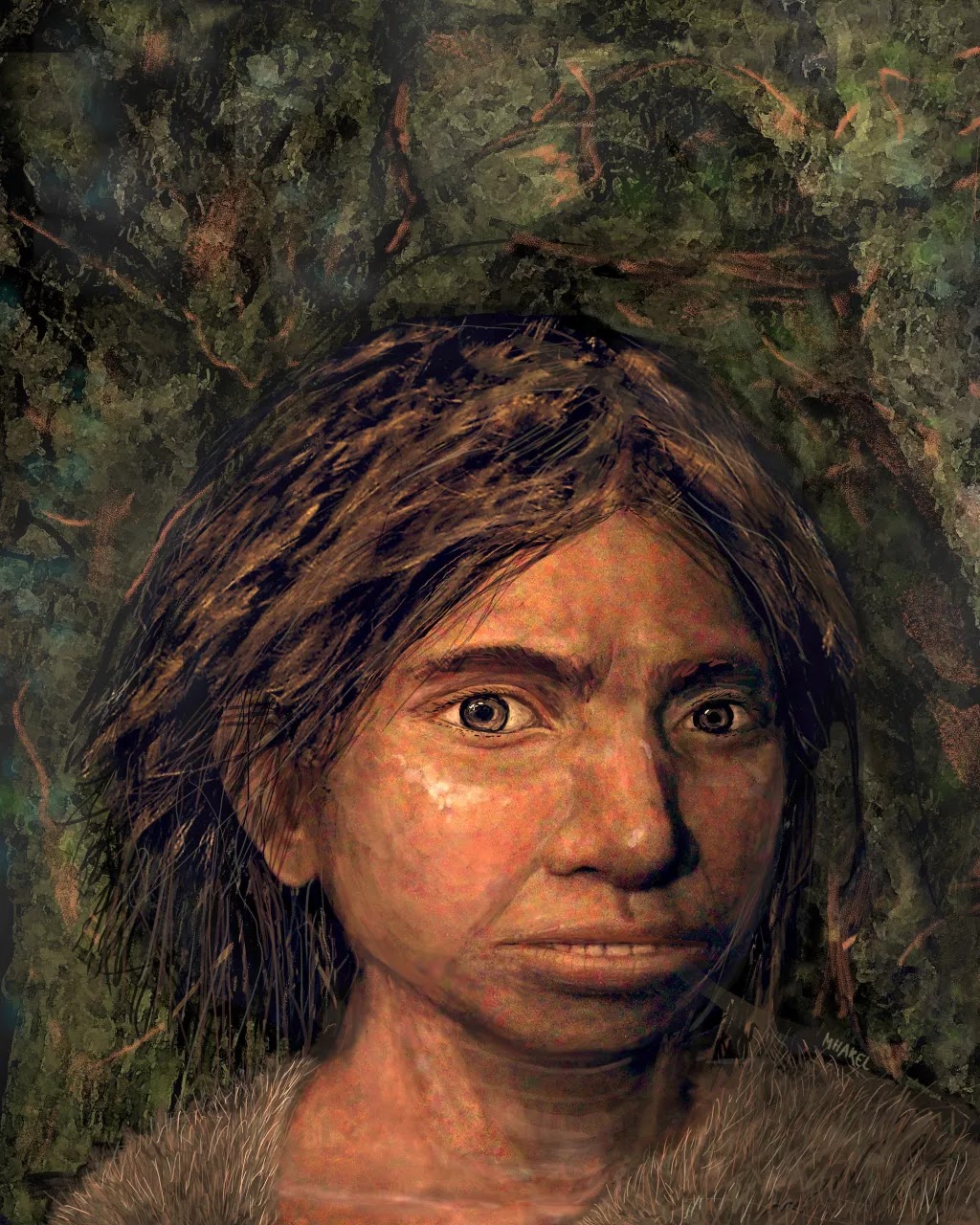
The recreated head of "Shanidar Z'' shows a Neanderthal  woman who lived about 75,000 years ago. 

 “A Neanderthal skull that was crushed to bits 75,000 years ago has been pieced back together and used to recreate the face of a wise-looking archaic woman with dark, flowing hair.” 

“Archaeologists painstakingly pieced together the skull of the individual, who researchers have named Shanidar Z, from hundreds of flattened bone fragments discovered in the Iraqi Kurdistan,”

What do we know Neanderthals? According to Genesis, they were descendants of Noah. 

Source:

Emily Cooke, 2024,  Neanderthal woman's face brought to life in stunning reconstruction | Live Science 2 May.


Tuesday, 12 September 2023

Humans wore shoes a long time ago


 Image courtesy of Charles Helm. 

Joel Kontinen

Accotding to evolution, humans might have started to worn shoes and their cousins, the Neanderthals may also have worn footwear, 

This stems from "unusual preserved footprints in South Africa, which may have been made by people wearing sandals."

We already know that humans and Neanderthals where the chidren of Adam and Eve, so that wearing shoes was normal for them, 

The neanderthals ashowed the things that make us human, such as, symbolic art, tool and weapon making, the use of fire, and burial ceremonies.  

 ,

Source; 

 Marshall,  Michael, 2023, Ancient humans may have worn shoes more than 100,000 years ago , New Scientist 29 August, 


Sunday, 13 August 2023

Climate change had an effect on human evolution


Image courtesy of Maayan Harel, public domain.

Joel Kontinen

Joel Kontinen 

Most of what evolutionists know about their ape men past is derived  from fossil evidence. ,

Researchers say that climate is a one of  the determinats of human evolution

,” Ruan et al. found patterns of interbreeding between the Neanderthals and Denisovans with climate and environmental change in Eurasia.

“Margari et al. have identified a previously unknown climate-driven depopulation of hominins in southern Europe during the early Pleistocene. “This is proof of the Genesis story of non.human evolution, 

Ssource: 

Vignieri,  Sacha, 2023.  Reconstructing the past, Science 11 August.  


Thursday, 4 August 2022

The human brain has merely evolved for 160, 000 years


M. Ponce de León and Ch. Zollikofer/Univ. of Zurich

Joel Kontinen

A study has found that the physical transformation of the human cranium over the past 160,000 years was probably driven by alterations in the face resulting from diet and lifestyle changes, not from the evolution of the brain itself as previously thought,

Christoph Zollikofer at the University of Zurich in Switzerland and his colleagues digitally restored the skulls of 50 hominins recovered in Ethiopia and Israel, including H. sapiens as well as Homo erectus and Neanderthalspecimens for comparison.

So evolutionist believe that humans are far smaller, with subtler indentation, than those of their so-called ancestors. 

Source;

 Taylor, Luke. 2022, Shape of human brain has barely changed in past 160,000 year.s New Scientist 1 August

Tuesday, 4 January 2022

Neanderthals were human just like us


Image courtesy of Gorodenkoff/Shutterstock,

Joel Kontinen


According to evolutionists, we the species that survived. A hundred years ago, they were depicted as mere cave men. But things have changed since then. More and more research shows that the Neanderthals were as human as us.

 ”Neanderthals might never even have gone extinct, instead genetically embedding themselves in the human genome as a result of interbreeding.”

They also showed the things that make us human, such as, symbolic art, tool and weapon making, the use of fire, and burial ceremonies.  

According to evolution, The brains of Neanderthals and Homo sapiens  “were similar in size and similar in blood supply from the internal carotid arteries to the cerebrum, the cognitive part of the brain … so effectively there is no evidence that the cognitive ability of the two species was any different,” Roger Seymour says.

We already know that Neanderthals were fully human and they lived mostly in Europe in the same way we do. We belief that they lived in Europe atter the flood of Noah’s day.

Source:

Novak. Sara, 2021 Debunking the Myth of Homo Sapiens Superiority, Discover  21 December,  

Sunday, 18 April 2021

Scientist Found 100,000 Year-Old Neanderthal Footprints

Image courtesy of Mayoral et al./Scientific Reports) 

 Joel Kontinen 

 The study of neanderthal children was published by Eduardo Mayoral, a paleontologist at the University of Huelva and lead author of the study, online March 11 in the journal Scientific Reports. 

In 2020, two biologists discovered the tracks on Matalascañas beach, in Doñana National Park after a period of intense storms and high tides

 Of particular interest are the two smallest footprints, approximately 14 centimetres, or6 inches long that are thought to have been made by a child about 6 years old. 

Neanderthals were the ape men of the late 18th century and early 19th century, but scientists have re-invented the category, According to creationists, the Neanderthals were the post.flood descendants oF Noah, 

In the model based on Genesis, Neanderthals are descendants of Noah.

They mostly lived in caves during the harsh ice age winters after the global flood, but they obviously also knew how to sail.

 Source:

 Metcalfe, Tom. 2021,100,000-year-old Neanderthal footprints show children playing in the sand
Live Science  11April.

Thursday, 4 March 2021

The Pre-Human Evolution just became weirder


.

Image courtesy of Dr Mike Baxter, fair use doctrine.

Joel Kontinen 

The pre-human evolution has became weirder. Evolutionists taught that the rift between the Neandertals and   early human stone culture was great but now scientist have shown us that it was not so.

Now scientist have come up with the fact that Neandertals and early humans culture existed for over 100,000 years.,

The study is based on the evolutionary scale of millions of years, that is spurious. the Neandertals were members of the adamic race of people who loved just after the flood of Noah.

According to the biblical model, the Neanderthals were Noah’s descendants who mostly lived in Europe during the ice ago following the global Flood. The harsh climate explains in part why they differed from us.

Source:

University of Kent. 2021. Neanderthal and early modern human stone tool culture co-existed for over 100,000 years.  Phys.org 1 Marsh.


Tuesday, 2 February 2021

Who Were The Denisovans?


Image courtesy of Maayan Harel, public domain.

Joel Kontinen


The existence of the  Denisovans was discovered just a decade ago through DNA alone. Now we're starting to uncover fossils and artefacts revealing what these early humans were like.

The archaeologists have also unearthed treasure troves of artefacts, including tools, jewellery and even art, that they think were created by  these mysterious people.

We are starting to piece together a picture of the Denisovans, one of our closest cousins, and a group that still lives on in the DNA of many people today.

According to the model based on Genesis, the Neanderthals were Adam’s descendants just like us. They probably lived in Europe during the ice age following the Flood of Noah and it seems the Denisovans where their closest comrades.


Source:

Marshall, Michael. 2021. The other humans: The emerging story of the mysterious Denisovans. New Scientist 27 January


Monday, 27 April 2020

Neanderthal traits still living in us

Neanderthal girl. Image courtesy of Christopher P.E. Zollikofer, Anthropological Institute, University of Zurich..


Joel Kontinen

Scientist say that Europeans and Asians inherited 1 – 2 per cent of their genome from Neanderthals.

So, if you said that "freckles, red hair and even narcolepsy are traits that a Neaderthal left in you. They found, “that Icelanders had inherited 3.3% of their archaic DNA from Denisovans and 12.2% from unknown sources. (84.5% came from close relatives of the reference Neanderthals.)”.

Neanderthals. and Denisovans are our cousins, but they lived in the not distant past, just after Noah’s Flood.

Source:

Gibbons Ann. 2020, The Neanderthal DNA you carry may have surprisingly little impact on your looks, moods. science April 22


Thursday, 6 June 2019

Birdman Decorated With 30 – 50 Bird Beaks and Skulls – Died in Siberia

Image courtesy of The Siberian Times.


Joel Kontinen

Evolutionists think that humans have come from humble beginnings to reach top society. However, science shows that even in the beginning, humans had the will to decorate themselves.

Recently, an iceman was found in Siberia:

"Archaeologists have unearthed a Bronze Age skeleton that was buried with an unusual garment: a collar or headdress made of dozens of bird beaks and skulls.

The so-called birdman's remains, which date to about 5,000 years ago, were discovered at the Ust-Tartas dig site in Siberia's Novosibirsk region, The Siberian Times reported.

The 30 to 50 bird skulls and long beaks were arranged underneath the human skull, "laid as if they meant to cover the neck like a collar," Lidia Kobeleva, a researcher with the Novosibirsk Institute of Archeology and Ethnography in Siberia, told The Times in a video
."

The iceman had company. a grave found nearby, with two children and an adult male.

Even the Neanderthals wanted to decorate themselves, and
other primitive societies
were not so primitive at all. And also Stonehenge tells us that early man was cleverer than we thought.

Source:

Weisberger, Mindy. 2019. Bronze Age Siberian 'Birdman' Wore a Collar of Beaks and Skulls. Live Science (3 June).


Tuesday, 2 October 2018

Neanderthals Could Hold a Pen

c
Image courtesy of EraserGirl, CC BY 2.0.


Joel Kontinen

"Neanderthals could hold objects between finger and thumb, just like we would hold a pen, because their hands were neandertal hastag more nimble than anyone thought."

This brings them to whole-heated humanity. Apes cannot write or read.

To find out how Neanderthals used their hands, "Katerina Harvati of the University of Tübingen in Germany and her colleagues studied 'entheses': the points on the bones where muscles were attached. Each enthesis is a raised area of bone."

Her team examined the hand entheses of six Neanderthals and six early modern humans.

Iin the creation mode, Neanderthals were ice age men, leaving in Europe after the flood. It was not surprising that they made the first gluey, they lost their cavemen traits and, we have seen more cavemen inventions.

Recently, more of the skills of the Neanderthals have also been discovered. Why not to treat them as they were, as descendants of Adam and Eve.

Marshall, Michael. 2018. Neanderthals had dexterous hands that could have held tools like a pen. New Scientist (26 September).

Sunday, 3 September 2017

Another Neanderthal Invention: They Made “First” Glue

Neanderthals spiced their food with herbs like these.


Joel Kontinen

Once upon a time, Neanderthals were thought to be very primitive. Darwinists initially hailed them as the first apemen.

But with an increasing number of their artefacts being discovered, Neanderthals are beginning to look fully human.

Many recent discoveries have shown that they were clever inventors.

New research published in the journal Scientific Reports suggests that Neanderthals made the world’s oldest glue some “200,000 years” ago. They obviously extracted tar from birch bark and heated it above a fire.

They used it to fix the point of a spear to the shaft.

This follows a long string of inventions, including cave art, string and even abstract art –thousands of years before Picasso.

In the model based on Genesis, Neanderthals are descendants of Noah.

They mostly lived in caves during the harsh ice age winters after the global flood, but they obviously also knew how to sail.

Source:

University of Leiden. 2017. How Neanderthals made the very first glue. Science Daily. (31 August).

Tuesday, 2 September 2014

Neanderthal Hashtag Shows Their Artistic Skills

A Neanderthal kid might have looked like this.


Joel Kontinen

The carving in a cave at Gibraltar is very old. Found in a Neanderthal place, it suggests that whoever made it invented abstract art thousands of years before Picasso’s time.

It looks a bit like a hashtag or a grid and it betrays the signs of design. No one could have made it accidentally as a by-product of cutting meat or skins.

Once upon a time, Neanderthals were thought to be very primitive. Darwinists initially hailed them as the first apemen.

But as an increasing number of their artefacts have been discovered, Neanderthals are beginning to look fully human.

In the model based on Genesis, Neanderthals are descendants of Noah. They mostly lived in caves during the harsh ice age winters after the global flood.

Unfortunately, some progressive creationists still regard Neanderthals as soulless creatures who are distinct from humans. Their view has become untenable, however. Neanderthals looked like humans because they were fully human, created in the image of God, just like you and me.

Source:

Gannon, Megan. 2014. Abstract Neanderthal Cave Engraving Discovered. Life Science (2 September).