Showing posts with label alien life. Show all posts

Saturday, 4 July 2026

This could be why we still haven’t found alien life


Image courtesy of NASA

 Joel Kontinen

Where is alien life? We have found hundreds planets but alien life is still missing. What is the reason for  this? It could be that alien life never existed or are there other valid reasons?

The search for extraterrestrial life has been a topic of fascination and speculation for centuries. The universe has not yet yielded conclusive evidence of alien life. This phenomenon, known as the Fermi Paradox, poses the question: given the high probability of habitable planets, why have we not detected signs of extraterrestrial civilizations? 

Scientists aren’t finding alien life because they are likely searching for the wrong signals or looking in the wrong places, a new study warns.

Astronomers are mainly focused on avoiding “false positive” cases of instruments being fooled by the biology-mimicking chemistry of non-living things on other planets. However, , the study says that they should consider false negatives as well. A false negative is when life is present on an alien world but it remains invisible to us because we aren’t looking for the right signals.

“We should be aware of these false-negative results,” Inge Loes ten Kate, an astrobiologist from the University of Amsterdam, said. “These shortcomings are not yet high on the research agenda.”

False negatives may yield from factors like poor preservation of biological traces, weak signals from planets or limits of existing instruments.

Some theories try to explain this:

The Rare Earth Hypothesis: Suggests that the conditions necessary for complex life are extraordinarily uncommon across the universe. 

Life Is Common, Intelligence Is Rare: Many scientists believe that while simple life forms may be abundant, the emergence of intelligence is a rare leap. 

The Great Filter: A theory that posits a barrier preventing most life from reaching our level of development, such as the leap from single-celled organisms to complex life. 

But what if there is no alien life?

 Source:

Vishwam Sankaran 2026 This could be why we still haven’t found alien life 28 May


Saturday, 16 September 2023

Researxhera have detexted signs of alien life on an exoplanet


Image courtesy of  NASA, CSA, ESA, J. Olmsted (STScI), 

 Joel Kontinen

NASA's James Webb Space Telescope has detected potential traces of dimethyl sulfide, a chemical only known to be created by phytoplankton on Earth, “

This took place in the atmosphere of an exoplanet that is thought to have an liquid ocean,

The exoplanet, K2-18 b, is a “sub-Neptune planet (between the size of Earth and Neptune) that orbits in the habitable zone around a red dwarf star roughly 120 light-years “ from us.

Researtcers are not sure if the exoplanet has life, They have discovered "dimethyl sulfide (DMS), a foul-smelling chemical that is only known to be produced by microscopic life in Earth's oceans. “ 

But that does not mean life, 

Source:

Baker , Harry, 2923. ,  James Webb telescope sees potential signs of alien life in the atmosphere of a distant 'Goldilocks' water world Live Science 16 September 

Monday, 12 June 2023

Evolutionists think that a supernova could harbour life,


Image courtesy of Paul Macklin.

Joel Kontinen.

Astronomers think that a supernova SN 2023ixf might be an opportunity for concocting other civilisations

 They are looking toward a recently  discover supernova that emits signals, in the hope that this would be other civilisation trying to contact us.

“Last month, a supernova dubbed SN 2023ixf was found in the nearby Pinwheel galaxy 21 million light years away, the closest stellar explosion detected from Earth in a decade,”,

However, the entire galaxy was formed by God in the beginnng


Source: 

 O’Callaghan,  Jonathan. 2023,  Astronomers are using a new supernova to search for alien signals,  New Scientist9 June. ,


Monday, 21 September 2020

Search For Alien Life In The Solar System


Enceladus, Image courtesy of NASA, public domain.


Joel Kontinen

When the creation account  in Genesis is discarded, scientists have a find novel ways to discover where life came from. The Earth's biosphere contains all the known ingredients necessary for life for instance liquid water, at least one source of energy, and an inventory of biologically useful elements and molecules.

But the recent discovery of possibly biogenic phosphine  in the clouds of Venus

Reminds us that at least some of these ingredients exist elsewhere in the solar system too. Here are the other most promising locations for extraterrestrial life.

Mars

Mars is one of the most Earth-like worlds in the solar system. It has a 24.5-hour day, polar ice caps that expand and contract with the seasons, and a large array of surface features that were sculpted by water during the planet's history.

The detection of a lake beneath the southern polar ice cap and methane in the Martian atmosphere (which varies with the seasons and even the time of day) make Mars a very interesting candidate for life. Methane is significant as it can be produced by biological processes. But the actual source for the methane on Mars is not yet known.

It is possible that life may have gained a foothold, given the evidence that the planet once had a much more benign environment. Today, Mars has a very thin, dry atmosphere comprised almost entirely of carbon dioxide.

OUND

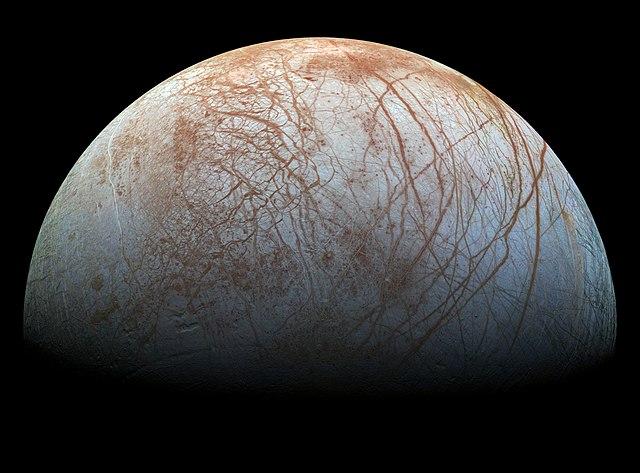
Europa

Europa  is slightly smaller than Earth's moon and orbits the gas giant at a distance of some 670,000km once every 3.5 days. Europa is constantly squeezed and stretched by the competing gravitational fields of Jupiter and the other Galilean moons, a process known as tidal flexing.

The moon is believed to be a geologically active world, like the Earth, because the strong tidal flexing heats its rocky, metallic interior and keeps it partially molten.

The surface of Europa is a vast expanse of water ice. Many scientists think that beneath the frozen surface is a layer of liquid water — a global ocean — which is prevented from freezing by the heat from flexing and which maybe over 100km deep.

At the bottom of this ocean world it is conceivable that we might find hydrothermal vents and ocean floor volcanoes. On Earth, such features often support very rich and diverse ecosystems.

Enceladus

Like Europa, Enceladus is an ice-covered moon with a subsurface ocean of liquid water. Enceladus orbits Saturn and first came to the attention of scientists as a potentially habitable world following the surprise discovery of enormous geysers near the moon's south pole.

These jets of water escape from large cracks on the surface and, given Enceladus' weak gravitational field, spray out into space. They are clear evidence of an underground store of liquid water.

Not only was water detected in these geysers but also an array of organic molecules and, crucially, tiny grains of rocky silicate particles that can only be present if the subsurface ocean water was in physical contact with the rocky ocean floor at a temperature of at least 90˚C. This is very strong evidence for the existence of hydrothermal vents on the ocean floor, providing the chemistry needed for life and localized sources of energy.

Titan

Titan is the largest moon of Saturn and the only moon in the solar system with a substantial atmosphere. It contains a thick orange haze of complex organic molecules and a methane weather system in place of water — complete with seasonal rains, dry periods and surface sand dunes created by wind.

The atmosphere consists mostly of nitrogen, an important chemical element used in the construction of proteins in all known forms of life. Radar observations have detected the presence of  rivers and lakes s of liquid methane and ethane and possibly the presence of cryovolcanoes — volcano-like features that erupt liquid water rather than lava. This suggests that Titan, like Europa and Enceladus, has a subsurface reserve of liquid water.

At such an enormous distance from the Sun, the surface temperatures on Titan are a frigid -180˚C — way too cold for liquid water. However, the bountiful chemicals available on Titan has raised speculation that lifeforms — potentially with fundamentally different chemistry to terrestrial organisms — could according to evolutionists exist there.

 But not according to the Genesis view.


 Source:


Dorrian, Gareth. 2020. The four most promising worlds for alien life in the solar system.  Live Science. 18 September.


Monday, 17 February 2020

British Scientist Thinks Octupses Live on Jupiter’s Moon Europa

Europa. image courtesy of NASA- Jet Propulsion Lab-Caltech / SETI Institute, Public Domain.


Joel Kontinen

The secularist haven’t given up on finding life, regardless of what it means. this time, it means finding life on Jupiter's moon Europa.

A British scientist says it is 'almost a racing certain' that the icy seas on Jupiter's moon Europa are home to alien life that are octopus-like live

Monica Grady, who is a professor of Planetary and Space Science at Liverpool Hope University, suggests the icy seas beneath Europa's surface is a prime location to find beings with similar intelligence to the marine animal.

Brady also thinks that the deep caverns and caves on Mars may also be harbouring life-forms, as these areas provide relief from the intense solar radiation.

'When it comes to the prospects of life beyond Earth, it's almost a racing certainty that there's life beneath the ice on Europa,'
she said.”

She obviously thinks that given an earth-like atmosphere, evolution would give life to those that are without it. However, life only come from life. It has to be created .

Source:

Liberatore, Stacy. 2020. British scientist says it is 'almost a racing certain' that the icy seas on Jupiter's moon Europa are home to alien life that are 'octopus-like creatures' Daily Mail 7 February.

Saturday, 14 December 2019

Will We Get Alien Life In 2020?

Image courtesy of SETh Shostak/SETI Institute.


Joel Kontinen
.
Writing on Space.com, Leonard David says; “Probably not, but there are reasons to be optimistic about our near-future prospects.

He goes to say that scientist have "found more than 4,000 exoplanets in three decades, as the numbers keep rolling in, observation says that every star in the universe can host more than one star."

He also asked a top SETI (search for extraterrestrial intelligence) experts for their advice in gaining site for intellectual life.

Seth Shostak said that apart ,from the typical ways to getting infornation, there’s also luck: "And, of course, there's always the unexpected," Shostak said. "In 1996, the biggest science story of the year was the claim that fossilized Martian microbes had been found in a meteorite. No one really saw that coming. So one can always hope to be taken by surprise."

The Martian microbes were bogus, and so it seems that the rest of SETAs tactics are also. One can only get life from an intelligent source.

Source:

David, Leonard. 2019. Will 2020 Be the Year We Find Intelligent Alien Life? Space.com (26 November).

.

Friday, 22 March 2019

Us Astronomer Posits That Aliens Might Shoot Lasers at Black Holes to Travel Our Galaxy

Image courtesy of NASA/JPL-Caltec.


Joel Kontinen

An astronomer at Columbia University has a new guess about how hypothetical alien civilizations might be invisibly navigating our galaxy: Firing lasers at binary black holes (twin black holes that orbit each other).

The idea is a futuristic upgrade of a technique NASA has used for decades.

Right now, spacecraft already navigate our solar system using gravity wells as slingshots. The spacecraft itself enters orbit around a planet, flings itself as close as possible to a planet or moon to pick up speed, and then uses that added energy to travel even faster toward its next destination. In doing so, it saps away a tiny fraction of the planet's momentum through space — though the effect is so minimal it's pretty much impossible to notice.

In a paper published in the preprint journal arXiv on March 11, David Kipping, the Columbia astronomer, proposed that an interstellar spacecraft could fire a laser at the gravity mirror of a fast-moving black hole in a binary black hole system.


This research posits that alien life exists. However, we haven’t had a chance to look into it yet. Even the famous wow signal was false and the same goes for Tabby Star. Likewise, all subsequent attempts have been false.

All news from the aliens are bogus. The extra-terrestrial evidence doesn’t look like 'Oumuamua.

However, many intelligent people look on aliens are real. As they believe in evolution, they also seem to think that our solar system was not unique.

Source:

Letzter, Rafi. 2019. Aliens Might Shoot Lasers at Black Holes to Travel the Galaxy. Live Science (15 March).

Thursday, 4 January 2018

More Wishful Thinking: Tides and Atmospheres on TRAPPIST-1 Planets Might Make Life Possible

Image courtesy of NASA.


Joel Kontinen

The TRAPPIST-1 planets orbit a cool red dwarf star. It is no secret that such stars are instable and prone to produce deadly flares.

Moreover, all TRAPPIST-1 planets are most probably tidally locked (with their same side always facing their sun), making life practically impossible.

However, this has not put an end to wishful thinking. For instance, an article in New Scientist suggests:

The outer planets of the TRAPPIST-1 system might be better for life than we thought. Their cores are stretched by gravity, which generates heat, and there’s a possibility these exoplanets have atmospheres, so the outermost planets could be warmer and wetter than we thought, maybe even with air.

The article relies on a number of unknowns, and is mostly inspired by wishful thinking, such as the power of tidal forces to “stretch and flex the planets’ cores enough to heat them from the inside.

Most exoplanets are more or less weird. For instance, superfast spinning stars show that our Sun is special – and so is Earth.

Source:

Crane, Leah. 2018. Tides and atmospheres on TRAPPIST-1 planets may help life thrive. New Scientist (3 January).

Saturday, 2 December 2017

Setback for Alien Life Hopefuls: No Signs of Water on Mars

Where’s the water? Image courtesy of NASA/JPL-Caltech/University of Arizona


Joel Kontinen

Just over a century ago, it was customary to see signs of an alien civilisation on the red planet. Italian astronomer Giovanni Schiaparelli (1835–1910) thought he saw canals on Mars.

Many others, including Percival Lowell (1855–1916), adopted this view.

Some people still think that there’s at least an inkling of truth in this.

Furthermore, Many people think that the red planet was once blue, sloshing with water.

Time magazine, for instance, has claimed that the Sun helped murder Mars.

And researchers have continued to speculate that liquid water might still be sloshing down the slopes of the red planet.

Now, however, Colin Dundas of the US Geological Survey and colleagues analysed satellite images.

Their research suggests that the assumed signs of running water on Mars dunes are probably just dry sand, as an article in New Scientist put it.

Source:

McKinnon, Mika. 2017. Signs of running water on Mars dunes are probably just dry sand. New Scientist (22 November).


Thursday, 20 April 2017

LHS 1140b: Newly Discovered Super-Earth Might Not Be a Good Place for Life

LHS 1140b. Image courtesy of ESO/spaceengine.org.


Joel Kontinen

The naturalistic worldview can’t tolerate the possibility that we are unique or that our planet might be very special. It requires a universe that is teeming with alien life.

After all, if life evolved on Earth, it should have evolved elsewhere as well, the naturalist thinks.

Thus, from time to time we are bombarded with the news of the discovery of an Earth-like exoplanet that might harbour life.

The latest candidate is LHS 1140b. Described as a “rocky, temperate super-Earth,” it orbits a red dwarf every 25 days, some 40 light years from us.

Red dwarfs tend to be anything but calm, throwing our flares that would soon snuff out all emerging life, but astronomers assume that the star LHS 1140 is unusually calm.

They hope it has liquid water. However, we can’t be sure of that. It might well be wishful thinking.

NASA and other space agencies have made so many false alarms in the past, so it’s best to remain a bit sceptical.

New Scientist discusses five of the best candidates for alien life. None of them are very convincing.

The Trappist system turned out to be a big disappointment after the initial excitement died off, and the other recently discovered “Earth-like” planets – Proxima b, Kepler 186f and GJ 132b – have not fared well, either.

What we know is that Earth’s twin is still missing and will probably remain so, as life only comes from life. It cannot be produced by Darwinian mechanisms.

It has to be created. In the beginning God createdis still the best explanation for why there is life anywhere in the universe.

Source:

Crane, Leah. 2017. The five best exoplanets in the galaxy to check for alien life. New Scientist (19 April).

Thursday, 23 February 2017

Trappist-1 System: Newly Discovered Exoplanets Appear to be Uninhabitable


An artist’s impression of two exoplanets orbiting Trappist-1. Image courtesy of NASA, ESA, and G. Bacon (STScI).


Joel Kontinen


Few topics make headlines as easily as the discovery of Earth-like planets, especially if they are thought to be habitable.

And many people who subscribe to a naturalistic worldview think that the universe is teeming with exoplanets that resemble our good Earth.

Some put the number at 100 billion billion.

Every so often we hear that Earth’s alien cousin or perhaps even twin has been found.

In reality, however, even the most Earth-like exoplanet (Kepler-438 B) is not habitable.

Most exoplanets are more or less weird. For instance, superfast spinning stars show that our Sun is special – and so is Earth.

The latest exoplanet hype features seven supposedly Earth-like planets orbiting the star Trappist-1 discovered by NASA’s Spitzer Space Telescope.

Some 39 light years from us, it is a cool dwarf star, and its roughly Earth-sized planets orbit it very close (1.5 to 12 days).

The Trappist-1 system. Image courtesy of NASA/JPL-Caltech.

All the Trappist-1 planets are thought to be habitable, at least in theory. While some astronomers hope to find liquid water on them, these alien worlds might be bombarded with intense solar radiation and they are probably tidally locked like Mercury in our solar system, with the same side always facing its sun.

It seems that just like the nearest exoplanet Proxima b, the Trappist planets might also turn out to be dead and unfriendly worlds.

In contrast, our world is special. God created Earth and filled it with life, just like Genesis tells us.

Sources:

Rincon, Paul. 2017. Star's seven Earth-sized worlds set record. BBC News (22 February).

Witze, Alexandra. 2917. These seven alien worlds could help explain how planets form. Nature News (22 February).


Saturday, 3 December 2016

Alien Life Floating on Dwarf Stars - Science or Science Fiction?


Some brown dwarfs might not look very brown. Image courtesy of R. Hurt/NASA, public domain.


Joel Kontinen

Has the quest for alien life become an obsession for some astronomers?

It seems so. They have even found worlds that might not exist.

Like the late Carl Sagan, they seem to detest the notion that Earth could be unique.

Life flourishes in seemingly impossible conditions on our planet, so why would it not do so on other worlds as well?

This time they have set their hopes on brown dwarf stars. An article in Science says:

There’s an abundant new swath of cosmic real estate that life could call home—and the views would be spectacular. Floating out by themselves in the Milky Way galaxy are perhaps a billion cold brown dwarfs, objects many times as massive as Jupiter but not big enough to ignite as a star. According to a new study, layers of their upper atmospheres sit at temperatures and pressures resembling those on Earth, and could host microbes that surf on thermal updrafts.”

Naturalism and wishful thinking seem to go hand in hand:

The idea expands the concept of a habitable zone to include a vast population of worlds that had previously gone unconsidered. ‘You don’t necessarily need to have a terrestrial planet with a surface,’ says Jack Yates, a planetary scientist at the University of Edinburgh in the United Kingdom, who led the study.”

The next step is a digression into science fiction: Inspired by Carl Sagan’s idea of an ecosystem in Jupiter’s atmosphere, they envision microbes floating around in hydrogen gas.

The article mentions that the idea is speculative. and that certainly is no understatement. No form of life can float around anywhere if it does not come into existence first.

And life, as we know, only comes from life.

Source:

Sokol, Joshua, 2016 Alien life could thrive in the clouds of failed stars. Science (2 December).


Sunday, 4 September 2016

Latest Space Signal Is a False Alarm, As Usual


Anyone there? The Atacama Large Millimeter/submillimeter Array (ALMA). Image courtesy of ESO/José Francisco Salgado (josefrancisco.org), Creative Commons (CC BY 4.0).


Joel Kontinen

The latest space signal is almost certainly a false alarm. No aliens there.

Last year, Russian astronomers picked up a strong radio signal coming from the star HD 164595, some 95 light years away from us.

The signal has been making headlines in recent weeks, probably due to discoveries like the nearest exoplanet Proxima b and Tabby’s star or KIC 8462852 that initially seemed to send a regular message that could not be explained by orbiting planets.

But like the famous wow signal, the message was probably caused by comets.

SETI (search for extraterrestrial intelligence) is (in)famous for searching for life in the wrong places.

Its history is fraught with false expectations, and very often science fiction has trumped science.

Despite all the false alarms, New Scientist is confident that aliens must be lurking somewhere in the universe:

Although we don’t know enough about the origin of life to say for sure, it is almost certain that aliens have arisen from the primordial goo elsewhere. Even if the odds of life are incredibly low, a universe 93 billion light years wide provides ample rolls of the dice to get things started. For Earth to be the sole flame of light in the darkness suggests some kind of outside influence, whether a supreme being or the reality that we live in an artificial simulation. Aliens are far, far more likely.”

But only if we a priori rule out the God who in the beginning created everything.

Life cannot create itself.

Source:

Aron, Jacob. 2016. Spoiler alert: Why strange signals are never really from aliens. New Scientist (1 September).

Thursday, 25 August 2016

Proxima b: Nearest Exoplanet Might Be Bombarded With Intense Solar Flares


An artist’s impression of Proxima b. Image courtesy of ESO/M. Kornmesser.


Joel Kontinen

Just over 4 light years away, Proxima b is the closest exoplanet we could get. What is more, astronomers think that it orbits its sun Proxima Centauri in the habitable zone where liquid water can potentially be found.

No wonder it has made overtly optimistic headlines.

However, it might be good to keep in mind that Venus and Mars orbit the Sun in its habitable zone, and look how friendly to life they are.

Proxima b has a mass that is at least 1.3 times bigger than Earth’s. It orbits its sun at a distance of 7 million kilometres, which is much closer than where Mercury orbits our sun.

As Proxima Centauri is a red dwarf, it is fainter and cooler and probably also more unstable than the Sun.

Nevertheless, some researchers believe that the planet could be habitable. According to Science Daily, it

has an estimated surface temperature that would allow the presence of liquid water.”

But there are some big iffs:

Despite the temperate orbit of Proxima b, the conditions on the surface may be strongly affected by the ultraviolet and X-ray flares from the star -- far more intense than the Earth experiences from the Sun.”

In other words, it might be a dead planet. With a year lasting only 11 days it is bound to be a world that differs enormously from what we are used to:

Two separate papers discuss the habitability of Proxima b and its climate. They find that the existence of liquid water on the planet today cannot be ruled out and, in such case, it may be present over the surface of the planet only in the sunniest regions, either in an area in the hemisphere of the planet facing the star (synchronous rotation) or in a tropical belt (3:2 resonance rotation). Proxima b's rotation, the strong radiation from its star and the formation history of the planet makes its climate quite different from that of the Earth, and it is unlikely that Proxima b has seasons.”

While the discovery of potentially habitable exoplanets tends to make splashing headlines, further research has often shown that even the most promising cases, for instance Kepler 438 b and Kepler 452 b, have turned out to be far less habitable than once assumed.

Some life-friendly exoplanets, such as Gliese 581 d and Gliese 581 c, might not even exist.

Exoplanets tend to be weird. The ones we know about don’t resemble Earth at all.

Why, then, are some people so keen to find them?

The naturalistic /materialistic worldview needs them. It detests the possibility that humans are unique and wants to see aliens everywhere in the universe.


Source:

European Southern Observatory (ESO). 2016. Planet found in habitable zone around nearest star: Pale Red Dot campaign reveals Earth-mass world in orbit around Proxima Centauri. Science Daily (24 August).


Monday, 9 April 2012

Some ”Habitable” Planets Might Not Be Habitable After All


Gliese 581c was once assumed to be a Goldilocks planet. Image courtesy of ESO.


Joel Kontinen

Planets orbiting a red dwarf in the sun's habitable zone might not be habitable after all, new research suggests.

Last week, New Scientist reported on a study conducted by Rory Barnes at the University of Washington in Seattle and his colleagues.

Red dwarfs, the most common type of stars in our galaxy, are known to be unstable. As they are fainter and cooler than our sun, their habitable zones are much closer to the star.

According to New Scientist,

Any planets orbiting in those zones feel very strong gravitational tugs from the star. Unless such a planet travels on a perfectly circular orbit, the strength of the star's pull varies at different points along its path. This squeezes and stretches the planet, heating it up.”

In other words, these planets could end up being hot like Venus.

The research suggests that some – or perhaps only one – planet system(s) seem to be designed for life.


Source:

Tides turn some habitable planets hellish. New Scientist 2859 (6 April 2012).