Showing posts with label Ernst Haeckel. Show all posts

Tuesday, 24 November 2020

Haeckel Beats Piltdown Man In Scientific Frauds


 Illustration courtesy of John Cooke in 1915, public domain,

Joel Kontinen

What is the greatest scientific fraud of all time? It seems that they almost had to do with Charles Darwin. A few years back National Geographic had a essay of the well-known hoaxes of all tines. Darwin took the first place, and even the second was his.

National Geographic said that Piltdown Man  was the  number one.

What should we say to  Earnest Haeckel, whose drawing have inspired Darwinians for over 140 years? 

Source:

Klinghoffer David. 2020, Science Frauds Go, Haeckel Beats Piltdown Man. Evolution News And Science Today 9 November.

Friday, 16 December 2016

Celebrating a Notorious Fraudster: Ernst Haeckel and His Tree of Life in Nature


Ernst Haeckel's tree of life (1866), public domain.


Joel Kontinen

A letter published in Nature sees Ernst Haeckel as a trailblazing scientist who built a more comprehensive tree of life than Darwin had done.

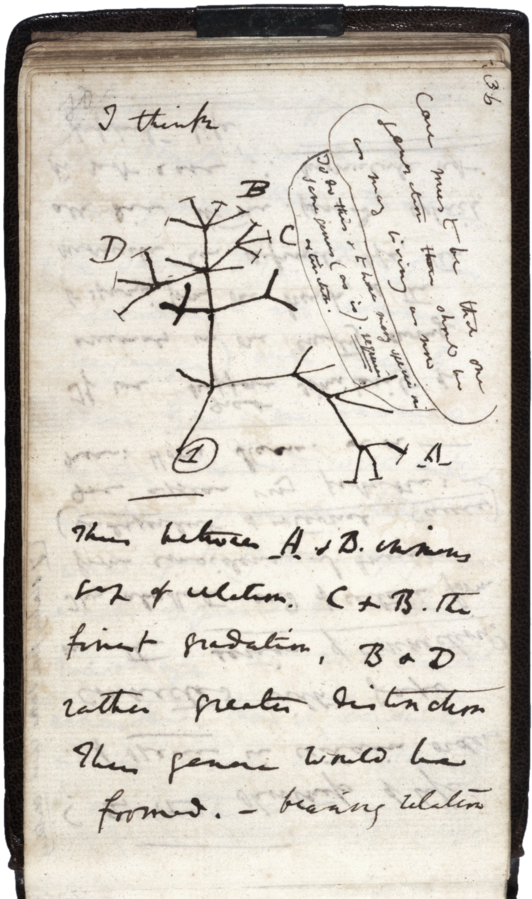
Darwin’s initial version that he sketched in 1837 was very simple. Haeckel “painstakingly drew up a much more comprehensive tree.”

Charles Darwin sketched his earliest tree in 1837. Image: public domain.

The letter presents a biased view of the zoologist who invented non-existing species as evidence for evolution and is now mostly remembered for his fraudulent embryo drawings.

He also inspired some leading Nazis.

This [i.e. Haeckel’s tree] represented Earth's wealth of species in the context of evolution — a concept he dubbed phylogeny (General Morphology of Organisms; 1866).

The root of the tree symbolizes a common primordial ancestor from which all other forms emerged. Haeckel developed his tree over almost 1,000 pages, basing it on palaeontological, embryological and systemic data — a precursor to modern biology's phylogenetic trees.”


We now know that Haeckel’s tree – just like Darwin’s – was simply wrong.

Secular researches have begun to understand that a bush or a net is a far more better description of the development and diversity of life.

Creationists have said so for decades.

Source:

Hossfeld, Uwe and Georgy S. Levit. 2016. Phylogeny: 'Tree of life' took root 150 years ago. Nature 540, 38.

Tuesday, 17 January 2012

100 Years Ago: Captain Scott and “Reptilian-Looking” Birds


The Terra Nova expedition of 1910–1913 tried to find evidence for Darwinian evolution. Image courtesy of Cherry-Garrard, Apsley, Project Gutenberg.


Joel Kontinen

Robert Falcon Scott (1868-1912) was a British navy officer known for his ill-fated expedition to Antarctica. He and his team lost the race to the South Pole and also lost their lives on the return trip.

On January 17th, 1912 they reached the Pole only to learn that Roald Amundsen and his team had already been there.

Their expedition also had an evolution connection. Three members of his team tried to find evidence for Darwinian evolution by examining penguin eggs.

According to New Scientist,

Emperor penguins were thought to be primitive birds. The idea was to collect embryos and see if any vestiges of reptilian ancestry could be discerned in the various stages of development. If so, it would link reptiles to birds and make a strong case for Darwin's theory of evolution. Sadly, the men only collected three eggs and returned frost-bitten, battered and bruised.”

However, no amount of eggs can prove the bird-reptile connection, which has enormous problems.

German zoologist Ernst Haeckel speculated that different species resemble each other during the early stages of their development. His embryo drawings have been used in textbooks for a century although they are known to be frauds.

Source:

Anathaswamy, Anil. 2011. Remember Scott's legacy of Antarctic science. New Scientist 2847, 24-25.

Wednesday, 27 January 2010

The Gates of Auschwitz Opened 65 Years Ago


Arbeit macht frei? These gates were opened 65 years ago. Image courtesy of Wikipedia.


Joel Kontinen

Soviet troops liberated the remaining prisoners of Auschwitz on January 27, 1945. It marked the end of one of the darkest and grisliest periods of Polish and German history.

The racist ideology of the Nazis had its roots at least partly in the writings of Ernst Haeckel. A zoology professor, Haeckel (1834-1919) spread the good news of evolution in central Europe in the late 19th century and early 20th century.

Nowadays, Haeckel is mostly remembered for his faked embryo drawings. His views on race are less well known. Like Charles Darwin, Haeckel thought that the coloured ”races” were not as evolved as the white ones.

The German Nazis assumed that their racial ideology was based on good science. The consequences of that ”science” turned out to be extremely horrible.


Source:

Darwin, Charles, 1871. (republished in 1981) The Descent of Man and Selection in Relation to Sex. Princeton: Princeton University Press.

Wednesday, 18 November 2009

Moneron and Other Fictive Creatures as Evidences for Evolution


Ernst Haeckel invented a fictive creature known as the Moneron. He claimed that it was an intermediate form between the living and the non-living. Image: The Swedish translation of Haeckel’s Natürliche Schöpfungsgeschichte (1868). The book’s English translation was entitled The History of Creation.


Joel Kontinen

Evolutionists have seldom been satisfied by merely presenting scientific evidence, but every now and then they have used their imagination to promote their views. The most notorious example is the use of Ernst Haeckel’s fraudulent embryo drawings.

Unfortunately, they are still very much alive on the pages of some biology textbooks. Recently, Richard Dawkins used them as evidence for evolution.

At last weekend’s Darwin Was Wrong Conference, Robert Carter, who has a PhD in marine biology, lectured on the incorrect assumptions behind evolution. Following the example set by Charles Darwin, evolutionists have often thought that life is much simpler than it is.

Darwin assumed that life could have originated in a warm little pond. He did not know anything about the sophisticated structure of the cell.

Doctor Carter also mentioned Ernst Haeckel, who repeatedly used fraud to spread the good news of evolution.

Ernst Haeckel, a German biologist and professor of anatomy, invented the Moneron. He claimed it was an intermediate form, bridging the living and the non-living. He called it Protomyxa aurantiaca.

Thomas Huxley, who was known as Darwin’s bulldog, said he had found the creature in the North Atlantic. Huxley gave it the name Bathybius haeckelii. It later turned out to be gypsum.

Fraud did not end with Haeckel, however. After Moneron there was Nebraska man, then Piltdown man. In 1999 National Geographic magazine made headlines with a feathered dinosaur called Archaeoraptor.

Have evolutionists learnt from their old mistakes?

Probably not very much. Last May we heard of Ida whom they initially introduced as our great-great… great grandmother.

Sources:

Carter, Robert. 2009. Darwin Was Wrong about The Complexity of Life. Lecture at the Darwin Was Wrong Conference. (14 November).

Grigg, Russell. 1996. Ernst Haeckel: Evangelist for evolution and apostle of deceit. Creation 18(2):33–36. http://creation.com/ernst-haeckel-evangelist-for-evolution-and-apostle-of-deceit

Friday, 9 October 2009

Richard Dawkins Used Ernst Haeckel’s Fake Embryo Diagrams as Evidence for Evolution


Ernst Haeckel’s embryo diagrams were known to be fraudulent 135 years ago. Image courtesy of Wikipedia.


Joel Kontinen

Richard Dawkins used Ernst Haeckel’s fake embryo diagrams as evidence for evolution in the TV series The Genius of Charles Darwin, which was filmed in 2008. At least some episodes are on You Tube.

In 1866 Ernst Haeckel published his notorious embryo diagrams in the book Generalle Morphologie der Organismen. He speculated that different species resemble each other during the early stages of their development. According to this hypothesis, humans go through a fish stage before birth.

During Haeckel’s lifetime, some scientists doubted his explanation. Already in 1874 professor Wilhelm His said that the drawings were fraudulent.

In 1997 Michael K. Richardson and colleagues published images of what the embryos really look like in the journal Anatomy and Embryology. They differed diametrically from Haeckel’s illustrations.

Both Science and New Scientist reported on Richardson’s findings. This should have been the death knell for Haeckel’s fraudulent drawings.

Unfortunately, high school and college biology text books continued to include embryo diagrams modelled after these fake drawings.

Now it seems that either Richard Dawkins does not read science journals or he does not bother to look at articles that pose hard questions for Darwinian evolution.

Or perhaps he thinks that it is permissible to use misleading evidence in a struggle between worldviews.

Recently, Richard Dawkins turned down an invitation to debate Stephen Meyer on evolution. Doctor Meyer’s book Signature in the Cell was published a few weeks ago.

This was not the first time when Dawkins refused to discuss Darwinism with its critics. For instance, a year ago he turned down the chance to debate the Turkish evolution skeptic Harun Yahya.

Dawkins would hardly have been successful in any debate had he used Haeckel’s embryo drawings as proof of Darwinian evolution.


Sources:

Grigg, Russell. 1998. Fraud rediscovered. Creation 20:2, 49–51.

West, John. 2009. No Joke: Richard Dawkins Still Peddling Haeckel’s Fraudulent Embryo Diagrams! Evolution News & Views (8 October) http://www.evolutionnews.org/

Tuesday, 8 September 2009

Butterfly evolution does not get air under its wings


A Monarch butterfly. Image courtesy of Kenneth Dwain Harrelson, Wikipedia. Butterfly evolution is a mystery for Darwinists.


Joel Kontinen

Butterfly evolution has been a mystery for Darwinists. How can an animal change into an entirely different form during its brief life? Now, Donald Williamson, a retired zoologist who worked at the University of Liverpool, UK, thinks he has found the solution.

According to Williamson, hundreds of millions of years ago an animal that does not live through a larva stage, for instance a grasshopper or cockroach, hybridised with a velvet worm. He suggests that butterflies are the descendants of this hybrid. They live through the stages of both ancestors.

This is typical Darwinian storytelling that has nothing to do with real observable science. It resembles Ernst Haeckel’s discredited ”Biogenetic Law” (“ontogeny recapitulates phylogeny”).

Williamson’s colleagues take a very critical approach to his hypothesis. Georg Mayer, a specialist in velvet worm development and taxonomy at the University of Jena in Germany, says that caterpillars do not even resemble velvet worms. Genetics does not support Williamson’s view, either.

New Scientist concludes its article on butterfly evolution by stating that the evidence does not support Williamson’s theory. Actually, his view does not fulfil the scientific criteria for a theory so it would be more appropriate to call it a hypothesis.

Butterflies are evidence of very intelligent design. Their Creator has seen fit to let them live in two distinct forms during their brief life. Instead of chance, their life speaks of teleology. In other words, they have been programmed to change from a caterpillar to a butterfly.

Source:

Holmes, Bob. 2009. Did two species mix to make butterflies? New Scientist 2723 (26 August)
http://www.newscientist.com/article/mg20327234.900-did-two-species-mix-to-make-butterflies.html

Sunday, 1 February 2009

Mengele’s Twin Experiments: An Aryan Master Race in Brazil?


Arbeit macht frei? The gate of no return at Auschwitz-Birkenau. Image from Wikipedia.


Joel Kontinen

There are over ten times more twins in a small Brazilian town than elsewhere on average. An Argentinian historian claims that this is the result of Josef Mengele’s genetic experiments.

Josef Mengele (1911-1979) was known as the Angel of Death. The Nazi doctor was notorious for performing medical experiments on concentration camp prisoners at Auschwitz-Birkenau from 1943 to 1945. He was also responsible for sending thousands of hapless Jews, Gypsies and other inmates to a certain death in gas chambers.

After World War II Mengele escaped to South America. Historian Jorge Camarasa interviewed people living in the small Brazilian town of Candido Godoi. He believes that Mengele continued his experiments there with the aim of creating a master race of blue-eyed Aryans. In this farming community, one in five pregnancies resulted in twins. Most of them were blond, blue-eyed “Aryans”.

The twin boom began in 1963, which roughly corresponds to the time when an itinerant medic now thought to be none other than Mengele was first seen in the area.

In his new book Mengele: the Angel of Death in South America Camarasa recounts the post-war odyssey of the chief Nazi eugenicist. He says that Mengele probably found refuge in one of the German enclaves in South America and continued his experiments even after Israeli agents seized his compatriot and fellow war criminal Adolf Eichmann.

The Nazi race ideology owes much to the writings of Ernst Haeckel (1834-1919). A professor of zoology who was the chief spokesman for Darwinian evolution in continental Europe in the late 19th and early 20th century, Haeckel is still remembered for his fraudulent embryo drawings. Less well known are his views on the inferiority of the black “races”. Like Charles Darwin, he thought they were less evolved than the white “races”.

While genetic studies have indicated that the entire concept of race is artificial, the Nazis sought to help natural selection in weeding out the less fit individuals and, probably reflecting the ideas of Friedrich Nietzsche (1844-1900), building a new Aryan super race.

The inhabitants of Candido Godoi remember Mengele as a friendly veterinarian and itinerant medic, who used the name Rudolph Weiss.

At Auschwitz, Mengele was known as the White Angel (der weisse Engel. His adopted surname Weiss is the German word for white. While this might be a mere coincidence, it could also be evidence for his deep-seated acceptance of the Nazi race ideology.


Source:

Evans, Nick. 2009. Nazi angel of death Josef Mengele 'created twin town in Brazil'. Telegraph. Co.uk. 23 January. http://www.telegraph.co.uk/news/worldnews/southamerica/brazil/4307262/Nazi-angel-of-death-Josef-Mengele-created-twin-town-in-Brazil.html

Sunday, 18 January 2009

The Sunday Times Questions Darwin - and Causes a Storm


This Victorian gentleman continues to be a source of fierce debate. Image from Wikipedia.


Joel Kontinen

Bryan Appleyard asked some hard questions in The Sunday Times about the significance of Charles Darwin's thinking on our lives. He let both Darwin’s supporters and dissenters say what they think about the man.

“Darwinism is what you have once you have denied the existence of God” he quoted Dr. David Menton as saying. Later Appleyard explained:

Darwin divided and still divides the western world. It’s not just a division between scientists and fundamentalists. Science itself is divided. To say nothing of the rest of us, who may accept Darwin in theory but find it hard to look in a mirror and see the descendant of a piece of slime.

This drew the ire of some ultra-evolutionists.

P. Z. Myers responded to Appleyard’s article, using colourful expressions that do not ring very scientific. He seemed to be especially upset about Darwin’s connection to Ernst Haeckel and the German Nazi ideology.

Historians have been writing about the role of Darwinism as an influence behind Hitler’s “Final Solution” for decades but Myers will not have any of this:

Darwin was an egalitarian who opposed slavery and wrote quite a bit about the humanity of the 'primitive' peoples he encountered.

Yet, In The Descent of Man this egalitarian Victorian gentleman wrote,

At some future period, not very distant as measured by centuries, the civilized races of man will almost certainly exterminate and replace throughout the world the savage races. At the same time, the anthropomorphous apes. . . will no doubt be exterminated. The break will then be rendered wider, for it will intervene between man in a more civilized state, as we may hope, than the Caucasian, and some ape as low as a baboon, instead of as at present between the Negro or Australian and the gorilla. (vol. 1, p. 201, my emphasis).

While I have probably quoted the one of the calmest portions of Myers’ post, the rest of the text, especially the ad hominem parts, bears every sign of high blood pressure.

Myers claims, for instance, that since Adolf Hitler did not explicitly use the words “genocide” or “Darwin” in Mein Kampf, the Victorian gentleman could not have inspired the mass killings of Jews. Yet, Darwin did use the word “exterminate” and Hitler did believe that the Jews were less evolved that the “pure-bred” Aryans. Myers seems to be skating on thin ice with his views.

Referring to the scathing feedback he received, Appleyard writes in his blog:

Darwinism is one of the ruling ideas of our civilisation. This is why the slightest challenge to its ascendancy, even quotations from people who don't believe it, arouses such anger, such fear. It is a threat to a world view some people find consoling.

Indeed. The issue appears to be extremely emotional, especially for those whose very worldview depends on the premise that there is no God.


Sources:

Appleyard, Bryan. 2009. For God’s sake, have Charles Darwin’s theories made any difference to our lives? The Sunday Times. 11 January. "http://www.timesonline.co.uk/tol/news/uk/science/article5488488.ece"

Appleyard, Bryan. 2009. Darwin for Idiots. http://www.bryanappleyard.com/blog/

Darwin, Charles, 1871. (republished 1981.) The Descent of Man and Selection in Relation to Sex. Princeton: Princeton University Press.

Myers, P. Z. 2009. For God’s sake, have Bryan Appleyard’s articles made any difference to our lives? http://scienceblogs.com/pharyngula/2009/01/for_gods_sake_have_bryan_apple.php

Sunday, 11 January 2009

The Pink Lizard That Darwin Missed


Some iguanas are greenish like this specimen on the Spanish island of Gran Canaria.


Joel Kontinen

When Charles Darwin visited the Galapagos islands in 1835, he obviously missed a pink variety of Iguana that now appears to be on the verge of extinction. A research team that investigated their habitat in 2008 found only ten of them left. Scientists think that they number less than a hundred.

The pink iguana (rosada) was first found on the island of Isabela in 1986. They live on the slopes of a volcano and are not known to breed with other subspecies of iguanas.

Iguanas are relatively large lizards. The largest variety can grow to be over 6.5 feet or two meters long. They have rows of spines running down on their back and tail. They are shy herbivores or plant-eating creatures. Brightly colored green iguanas (Iguana iguana) are often kept as pets since they are rather peaceful creatures.

A recent study published in the journal Proceedings of the National Academy of Sciences (PNAS) and reported by BBC news suggests that the existence of pink iguana will cause the evolutionary tree of the Galapagos iguanas to be re-written.

Evolutionary trees are often built on speculations. Some early evolutionists, such as Ernst Haeckel (1834-1919), the German scientist who popularised Darwinism in continental Europe and is now known for his fabricated embryo drawings, used their imagination rather freely in drawing evolutionary trees. Haeckel for instance constructed a link between life and non-life, naming it Monera, and invented a link between man and apes called Pithecanthropus alalus.

The problem with these two additions to the tree of life was that there was absolutely no fossil evidence or other kind of evidence for them. While more recent family trees are not so suspect, they are often built on very little actual data so that a single find may cause scientists to re-write them, as in the recent case with pink iguanas.

This, in turn, might – and should - raise questions about the validity of Darwinian evolution itself.


Sources:

Black, Richard. 2009. Pink iguana rewrites family tree. BBC News. (5 January). http://news.bbc.co.uk/2/hi/science/nature/7811875.stm

Grigg, Russell. 1996. Ernst Haeckel. Evangelist for evolution and apostle of deceit. Creation 18:2, 33–36. http://www.answersingenesis.org/creation/v18/i2/haeckel.asp