Showing posts with label Earth. Show all posts

Monday, 10 August 2026

Earth extremophile can grow in near-Mars-like conditions


A view of Mars’s surface captured by the Perseverance rover. Image courtesy of NASA/JPL-Caltech/ASU/MSSS

Joel Kontinen

A salt-loving microorganism found in places like the Dead Sea can not just survive but actively grow in conditions close to those that may be found just under the Martian surface

Was there life on Mars? Some Darwinist suppose that there  was live in the past and some think that there might still be live there.  

 A study here on Earth has made that idea more plausible by showing that salt-loving, or halophilic, microbes can grow in conditions close to those that might be found in little pockets of highly salty water just below the surface of Mars.

“We show that these halophilic microorganisms can actively grow under a combination of anoxic [oxygen-free], low-pressure atmosphere conditions and a high-salt liquid media that contains harmful Martian chemicals that are similar to bleach, which are the perchlorates,” says Adam Robinson at the University of Florida. “And image courtesy that’s something that nobody had been able to show before.”

We have found tantalising hints that not only was there once life on Mars, but that it might still exist on the Red Planet. Now, a study here on Earth has made that idea more plausible by showing that salt-loving, or halophilic, microbes can grow in conditions close to those that might be found in little

The type of life we have seen about the Red Sea gives the researchers live on Mars.

Source:

 Michael Le Page  2026 Earth extremophile can grow in near-Mars-like conditions | New Scientist 10 August


Thursday, 18 June 2026

Complex life on Earth may last 500 million years longer than expected


Image courtesy of Vimal-S/Unsplash,

Joel Kontinen

How long  will complex life dwell on Earth? Some researchers say that it will be 500 million years in the future.

As the sun expands over the coming billions of years, Earth will become inhospitable to any life more complex than a microbe – but that might take longer than we thought.

The sun is getting brighter and expanding as it ages, and will one day begin to cook our planet before engulfing it altogether – but complex life may be able to hold on in this hellish Earth scenario for much longer than we previously thought.

Estimates based on looking at other stars suggest that our sun is maturing into a red giant, a process that will destroy Earth in around 5 billion years, but it remains an open question as to how long the planet will remain habitable. As far as complex life goes, the last standing will be the vegetative biosphere – plants, both aquatic and terrestrial. Their ability to continue thriving will be mediated in part by the temperature of the planet, but mainly by the levels of carbon dioxide, which is necessary for photosynthesis.

But  according to the book of Revelation, life on Earth will be very different.

 Source:

 Leah Crane 2026 Complex life on Earth may last 500 million years longer than expected | New Scientist18 June 


Saturday, 6 June 2026

Earth has a mysterious triple symmetry that may influence its climate


Image courtesy of Planetary Visions Ltd/Science Photo Library

Joel Kontinen

The Earth is more special than we thought.

A line that runs through Africa, Europe, Alaska and both poles divides Earth into two halves that reflect the same amount of light – and this newly discovered symmetry may play a critical role in the planet’s climate.

It was previously known that the northern and southern hemispheres have almost equal reflectivity, or albedo, but Jianhao Zhang at the National Oceanic and Atmospheric Administration in the US and his colleagues have now uncovered a second line of symmetry along the 27° east and 153° west meridians.

At first, Zhang thought it must be a coincidence. “What convinced me that the east-west symmetry is not trivial are three features: its uniqueness, its persistence and what we call the triple symmetry feature,” he says. “Finding one division with equal total reflection might be expected. But finding a persistent, unique east-west division that also balances land-ocean distribution, clear-sky reflection and cloudy-sky reflection is much less trivial – especially given how variable and dynamic clouds are.”

Øivind Hodnebrog  says “I was a bit sceptical of an east-west symmetry separated at around 27 degrees east, which intuitively seems much less obvious than a separation at the equator,

However, Hodnebrog says he now agrees it is likely a “robust feature, and potentially another fascinating property of the Earth”.

The connection to ENSO may also be significant, says Hodnebrog. Unlike the north-south symmetry, which appears to be weakening due to the effects of climate change on sea ice and clouds, the east-west symmetry is currently stable, though models suggest it could weaken in future. “A potential future asymmetry could be an indication of changes in the atmospheric circulation,” he says.

Martin Jucker at the University of New South Wales, Sydney, says there is a high potential that the east-west symmetry is a coincidence.

“Earth’s weather and climate communicate easily across longitudes,” says Jucker. “This is due to Earth’s rotation, which creates bands of circum-global easterly and westerly winds, and atmospheric perturbations preferentially propagating in the east-west direction as well.”

Source:

James Woodford 2026 Earth has a mysterious triple symmetry that may influence its climate | New Scientist 3 June 

Wednesday, 25 March 2026

Earth may have formed from two separate rings around the sun


Models suggest something is wrong with our picture of the early solar system. Image courtesy of Panther Media Global / Alamy.

Joel Kontinen

According to evolutionary story, our solar system’s rocky planets – Mercury, Venus, Earth and Mars – may have formed from two rings around the young sun, rather than a single disc.

The inner solar system may have formed differently from how scientist thought must have. For decades, researchers have thought that according to evolution, the rocky planets formed from a single disc of dust and debris in the early solar system, but new simulations indicate there might have been two separate discs of material.

Models featuring a single disc or ring of material around the young sun tend to be unable to recreate several features of the solar system as we observe it. For one, Earth seems to be made of two different kinds of rocks, which wouldn’t make sense if they all came from the same ring.

Also, single-ring models tend to end up with Mercury and Mars too big, Venus and Earth too close together and the compositions of Earth and Mars too similar.

The real history of the planets can be read from the book of Genesis, in which God made the planets and stars at one go.

Source:

Leah Crane 2026 Earth may have formed from two separate rings around the sun | New Scientist 24 March 


Friday, 6 March 2026

Did Earth life actually begin on Mars? Asteroid impacts could let microbes planet-hop, study suggests


Image courtesy of NASA/JPL-Caltech.

Joel Kontinen

Billions of years ago Mars hosted lakes, streams and perhaps even a huge ocean according to evolution believing scientists.

A remarkably hardy bacterium can survive pressures similar to those generated when asteroid impacts blast debris off Mars, a new evolutionary study has found.

The findings, published earlier this week in the journal PNAS Nexus, may prompt scientists to reconsider where life could exist across the solar system and could lead to a reassessment of "planetary protection" rules designed to prevent contamination between worlds.

"Life might actually survive being ejected from one planet and moving to another," study co-author Kaliat Ramesh, a mechanical engineer at Johns Hopkins University in Maryland, said. "This is a really big deal that changes the way you think about the question of how life begins and how life began on Earth."

Researchers recently exposed the bacterium Deinococcus radiodurans to the pressures experienced during an asteroid strike. The microbe survived, suggesting that impacts could spread life from planet to planet. 

The new findings lend support to a long-debated theory known as lithopanspermia, which proposes that life can spread between planets by hitching a ride on fragments of rock blasted into space by massive impacts. The idea remains unproven.

For the study, Ramesh and his colleagues tested the endurance of Deinococcus radiodurans, an exceptionally resilient bacterium found, among other places, in Chile's high-altitude deserts. With a thick outer shell and a remarkable ability to repair its own DNA, D. radiodurans is famously tolerant of intense radiation, freezing temperatures, extreme dryness and other harsh conditions similar to those found in space. It has been nicknamed "Conan the bacterium," after all.

To simulate the forces involved in an asteroid impact, the researchers sandwiched samples of D. radiodurans between two steel plates. Using a gas-powered gun, they fired a projectile at roughly 300 mph (480 kph), subjecting the microbes to pressures between 1 and 3 gigapascals.

Nearly all of the microbes survived impacts generating 1.4 gigapascals of pressure, while about 60% remained alive at 2.4 gigapascals. At lower pressures, the cells showed no signs of damage, though researchers observed ruptured membranes and some internal cellular damage at higher pressures, the study reports.

"We continuously redefine the limits of life," Madhan Tirumalai, a microbiologist at the University of Houston who was not involved with the new study, told The New York Times.

As the pressure increased, the researchers also detected heightened activity in genes responsible for repairing DNA and maintaining cell membranes.

"We expected it to be dead at that first pressure," Lily Zhao, a mechanical engineer at JHU who led the experiment, said in the statement. "We started shooting it faster and faster. We kept trying to kill it, but it was really hard to kill."

The experiment eventually ended, the statement read, because the steel structure holding the plates "fell apart before the bacteria did."

This study does not take the existence of a Creator as established. Only God can give life to planets such as Earth.

Source:

Sharmila Kuthunur 2026 Did Earth life actually begin on Mars? Asteroid impacts could let microbes planet-hop, study suggests | Space 6 March

Monday, 24 November 2025

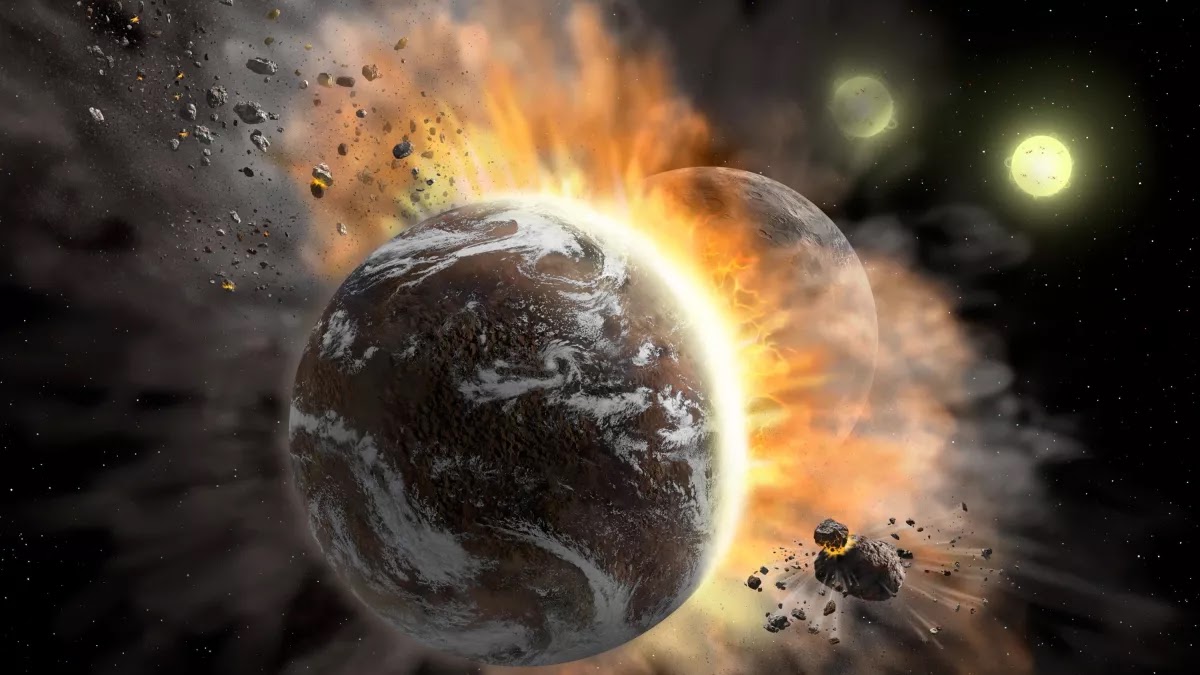
Giant impactor Theia formed nearby


Computational simulation of the impact between a proto-Earth and the small planet Theia. Image courtesy of  Jacob Kegerreis/NASA Ames And Durham University/Institute For Computational Cosmology/Swift/Dirac

Joel Kontinen

In evolutionary theory a very small planed called Theia collided into a proto Earth.  According to the same theory, it formed the Moon and materials from it formed the Earth.

There is no solid evidence that the planet even existed.

Hopp et al. measured iron isotopes in lunar samples, Earth samples, and meteorites. They then combined these results with previous measurements of other elements with different geochemical behaviours. By simultaneously calculating the contributions of Theia material to each of those elements in both bodies, the authors concluded that Theia formed in the inner Solar System, nearby to Earth but possibly slightly closer to the Sun.

Source:

Keith T. Smith 202In Science Journals | Science 20 November


Sunday, 28 September 2025

Did a star blow up and hit Earth "10 million years" ago?


Image courtesy of muratart/Shutterstock

Joel Kontinen

According to evolution, did a supernova blow up some 10 millions years ago?

There are signs deep beneath the Pacific Ocean that an exploding star once sent cosmic rays blasting out towards Earth, and now we have an idea of which stars may be to blame have sent cosmic rays hurtling at Earth, ang star may have sent cosmic shrapnel flying to hit Earth 10 million years ago, and astronomers have now in arrowed down the most likely culprits behind this interstellar incident.

Earlier this year, Dominik Koll at the Helmholtz-Zentrum Dresden-Rossendorf in Germany and his colleagues discovered a spike of radioactive beryllium buried in metallic rocks 5 kilometres beneath the Pacific Ocean, which they dated to just over 10 million years old. This form of beryllium is produced only when cosmic rays smash into Earth’s atmosphere, so Koll and his team theorised that one possible cause could be from a supernova that exploded long ago.

Source: 

Alex Wilkins 2025 Did a star blow up and hit Earth 10 million years ago? | New Scientist 26 September 

Wednesday, 17 September 2025

Mars once had an atmosphere that was thicker than Earth's today


Modern Mars barely has an atmosphere. Image courtesy of NASA/JPL/USGS

Joel Kontinen

According to some evolutionists, Mars had an atmosphere that was thicker than Earth’s  atmosphere. In their view, some 4 million years after the origin of the solar system Mars was already almost complete.

Mars’s atmosphere may have once been hundreds of times thicker than it is today, acting as a blanket that protected it from frequent asteroids that ravaged other planets

At this time, the planets existed in a vast ball of hot gas and dust that swirled around the young sun, called the solar nebula, which some planets would have temporarily absorbed into their atmospheres. However, once the solar nebula receded, it was thought that the planets would quickly have lost this gas, reducing the densities of their atmospheres.

Source:

Alex Wilkins 2025 Mars once had an atmosphere that was thicker than Earth's today | New Scientist 15 September 


Sunday, 3 August 2025

What would it feel like to be on a planet spinning out of control?

“The faster the planet, the fiercer the storms…”

elementix / Alamy Stock Photo

Joel Kontinen

Exoplanets are strange. They are not meant for life. But God has made the Earth in check so that life can continue on Earth.

"In the past month, Earth experienced some of its shortest days on record. The planet spun quickly enough to shave 1.4 milliseconds off of its usual 24-hour day. These natural accelerations in Earth’s spin are, of course, hard to notice. But if you’re anything like me, the feeling that our world is spinning out of control – metaphorically, at least – might not be unfamiliar.

The straightforward effects of the sun rising and setting ever-more frequently are easy to imagine. How many of us already feel as if there’s not enough time in the day? In Circular Motion, the characters are increasingly overworked, struggling to keep up with the demands of everyday life while their days keep shortening on them. Because their productivity relies on a high-speed global transport system that is itself the cause of the planet’s acceleration in the book, their rushing only makes the problem worse.”

By Alex Foster 2025 Alex Foster on his new novel, which imagines what it would feel like to be on a planet spinning out of control | New Scientist 1 August 


Saturday, 22 March 2025

4 tiny, Earth-like planets found circling secod-closest star system to us


Image courtesy of International Gemini Observatory/NOIRLab/NSF/AURA/R. Proctor/J. Pollard

Joel Kontinen

A new study reveals that four exoplanets, each about 20% to 30% the size of our planet, circle one of our closest stellar neighbour. The rocky alien worlds are close enough that future generations of humans may be able to visit them with futuristic rocket propulsion technology.

 But we would not find live in each of them.  

“Astronomers have long suspected that there was at least one exoplanet orbiting Barnard's Star — a red dwarf with a mass around one-sixth that of the sun. At 5.97 light-years from Earth, it is the fourth-closest star to our solar system, after the three interconnected stars of the Alpha Centauri system. (Five potential planets have also been detected around the stars of Alpha Centauri, though not all of them have been confirmed yet.)”

”But in a new study, published March 11 in The Astrophysical Journal Letters, researchers say they have discovered that this wobbling is not caused by the pull of one gas giant but instead by the combined force exerted by four smaller, rocky worlds, each around four times more massive than as they are so close to their sun, they are probably not habitable..

But as the planets are too close to the sun, they probably are not habitable,

Source:

 Harry Baker 2025 4 tiny, Earth-like planets found circling 2nd-closest star system to us — and could be visited by future human generations | Live Science 19 March


Saturday, 28 December 2024

Massive subterranean ocean found: 3 times more water than Earth’s surface oceans


Joel Kontinen

This hidden reservoir, located approximately 400 miles beneath the planet’s surface, contains an astounding three times more water than all of Earth’s surface oceans combined. 

At the heart of this revelation lies a remarkable mineral called ringwoodite. This unique rock type possesses an extraordinary ability to trap water within its crystal structure. Geophysicist Steve Jacobsen, a key member of the research team, explains, “The ringwoodite is like a sponge, soaking up water. There’s something very special about the crystal structure of ringwoodite that allows it to attract hydrogen and trap water.”

This discovery  shows  that the Genesis Flood  was real.  Some evolutionist think that it shows  the origin of water on our planet but it does not show how out planet formed  in the beginning.

Source:

Samir Sebti 2024 Massive subterranean ocean found : 3 times more water than Earth's surface oceans combined December 16.


Saturday, 21 December 2024

Earth had a mini-moon for two months


There may be more moon-born asteroids near Earth than we thought

Image courtesy of ESA/P.Carril

Joel Kontinen

What do we say about a mini moon for some two months that followed Earth for  about 2 months? Some scientist say that it appears to have originated from the moon.

This is just Darwinian storytelling.  

“The asteroid, called 2024 PT5, is about 10 metres wide. Spotted in August, it was later snared by Earth’s gravitational pull, becoming a second moon of our planet, referred to as a mini-moon. It was visible between September and November.”

Source:

Jonathan O’Callaghan 2024 Earth had a temporary mini-moon that was a chunk of the real moon | New Scientist 17 December 


Wednesday, 11 December 2024

Earth may have had its water delivered by a vast cloud of vapour


Image courtesy of ESA/Hubble NASA, ESA, M.A. Garlick (space-art.co.uk), University of Warwick, and University of Cambridge.

Joel Kontinen

Rather than getting its water from impacts, our planet may have drawn in water vapour after the sun boiled it off early icy asteroids.

The sun may have created a vast mass of water gas by heating asteroids.

ESA/Hubble Copyright: NASA, ESA, M.A. Garlick (space-art.co.uk), University of Warwick, and University of Cambridge.

Where did Earth get its water? According to the Darwinian way, it got it from asteroids.  There is no proof of this, so it is just evolutionary speculation.

”A vast cloud of vapour expelled from boiled asteroids may have lingered in the solar system for millions of years before raining down on Earth, according to a new idea for how our planet got its water.

The origin of Earth’s water has long puzzled scientists. It is hard to argue that our planet has always had the water we see today, because the young sun would have been got its water from asteroids.”

But Genesis paints a different story, the Earth has always had water.

Source:

Alex Wilkins 2024 Earth may have had its water delivered by a vast cloud of vapour | New Scientist 11 December


Saturday, 28 September 2024

Planet in the 'forbidden zone' of dead star could reveal Earth's fate


Image courtesy of NASA/JPL-Caltech

Joel Kontinen 

 A distant planet should have been consumed when its star expanded to become a red giant, perhaps offering insights into planetary migration

How  do evolutionist see the fate of Earth? It does not sound promising,

“A planet has been found orbiting a dead star in a zone where it should have been incinerated when the star died. The discovery might give us a window into the future of our solar system.-

When stars like our sun exhaust their fuel, they first expand to become a red giant, then collapse into a dense, Earth-sized remnant called a white dwarf.”

But for the ones who believe in a Creator, It is a different story, we will have a new heaven and new Earth.  

Source:

Jonathan O’Callaghan, 2024Planet in the 'forbidden zone' of dead star could reveal Earth's fate | New Scientist 26 September . 


Sunday, 22 September 2024

Iron winds and molten metal rains ravage a hot Jupiter exoplanet


Image courtesy of Tania Cunha (Planetário do Porto - Centro Ciência 

Joel Kontinen

"Our observations indicate the presence of probably fuelled by a hot spot in the atmosphere."

Exoplanets can be odd, on a planet called WASP-76b it rains iron strong winds. It has a temperature of 2,400 degree or 4,350 degrees Fahrenheit so it can pummel the planet's surface.

It is a hot Jupiter type of exoplanet. The high temperature stems from the planets is so close to its star.  

It seems that Earth is a very special place.  

Source: 

Robert Lea 2024. Iron winds ravage a hellish hot Jupiter exoplanet | Space  13. September.

Thursday, 14 March 2024

Europa’s seafloor may be impenetrable and inhospitable to life


Image courtesy of NASA/JPL-Caltech/SETI Institute.

Joel Kontinen

Is there life on Europa? A few weeks ago, it seemed that there was.  But now it seems that there is not.

“Jupiter’s icy moon Europa may not be as ripe for life as previously thought. Its underground ocean has long made it one of the most promising candidates in our solar system to host life, but theoretical studies of its seafloor are putting a damper on its promise.”

On Earth, much of the life in the oceans is supported by hydrothermal activity at the seafloor, where water interacts with rock. This activity is missing on Europa.“

Well, God made the Earth a space for humans and not other planets or their moons.

Source:

 Leah Crane, 2024. Europa’s seafloor may be impenetrable and inhospitable to life | New Scientist 13 March.


Monday, 4 December 2023

Largest stream of stars ever found could teach us about dark matter


Image courtecy of William Herschel Telescope/Román et al.

Joel Kontinen

The newfound Giant Coma Stream of stars stretches nearly 1.7 million light years across the cosmos, and it could have holes blasted through it by clumps of dark matter

The black streak is the newly discovered Giant Coma Stream, which is ten times as long as the Milky Way.

Some astromomers have found the biggest stream of stars ever recorded. This tendril of stars is extraordinarily faint, but it and others like it could eventually help us unveil the true nature of secrets of dark matter.

The stream of stars, called the Giant Coma Stream, appears to float unmoored from any particular galaxy in the Coma galaxy cluster, about 300 million light years away from Earth. 

Source: 

Leah Crane 2023. Largest stream of stars ever found could teach us about dark matter | New Scientist

2 December.


Thursday, 11 May 2023

Earth should not exist


Image courtesy of  BlenderTimer / Pixabay. 

Joel Kontinen 

Earth and the other inner solar planets —Mercury, Venus, and Marsshould be a chaotic messaa nd models have suggested that they should not exist.

 “Planets constantly exert a mutual gravitational pull on each other – and these little tugs constantly make minor adjustments to the planets' orbits. The outer planets, which are much larger, are more resistant to little tugs and so maintain comparatively stable orbits.” 

They should have should have crashed into each other by now. However, that hasn't happened. 

Source: 

 Demming , Anna. 2023,  Scientists discover secret 'symmetries' that protect Earth from the chaos of space.  Live Science 9 May. 


Thursday, 16 March 2023

Unstable exomoons may pose a diffculty for life on some planets


 Image courtesy of NASA/SOFIA/Lynette Cook). 

Joel Kontinen 

According to evolution, alien planets may collide with their own moons, They may be doing so regularly, 

Recently, a study  published in the journal Monthly Notices of the Royal Astronomical Societyion, alien planets may collide with their own moonsto show that collisions between exoplanets and their moons (called exomoons) may actually be a regular occurrence. These may be disaustous for any life on those planets, just like a Mars did for early Earth,  according to evolution

Source:

Lewis Briley.  2023, Unstable' moons may be obliterating alien life across the universe  Live Science 15 March

Saturday, 6 August 2022

Millions of years in Science


Kuva: Suedwand, CC BY-SA 3.0.

 Joel Kontinen

 Evolutionists believe that between roughly 1.25 million and 800,000 years ago, the climate system went through a major change during a period called the Middle Pleistocene Transition.

 Evolutionists ask was the inventory of dissolved oxygen in the ocean affected by this episode? They believe that Earth was covered by ice at that time. Thomas et al. show that oxygen concentrations in glacial deep North Atlantic waters suffered a stepped reduction about 900,000 years ago, coincident with reductions in the concentration of glacial atmospheric carbon dioxide and global ice volume.

Source;

H. Jesse Smith Deep concentration Science 5-8.