Showing posts with label human evolution. Show all posts

Tuesday, 2 February 2021

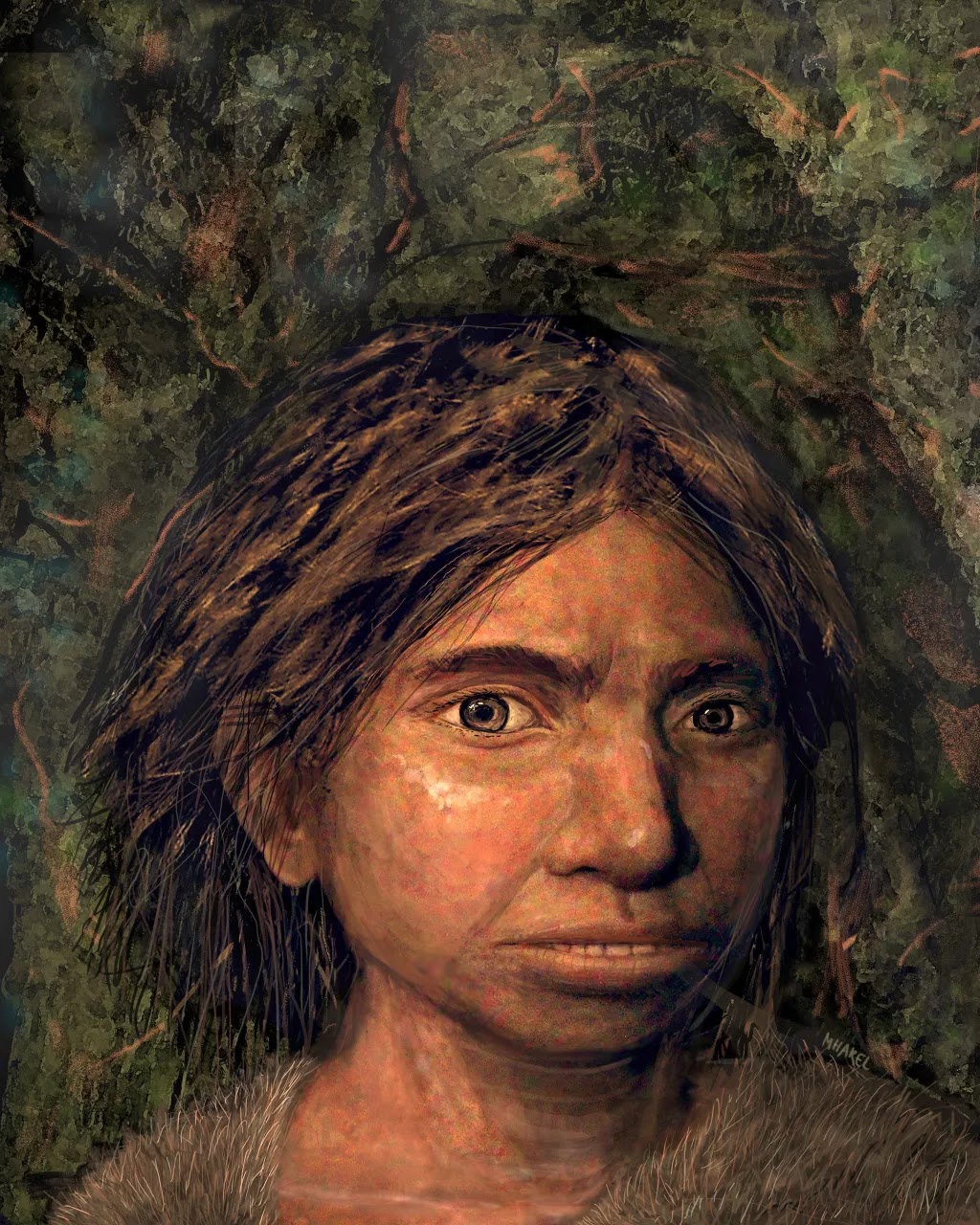
Who Were The Denisovans?


Image courtesy of Maayan Harel, public domain.

Joel Kontinen


The existence of the  Denisovans was discovered just a decade ago through DNA alone. Now we're starting to uncover fossils and artefacts revealing what these early humans were like.

The archaeologists have also unearthed treasure troves of artefacts, including tools, jewellery and even art, that they think were created by  these mysterious people.

We are starting to piece together a picture of the Denisovans, one of our closest cousins, and a group that still lives on in the DNA of many people today.

According to the model based on Genesis, the Neanderthals were Adam’s descendants just like us. They probably lived in Europe during the ice age following the Flood of Noah and it seems the Denisovans where their closest comrades.


Source:

Marshall, Michael. 2021. The other humans: The emerging story of the mysterious Denisovans. New Scientist 27 January


Tuesday, 24 November 2020

Haeckel Beats Piltdown Man In Scientific Frauds


 Illustration courtesy of John Cooke in 1915, public domain,

Joel Kontinen

What is the greatest scientific fraud of all time? It seems that they almost had to do with Charles Darwin. A few years back National Geographic had a essay of the well-known hoaxes of all tines. Darwin took the first place, and even the second was his.

National Geographic said that Piltdown Man  was the  number one.

What should we say to  Earnest Haeckel, whose drawing have inspired Darwinians for over 140 years? 

Source:

Klinghoffer David. 2020, Science Frauds Go, Haeckel Beats Piltdown Man. Evolution News And Science Today 9 November.

Wednesday, 26 August 2020

Earliest Human Bedding Found In South Africa


Image courtesy of Bob Rayner CC BY 2.0.


Joel Kontinen

Evolutionists see the Border Cave in the Lebombo Mountains of South Africa as the earliest bedding made by humans, some 200,000 years ago.

They see that “the ancient humans used ash and plant material to repel insects while they slept. “

“Lyn Wadley, an archaeologist at the University of the Witwatersrand, made the discovery when excavating Border Cave with her team.”

Researchers aren’t sure about the dates. They could be off by thousands of years

Source. 

O’Grady Cathleen. 2020. World’s oldest camp bedding found in South Africa  Science August 13.


Wednesday, 29 May 2019

New Darwinian Story: Exploding Stars May Have Put Humanity On Two Feet

Image courtesy of NASA/CXC/SAO.


Joel Kontinen

A new Darwinian hypothesis goes like this: “As human ancestors went from swinging through trees to walking on two legs, they may have received a boost from an unlikely source: ancient supernovas.

These powerful stellar explosions may have showered Earth with enough energy to shift the planet's climate, bathing Earth in electrons and sparking powerful, lightning-filled storms, according to a new hypothesis.

Lightning then could have kindled raging wildfires that scorched African landscapes. As savanna replaced the forest habitat, early humans that lived there may have been pushed to walk on two legs, the new study suggest.
"

But then live science tells us that we should not jump to conclusions just then. As it tells us, the evolution of bipedalism is could have occurred earlier.

What we did only we learnt to walk on too feet? It seem that Darwinian folktales are related to African folktales .

The source says that “Clues to the ancient supernovas were found in traces of iron-60 in Earth's crust.”

However, many other things could have resulted in iron-60 in Earth.

The findings were published yesterday (May 28) in The Journal of Geology.

Source:
Weisberger, Mindy. 2019. Exploding Stars May Have Put Humanity on Two Feet. Live Science (28 May).

Wednesday, 17 April 2019

A quest to undermine human education and understanding

Image courtesy of Shantanu Kuveskar, CC BY-SA 4.0.

Joel Kontinen

A Chinese team has genetically engineered a macaque monkey to make it more human.

This was the first attempt to understand the evolution of human cognition using a transgenic monkey model,” says Bing Su, the geneticist at the Kunming Institute of Zoology who led the effort.
According to their findings, the modified monkeys did better on a memory test involving colours and block pictures, and their brains also took longer to develop—as those of human children do. this There wasn’t a difference in brain size
.

This has created a backlash among US developers:
¨
The use of transgenic monkeys to study human genes linked to brain evolution is a very risky road to take,” says James Sikela, a geneticist who carries out comparative studies among primates at the University of Colorado. He is concerned that the experiment shows disregard for the animals and will soon lead to more extreme modifications. “It is a classic slippery slope issue and one that we can expect to recur as this type of research is pursued,” he says.

This is still a long way to the quest of evolutionists. the union of man and monkey.

Human exceptionalism is a Darwinian enigma. Thus, evolutionists are willing to see human traits in animals and animal traits in humans.

At times, their strategy borders on the absurd. A case in point is the rumour that US scientists engineered a human-chimp hybrid in the 1920s in the first primate research centre established in the US in Orange Park, Florida.

It failed.

The Russian biologist Ilya Ivanovich Ivanov also attempted to produce a human-chimp hybrid, but needless to say, he failed.

Humans are created in the image of God, but apes aren’t so trying to hybridize them is doomed to failure.

All successful hybrids belong to the same Genesis kind.

Source:

Regalado, Antonio. 2019. Chinese scientists have put human brain genes in monkeys—and yes, they may be smarter. MIT Technology Review. (10 April).

Friday, 15 February 2019

A Taste for Fat May Have Made Us Human

Image courtesy of Delphine Bruyere, Wikipedia.


Joel Kontinen

Evolution would be boring without a never-ending stream of new just so stories that often contradict each other, but they do keep on making headlines across the popular media.

Long before human ancestors began hunting large mammals for meat, a fatty diet provided them with the nutrition to develop bigger brains, posits a new paper in the journal Current Anthropology.

"Our human ancestors were likely awkward creatures," the paper’s lead author Jessica Thompson, an anthropologist at Yale University says. "They weren't good in trees, like chimpanzees are, but they weren't necessarily all that good on the ground either. So, what did the first upright walking apes in our lineage do to make them so successful? At this stage, there was already a small increase in the size of the brains. How were they feeding that?"

The easy way to do this was to eat up, so that they’d become less awkward and brainy.

Source:

Yale University. 2019. A taste for fat may have made us human. Science Daily (5 February 2019).


Friday, 25 May 2018

The Human Brain Continues to Puzzle Evolutionists

Image courtesy of Patrick J. Lynch, CC BY 2.5.


Joel Kontinen

The human brain is a Darwinian enigma.

In 2008 Harvard professor Richard Lewontin admitted that scientists did not know anything about brain evolution.

That did not put an end to speculations, however. From just-so stories about our assumed lizard brain to more sophisticated – but not necessarily brainy – assumptions, evolutionists have brought up new hypotheses and resurrected some old ones.

Neuroscientists are willing to admit that the human brain is a wonderful organ, capable of surprisingly complex interactions,” as the journal Neuron put it in 2016.

Our large brain continues to puzzle scientists. A paper published in Nature attempts to explain how it came to be so big, six times as large as those of mammals of comparable size.

According to the abstract, “establishing causes for brain-size evolution remains difficult. Here we introduce a metabolic approach that enables causal assessment of social hypotheses for brain-size evolution. Our approach yields quantitative predictions for brain and body size from formalized social hypotheses given empirical estimates of the metabolic costs of the brain. Our model predicts the evolution of adult Homo sapiens-sized brains and bodies when individuals face a combination of 60% ecological, 30% cooperative and 10% between-group competitive challenges, and suggests that between-individual competition has been unimportant for driving human brain-size evolution.” (internal references omitted).

The authors go on to conclude: “Our model indicates that brain expansion in Homo was driven by ecological rather than social challenges, and was perhaps strongly promoted by culture.”

The problem with all evolution-inspired brain research is that it assumes that our brain evolved from chimpanzee-like brains.

But if the human brain never evolved from an ape-like brain, then all Darwinian explanations turn out to be mere storytelling masquerading as science.


Source:

González-Forero, Mauricio and Andy Gardner. 2018. Inference of ecological and social drivers of human brain-size evolution. Nature 557, 554–557.

Saturday, 9 September 2017

Humans Are Still Evolving, New Study Claims

Reconstruction of Homo habilis. Many paleoanthropologists now believe that this species doesn’t even exist. Image courtesy of Lillyundfreya, CC BY-SA 2.5.


Joel Kontinen

Evolutionists seem to have a hard time pondering whether or not we are still evolving.

Last year, research suggested that human evolution has not stopped.

Now, Joseph Pickrell at Columbia University in New York and colleagues published a paper in PLoS Biology, suggesting that we are indeed evolving, albeit slowly.

How did they discover this?

They found that a variant, of the gene CHRNA3, which is often associated with heavy smoking, has become rarer.

An article in New Scientist also mentions that a variant of the gene ApoE4 that is “known to increase the risk of late-onset Alzheimer’s disease, as well as cardiovascular disease, may also be getting rarer.”

So, it seems that researchers have noticed some tiny changes in human gene variants. But it is still a long way to Tipperary (or anywhere else).

There are better explanations for why people smoke less (or not at all) or have become less prone to Alzheimer’s: epigenetic changes resulting from leading a healthier lifestyle (i.e., more exercise and a wholesome diet).

Source:

Le Page, Michael. 2017. Alzheimer’s and smoking genes suggest we’re still evolving. New Scientist (5 September).


Sunday, 3 September 2017

Another Neanderthal Invention: They Made “First” Glue

Neanderthals spiced their food with herbs like these.


Joel Kontinen

Once upon a time, Neanderthals were thought to be very primitive. Darwinists initially hailed them as the first apemen.

But with an increasing number of their artefacts being discovered, Neanderthals are beginning to look fully human.

Many recent discoveries have shown that they were clever inventors.

New research published in the journal Scientific Reports suggests that Neanderthals made the world’s oldest glue some “200,000 years” ago. They obviously extracted tar from birch bark and heated it above a fire.

They used it to fix the point of a spear to the shaft.

This follows a long string of inventions, including cave art, string and even abstract art –thousands of years before Picasso.

In the model based on Genesis, Neanderthals are descendants of Noah.

They mostly lived in caves during the harsh ice age winters after the global flood, but they obviously also knew how to sail.

Source:

University of Leiden. 2017. How Neanderthals made the very first glue. Science Daily. (31 August).

Wednesday, 10 May 2017

Homo naledi Is “Startlingly Young” – Can’t Be a Missing Link


H. naledi. Image courtesy of John Hawks, Marina Elliott, Peter Schmid et al, Creative Commons (CC BY-SA 4.0).


Joel Kontinen

All we know of the Missing Link is that he is missing,” G.K. Chesterton famously said roughly a century ago.

This is still true.

Evolutionists hoped that Homo naledi could be the link between Australopithecines (such as Lucy aka Au. afarensis and Au. Sediba) and humans, when the first paper on the fossils was published in 2015.

Professor Lee Berger, who with his colleagues discovered the remains, believed that H. naledi could be as old as “3 million years”, a convenient age for a transitional fossil.

However, the remains were recently dated, giving an age between “236,000 and 335,000 years,” yet they had very primitive features.

This is astonishingly young for a species that still displays primitive characteristics found in fossils about two million years old,” Chris Stringer told BBC news.

Three new papers published in the journal eLife report on the discovery of a second cave near the first, featuring relatively complete remains of H. naledi.

Their message does nothing to help evolution. What has been missing since Darwin’s days is still missing.

Sources:

Rincon, Paul. 2017. Amazing haul of ancient human finds unveiled. BBC news (9 May).

University of the Witwatersrand. 2017. Homo naledi's surprisingly young age opens up more questions on where we come from: Homonin [sic] discovered in 2015 by the Rising Star team in South Africa was alive between 335,000 and 236,000 years ago. Science Daily. (9 May).


Wednesday, 26 April 2017

Homo naledi Turns Out to Be Much Younger Than Expected


Homo naledi. Image courtesy of Lee Roger Berger research team, Creative Commons (CC BY 4.0).


Joel Kontinen

This has been an interesting week for the evolution of two assumed human ancestors.

First, the journal Science suggested that Australopithecus sediba should be tossed out of the human family tree. Then, National Geographic acknowledged that Homo naledi is “only” 200,000 – 300,000 years old, making it far too young to be a direct human ancestor.

Both discoveries were known to be very controversial.

In 2010 Lee Berger and his team discovered Australopithecus sediba that was once touted as a human ancestor but was later practically tossed aside by some other anthropologists.

Then, in 2015 Professor Berger and colleagues published a paper on what they claimed to be a new human species. Found in a cave in South Africa, their discovery consisted of 1,500 pieces of teeth and bones that were not dated, and some experts thought they might be too young to fit into our family tree.

One of the estimates put their age at 912,000 years BP (before present).

Now, in an interview published in National geographic, Berger suggested that H. naledi might be a lot younger.

For evolutionists, the curved ape-like fingers, small skull and other primitive features of H. naledi are an enigma. They believe that modern H. sapiens appeared some 200, 000 years ago, leaving practically no time for evolution.

Chris Stringer of the Natural History Museum in London thinks that H. naledi might be “a relic species, retaining many primitive traits from a much earlier time.”

Prof. Berger has likened it to the Coelacanth (Latimeria chalumnae), the living fossil that was supposedly able to retain primitive features for 400 million years.

Others have compared it to the hobbit or H. floriensis that has been the source of heated debate since its discovery in 2003.

And least one thing is sure: there’s no end in sight for updates to our assumed family trees, and artists will hardly have to fear for their jobs until the day comes when Darwinian evolution will be tossed out as pseudoscience.

Source:

Barras, Colin. 2017. Homo naledi is only 250,000 years old – here’s why that matters. New Scientist (25 April).
Monday, 4 July 2016

Homo Naledi Might Be Too Young for Human Evolution


H. Naledi was put together from tiny bits and pieces. Image courtesy of the Lee Roger Berger research team, Creative Commons (CC BY 4.0).


Joel Kontinen

While the entire idea of human evolution has always been more or less fuzzy, it has now turned out to be a total mess.

We can thank a new assumed date of 912,000 years BP (before present) for Homo Naledi for this devolution.

In 2015 Lee Berger and his colleagues published a paper on what they claimed to be a new human species. Their discovery consisted of 1,500 pieces of teeth and bones.

Lee Berger is also known for the discovery of the very controversial Australopithecus sediba that was once touted as a human ancestor but was later practically tossed aside.

The success of purported human ancestors tends to be very brief. Some, like nutcracker man and Taung child a.k.a. Australopithecus africanus, have fared a little longer.

Soon after Berger and colleagues published the discovery of H. naledi in the rather obscure journal eLife, some anthropologists voiced their scepticism of its inclusion in the human family tree. They even doubted that all the bones and pieces belonged to the same species.

This scepticism hasn’t gone away. And the fossils were never dated.

Several studies have suggested that radiometric dating cannot be trusted, as it tends to give too old dates for fossils.

However, it seems that Darwinists can come up with a date for fossils without actually dating them. In their method, the evolutionary tail wags the Darwinian dog:

Mark Collard, a biological anthropologist at Simon Fraser University in British Columbia, and his colleagues developed a computer model with which they could analyse skull, jaw and tooth features of assumed human ancestors.

The model suggests a date of 912,000 years BP for H. naledi, which would make it too young for a human ancestor, as the oldest specimens of the fully-human H. erectus are much older.

The Hobbit or H. floresiensis has likewise rocked the Darwinian paddleboat that is now drifting in the wrong direction.

Source:

Choi, Charles Q. 2016. Newfound Human Species Suggests Africa Was Evolutionary Melting Pot. Live Science (29 June).


Monday, 23 May 2016

Humans Are “Evolving” in Britain – But It’s Not the Darwinian Variety of Change

Modern Brits in old battle gear. Image courtesy of David Friel, Creative Commons (CC BY 2.0).


Joel Kontinen


Evolution in action is a catchphrase that Darwinists use when they think that they can see small changes within one and the same species. It often has to do with finches turning into finches or bacteria turning into bacteria.

But when that species happens to be us (H. sapiens), it is bound to make bold and misleading headlines.

According to an article in Science:

’Being able to look at selection in action is exciting,’ says Molly Przeworski, an evolutionary biologist at Columbia University. The studies show how the human genome quickly responds to new conditions in subtle but meaningful ways, she says. ‘It’s a game-changer in terms of understanding evolution.’ ”

So what happened?

Genomic studies show that there are more blond and blue-eyed Brits now than in Roman times and they tend to be taller than what their ancestors were some 2,000 years ago.

But is this evolution in the orthodox Darwinian sense of the word? While the Brits might have been slightly shorter and more dark-haired in the beginning, they were humans, just as they were at the end of the story.

Most evolution headlines have amounted to mere speculations. Here are some examples:

· Human evolution is over.
· Eating meat made us human.
· The human hand is primitive.

And it is quite a stretch to claim that humans are evolving, when the research merely looked at Anglo-Saxons. I don’t see such changes in me, for instance. While I’m probably a bit taller than the average legionary (ok, maybe some change here), my hair (brown) and eyes (greyish-green with a touch of brown) have obviously forgotten to evolve with the times.

But, then, I’m not British, even though I like my 5 o’clock tea (milk but no sugar, just like the Queen). Or am I digressing?

Source:

Pennisi, Elizabeth. 2016. Humans are still evolving—and we can watch it happen. Science. (17 May).


Tuesday, 14 October 2008

Human Evolution is Over

Our closest cousins according to T. H. Huxley. (Image courtesy of Wikipedia).


Joel Kontinen


Human evolution is about to stop as there are too few older fathers in the western world.

Recently, Steve Jones, professor of genetics at University College London, disclosed that due to the scarcity of older fathers, we will have to say goodbye to human evolution. He explained that fathers who are over 35 probably pass on more mutations to their offspring than younger men.

According to Jones, evolution consists of three main elements – natural selection, mutation, and random change. He says that the amount of mutations has diminished considerably. He suspects that this is due to the fact that there are too few older fathers.

As reported by Times Online, professor Jones explained, “Every time there is a cell division, there is a chance of a mistake, a mutation, an error. For a 29-year old father there are around 300 divisions between the sperm that made him and the one he passes on – each one with an opportunity to make mistakes.”

He went on to say that for a 50-year old father there are over a thousand chances of errors. Thus, the decrease in the number of older fathers has an effect on how many mutations can appear.

Jones also thinks natural selection has weakened as people are living longer. Nowadays ethnic groups are more connected with others, which diminishes randomness. Taken together, these factors will bring human evolution to a standstill.

Paul Taylor of the Christian apologetics ministry Answers in Genesis (UK/Europe) summarises professor Jones’ ideas as follows:

1. Actual scientific evidence suggests that humans are not evolving today.
2. We don't have any evidence that they were evolving in the past either.
3. But we think that they were!


In other words, the idea of human evolution is entirely based on faith and storytelling that is typical of Darwinists.


Sources:

Belluz, Julia. 2008. Leading geneticist Steve Jones says human evolution is over. Times Online (7 October).
http://www.timesonline.co.uk/tol/news/uk/science/article4894696.ece

Taylor, Paul. 2008. Human Evolution Has Stopped! Answers in Genesis UK/Europe Newsletter October 2008 (Issue 9)