Showing posts with label dark matter. Show all posts

Tuesday, 1 September 2026

The first signs of dark matter particles may finally have been spotted


 Inside the LUX-ZEPLIN detector. Image courtesy of Matthew Kapust/Sanford Underground Research Laboratory

Joel Kontinen

Most of the matter in the universe is dark matter, but for decades physicists haven’t been able to directly observe it – that may have just changed.

Some researchers think that dark matter does not exist.  Some think that it does.

Researchers may have spotted the first signs of a dark matter particle. If the result is confirmed, it could be one of the most monumental discoveries in the history of physics.

Dark matter makes up about 85 per cent of the universe, but for decades physicists have been unable to determine what it itself is made of. Hypotheses have ranged from different sorts of particles and forces to strangely-behaving gravity and everything in between – but the leading idea has always been that of the weakly-interacting massive particle, or WIMP. As we have built more and more powerful detectors to search for WIMPs, though, their failure to show up has led many to doubt their existence and move on to more exotic ideas.

Source:

Leah Crane 2026 The first signs of dark matter particles may finally have been spotted | New Scientist 1 September 

Wednesday, 6 May 2026

300-year-old experiment could become world's best dark matter detector


Image courtesy of ESA/Euclid/Euclid Consortium/NASA, image processing by M. Schirmer (MPIA, Heidelberg)

Joel Kontinen

 Is dark matter real? Some scientist are saying that it is not and others are no so sure of it.  Many scientists believe that the universe was created by Big Bang.

In 1773, British scientist Henry Cavendish set up a simple experiment aimed at uncovering the nature of electromagnetism. It involved measuring the electric potential at the surface of two nested metal shells to discern how charged particles affect each other within them.

Now, Peter Graham at Stanford University in California and his colleagues say that reviving Cavendish’s experiment could help reveal an even more mysterious feature of our cosmos – the particles that make up dark matter. Dark matter makes up more of our universe than ordinary matter.

A centuries-old experiment could help accelerate the search for new and exotic particles, including those that make up dark matter.

Source:

Karmela Padavic-Callaghan 2026 300-year-old experiment could become world's best dark matter detector | New Scientist 4 May 


Thursday, 19 February 2026

Is our galaxy’s black hole actually made of dark matter?


Image courtesy of EHT Collaboration.

Joel Kontinen

Does dark matter exist? Some researchers think that it will not but some are adamant that it will in the central black hole that defines our galaxy.

At the centre of our galaxy lies a supermassive black hole called Sagittarius A* – but one group of researchers is suggesting it may not be a black hole at all. The team says that it, and other black holes around its size, may actually be clumps of dark matter.

Dark matter, so named because it doesn’t seem to interact with light or regular matter in any way except gravitationally, makes up about 85 per cent of the total matter in the universe, but we know very little about it. What we do know, because of the way galaxies rotate, is that most galaxies are embedded in a halo of the stuff. “We know it has to be at the outskirts of galaxies, but we don’t know what happens at the very centre,” says Valentina Crespi at the National University of La Plata (UNLP) in Argentina.

Source: 

Leah Crane 2026 Is our galaxy’s black hole actually made of dark matter? | New Scientist 19 February 

Monday, 13 October 2025

Galaxies fling out matter much more violently than we thought


Black holes are extremely powerful matter distributors. Image courtesy of NASA Image Collection/Alamy

Joel Kontinen

From where does dark matter come? Even the ordinary cosmic matter is a mystery for some cosmologists. Now they have a solution, black holes.

Unexpectedly violent black holes may have caused the mystery of the missing cosmic matter.

Most of the universe is filled with mysterious dark matter, but even ordinary matter has stumped cosmologists. Some of this normal matter – made up of particles called baryons – seemed to have been missing for a long time. Researchers recently worked out where it was hiding, and now Boryana Hadzhiyska at the University of California, Berkeley and her colleagues have learned how black holes may have shaped its distribution and kept it hidden.

 Source:

Karmela Padavic-Callaghan 2025 Galaxies fling out matter much more violently than we thought | New Scientist 6 October

Monday, 18 August 2025

Jupiter's moon Ganymede could be a giant dark matter detector


Image courtesy of JunoCam/NASA/JPL-Caltech​/SwRI/MSSS/Kalleheikki Kannisto

Joel Kontinen

Could Jupiter’s moon Ganymede be a vast dark matter detector? Some evolutionists suppose it could  be.

But dark matter is a farce.

Jupiter’s moon Ganymede could be a vast dark matter detector, and upcoming space missions might be able to spot distinctive dark matter craters on its ancient surface.

Physicists searching for dark matter usually look for tiny, extre, smely light particles that interact weakly with standard matter, requiring large and well-insulated underground detectors. Another kind of dark matter particle could instead be very large – from the size of basketballs to asteroids – but also vanishingly rare, interacting with normal matter extremely infrequently. To detect large dark matter particles, you would need a detector the size of a moon or planet to make up for their sparsity.

Source:

Alex Wilkins 2025 Jupiter's moon Ganymede could be a giant dark matter detector | New Scientist 18 August


Monday, 21 July 2025

Immortal stars could live forever by 'eating' dark matter


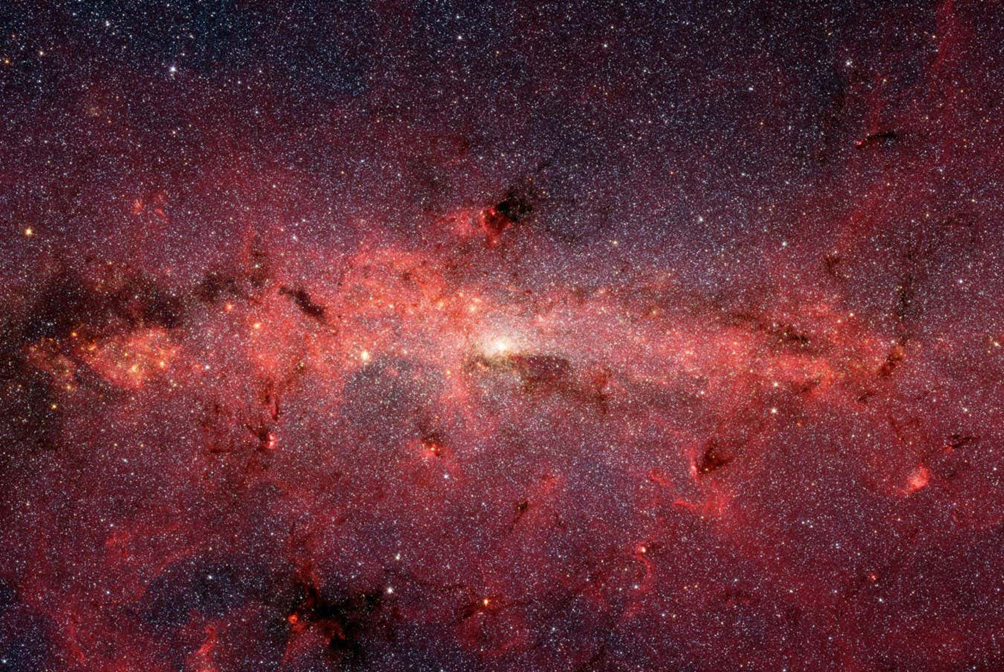
At the centre of the Milky Way, stars look younger than they should. Image courtesy of NASA, Caltech, Susan Stolovy (SSC, Caltech)

Joel Kontinen

Some evolutionists say that immortal stars eat up dark matter to go on living forever, but dark matter is never found. 'Impossible' particle that hit Earth according to some evolutionists may have been dark matter.

“Stars close to the centre of our galaxy may be nearly immortal because they gobble up dark matter for energy.

More than two decades ago, astronomers noticed something odd about the stars near the centre of the Milky Way. First, the light they emit suggests they are younger than expected based on their mass, a problem dubbed the “paradox of youth”. Second, older stars are unusually scarce in this region, an issue called the “conundrum of old age”.”

Source:

Karmela Padavic-Callaghan  2025 Immortal stars could live forever by 'eating' dark matter | New Scientist 21 July 


Sunday, 1 September 2024

Dark matter could be hiding inside strange failed stars


Image courtesy of NASA/JPL-Caltech

Joel Kontinen

Where is dark matter? Is it just a fluke or does it exist.

Now, some researchers think they may have spotted them.   

They say that “dark matter-fuelled brown dwarfs could be lurking at the centres of galaxies. If astronomers manage to spot them, they could teach us about how dark matter interacts with regular matter.

Brown dwarfs are vast balls of gas, between 13 and 72 times as massive as Jupiter but smaller than stars and with too little matter to sustain the nuclear fusion of hydrogen in their cores.

The threshold at which they start fusing hydrogen and become stars.“

But if it does not exist, what would it matter?

Source:

 Alex Wilkins. 2024. Dark matter could be hiding inside strange failed stars | New Scientist 30 August.


Monday, 5 August 2024

Galaxy clusters and "dark matters"


When galaxy clustrse collided, the dark matter (blue) sailed ahead of the normal matter (orange). Image courtesy of W.M. Keck Observatory/Adam Makarenko.

 Joel Kontinen

Astronomers have spotted two colossal clusters of galaxies colliding and shooting out all of their dark matter, which may provide crucial evidence of how dark matter shapes the cosmos.

According to evolutionists, “when two enormous clusters of galaxies collided billions of years ago, their dark matter shot right out of them, leaving behind the gas and stars that made up the remains of the clusters. Understanding this process could help us figure out the nature of dark matter and its effects on the universe

Clashes between galaxy clusters are difficult to observe. We have to catch the collisions at exactly the right time.”

But the creation view has a different approach . It says that everything was made almost instantly ar the beginning of time, and dark matter dark matter does not exist.

Source:

Leah Crane. 2024. Galaxy cluster smash-up lets us observe dark matter on its own | New Scientist 1 August


Monday, 4 December 2023

Largest stream of stars ever found could teach us about dark matter


Image courtecy of William Herschel Telescope/Román et al.

Joel Kontinen

The newfound Giant Coma Stream of stars stretches nearly 1.7 million light years across the cosmos, and it could have holes blasted through it by clumps of dark matter

The black streak is the newly discovered Giant Coma Stream, which is ten times as long as the Milky Way.

Some astromomers have found the biggest stream of stars ever recorded. This tendril of stars is extraordinarily faint, but it and others like it could eventually help us unveil the true nature of secrets of dark matter.

The stream of stars, called the Giant Coma Stream, appears to float unmoored from any particular galaxy in the Coma galaxy cluster, about 300 million light years away from Earth. 

Source: 

Leah Crane 2023. Largest stream of stars ever found could teach us about dark matter | New Scientist

2 December.


Monday, 31 July 2023

No dark matter in galaxy


Joel Kontinen

Cosmic evolution is in trouble.

"Dark matter, which accounts for around 85% of the matter in the universe, seems to be absent from the galaxy NGC 1277, part of the Perseus Cluster of galaxies. ,"

The galaxy is situated some 240 million from Earth and. it is the first galaxy that does not contain dark matter. 

This is a serious blow to big bang cosmology, The big bang has other problems as well, for instance missing antimattercosmic inflation, quantum fluctuation


Source:

Lea,  Robert, 2023, Bizarre 'relic galaxy' is missing a key component of the universe, and scientists are stumped. Live Science, 23 July., 


Friday, 21 April 2023

Evolutionists claim that dark matter has been found


Image courtesy of NASA/ESA/STSci.

Joel Kontinen

 Evolutionists claim that a possible candidate for dark matter has been found. . It is a axion dark matter than weakly massive particles (WIMPs), which have long been the leading candidate for dark matter

 They say that galaxies to be surrounded by haloes of dark matter. But some scientists are not satisfied with the explanation, 

Source: 

Crane,  Leah, 2023. Weird dark matter waves seem to warp the light from distant galaxies .  New Scientist20 April. 


Saturday, 9 July 2022

Dark matter is still missing


Image courtesy of Szczureq, CC BY-SA 3.0.

Joel Kontinen


Where is the dark matter, that is suspected of 85 per cent of the universe materia?


Researchers haven’t found it here and here. They  have used searches by “mass, motivated by different models of dark matter composition and interactions with radiation."


Source:  

Wong, Wei. 2022 Dark matter isn’t hiding here Science,  8. 7. 


Tuesday, 1 March 2022

Dark matter is still missing


 https://www.blogger.com/blog/post/edit/5582253367135077215/5505772486806786921#

Joel Kontinen

Researchers have question about dark matter, that is thought to account for about 85% of the matter in the universe.

Axion dark matter is proposed to consist of an oscillating radiofrequency field coupled to ordinary matter with charge-parity violating interactions. Detection experiments use magnetic fields to try to convert dark matter axions into weak signals of radiofrequency photons. New experimental typologies and advances in precision measurement have dramatically expanded the range of detectability, and evolutionists hope that they may succeed in discovering the axion in the near future.

 All matter was squelched so tightly that it’s hard to guess how this came to be, the big bang has all promlems with cosmic inflation and dark matter is still hiding and dark energy is also missing.


Moreover, antimatter is still the 
big bang’s problem.

However, the standard model of the solar system cannot be active with so big a state of the necessary ingredients missing.  

The big bang has other problems as well, for instance missing antimattercosmic inflation, quantum fluctuation

Source:  

Ali, Mazhar N. 2022. The search for axion dark matter Science,  25 February. 


Tuesday, 3 March 2020

Antimatter Is still The Big Bang’s Problem

The Big Bang should have produced equal amounts of matter and antimatter. Image courtesy of NASA.


Joel Kontinen

Evolutionists think that the big bang is ”the beginning of all things. Space, time, matter and energy bursting into existence from a pinprick of infinite temperature and density. Space racing away from itself faster than the speed of light. Maybe even the making of a multiverse.”

The multiverse is a bogus idea. No scientific data can testify of it.

Antimatter is like matter, but it has the opposite electrical charge and it destroys normal matter when they interact. It thus means the universe shouldn’t exist, CERN physicists conclude. or they will have to do away with the Big Bang Model.

A part form of dark matter and dark energy, antimatter is a problem for the big bang. it is not produced naturally and experiments produce so little of it that they do not give proof of its reality.


Source:

Webb, Richard. 2020. The antimatter factory about to solve the universe's greatest mystery. New Scientist 26 February.
,

Tuesday, 12 March 2019

Big Bang is Losing Its Dark Energy

Gravitational lens mirage around a galaxy, Image courtesy of NASA.


Joel Kontinen

Dark matter is a big problem for the big bang. In 2012, researchers found no evidence of it. The same case was repeated in 2016, when they finally said that dark matter was dead.

The years following have also been troublesome for one of the big bang’s favourites that was supposed to contain 83 per cent of the universe’s mass. Its absence is a great loss for the big bang.

A study in 2018 also showed the there was not a whiff of dark matter.

The big bang has also got other problems, for instance a star is older that the universe.

And dark energy is an illusion, say its an illusion.

Juri Smirnov is vaunting for a different approach:

“One well known attempt to get rid of the need for dark matter is Modified Newtonian Dynamics (MOND), which suggests that Newton’s law of gravity becomes irregular when the gravitational pull is very weak – as is the case in the outer regions of the galaxy. But this theory, although successful in many respects, hasn’t passed the same stringent tests as our standard model of cosmology, which includes dark matter.”

So the problem continues:

One well known attempt to get rid of the need for dark matter is Modified Newtonian Dynamics (MOND), which suggests that Newton’s law of gravity becomes irregular when the gravitational pull is very weak – as is the case in the outer regions of the galaxy. But this theory, although successful in many respects, hasn’t passed the same stringent tests as our standard model of cosmology, which includes dark matter.”

Source:

Smirnov, Juri, 2019. Dark matter may not actually exist – and our alternative theory can be put to the test. The Conversation (31 January).


Saturday, 22 December 2018

Scientist Haven’t Got A Whiff of Dark Matter

Image courtesy of NASA, ESA, M.J. Jee and H. Ford (Johns Hopkins University), public domain.


Joel Kontinen

"Scientists have very good reason to dark matter exists— that there's some unseen stuff tugging on everything with its gravity but that's invisible to our telescopes.

But they don’t know what that dark matter is actually made of. Physicists have some guesses."


"One popular theory of dark matter states that the stuff is made up of particles called ‘weakly interacting massive particles,’ or ‘WIMPS.’ These WIMPs would be heavy particles not described in the Standard Model of physics, though they would likely be supersymmetric partners of Standard Model particles. "

They’ve just missed one. "A single detector in Italy sparkled more in the winter than the summer, hinting that a particular model of dark matter was correct."

However, the Italian detector was probably wrong. And dark energy is dead too.

The big bang has other problems as well, for instance missing antimatter, cosmic inflation, quantum fluctuation

In addition, the earliest galaxies formed too quickly.

He [God] made the stars also,” Genesis tells us. That is by far the best explanation for the existence of the universe.


Source:

Letzter, Rafi, 2018. Physicists Keep Trying — and Failing — to Find Dark Matter in Dark Places.
Live Science (11 December)

Monday, 18 December 2017

Dark Energy: “The Worst Theoretical Prediction in the History of Physics”


Image courtesy of Szczureq, CC BY-SA 3.0.


Joel Kontinen

Dark energy is in big trouble. It was assumed to make up 68.3 percent of the mass of the universe, but it might be a mere illusion.

Live Science calls it the worst theoretical prediction in the history of physics. Physicists don’t know what it is or if it is.

“We're clueless," astrophysicist Neil deGrasse Tyson admits, but he’s unwilling to throw overboard the model that requires it.

Dark matter hasn't fared any better. Experiments can’t find traces of it.

The Big Bang model has been struggling for years. The facts don’t support it.

Early galaxies grew too fast, there’s no clear evidence of cosmic inflation (that, by the way, has been called a totally bonkers idea), and antimatter is still missing.


Source:

Pomeroy, Ross. 2017. The Worst Theoretical Prediction in the History of Physics. Live Science (1 December).

Thursday, 21 September 2017

Older Than the Universe? Methuselah Star HD 140283 Is a Big Problem for the Big Bang

Image courtesy of Digitized Sky Survey (DSS), STScI/AURA, Palomar/Caltech, and UKSTU/AAO, CC BY 4.0.


Joel Kontinen

The Methuselah Star, or more formally known as HD 140283, is an enigma for those who believe the universe began with a big bang some 13.8 billion years ago.

At just 190 light years away, we can measure its luminosity, surface temperature, and composition very precisely; we can also see that it's just beginning to evolve into the subgiant phase and towards becoming a red giant. These pieces of information, combined, allow us to get a well-constrained value for the star's age, and the result is disturbing, to say the least: 14.46 billion years,” astrophysicist Ethan Siegel writes in Forbes magazine.

And that is not its only problem. HD 140283 does not look like it is among the earliest stars:

Yet some of the other properties it displays, like an iron content of 0.4% the Sun's, suggest that it's very old, but not quite among the very oldest stars of all. Although there is an uncertainty on the age of around 800 million years, that still places it uncomfortably early, and hints at a potential conflict between how old the stars are and how old the Universe is.”

In other words, some stars have to be older than HD 140283, if Big Bang cosmology is true.

HD 140283 is a population II star that has relatively little metal. The BB model postulates that these stars were preceded by population III stars, which are assumed to be extremely massive and hot with hardly any metal.

The Big Bang model is built on questionable assumptions, such as the initial quantum fluctuation, cosmic inflation, the elusive dark matter and missing dark energy as well as antimatter that is likewise missing.

In addition, the earliest galaxies formed too quickly.

The Genesis model does not have these problems.

Source:

Siegel, Ethan. 2017. The Greatest Cosmic Puzzle: Astronomers Find Stars That Appear Older Than The Universe. Forbes (7 September).

Friday, 22 July 2016

Is Dark Matter Dead? Two-Year Experiment Didn’t Find A Whiff


Some would see dark matter in this picture. Image courtesy of NASA, N. Benitez (JHU), T. Broadhurst (Racah Institute of Physics/The Hebrew University), H. Ford (JHU), M. Clampin (STScI),G. Hartig (STScI), G. Illingworth (UCO/Lick Observatory), the ACS Science Team and ESA.


Joel Kontinen

This summer has not been good for dark energy, one of the several unknown factors used to prop up the Big Bang. Some astronomers want to get rid of it.

And now it seems that dark matter is faring even worse. A two-year search for this elusive stuff found absolutely nothing.

Astronomers believe that this stuff should “be made up of particles that have some mass and interact weakly with other matter,” as New Scientist puts it; hence the name weakly interacting massive particles, or WIMPs.

But a fancy name does not mean that it really exists. In the standard model, i.e. the Big Bang, dark matter is needed to keep galaxies together, otherwise they might fly apart and the universe would be a mess.

Writing in New Scientist, Jacob Aron says: “What’s unknown is how often these particles bounce off each other – their scattering cross section – and their mass. They should also occasionally bump into normal matter. These rare collisions are what experiments like the Large Underground Xenon detector (LUX) are designed to pick up, in order to determine WIMPs’ properties.”

But they didn’t find “a single whiff”.

Basically, the Big Bang model says that in the beginning there was a quantum fluctuation that occurred for no reason at all, and then the universe suddenly accelerated for no reason, breaking all cosmic speed limits during a brief epoch called inflation.

The BB model should have produced as much antimatter as there is matter and thus blown everything up.

Obviously, it didn’t. Instead, we see a finely tuned universe in which early galaxies grew too fast for the Big Bang.

Everything in our cosmic neighbourhood points to Divine foresight.

God by His sovereign wisdom created a
habitable place for us.

Source:

Aron, Jacob. 2016. Dark matter no-show puts favoured particles on death row. New Scientist (21 July).