Showing posts with label Pluto. Show all posts

Monday, 4 May 2026

Tiny frozen world unexpectedly appears to have an atmosphere


Image courtesy of NAOJ/Ko Arimatsu.

Joel Kontinen

A tiny The object, located in the Kuiper Belt of distant frozen bodies at the edge of the solar system, is formally named (612533) 2002 XV93, after the date of its discovery nearly a quarter of a century ago. It has a diameter of less than 500 kilometres.

he object also belongs to a class of objects known as plutinos because they are in the same stable orbit as Pluto, completing three revolutions around the sun for every two made by Neptune.

It seems that this object, though it is small,  has an atmosphere,   

On 10 January 2024, 2002 XV93 passed in front of a distant star, causing what is called an occultation. Ko Arimatsu at Kyoto University and his colleagues observed this event from three locations in Japan.

The team saw the star gradually fade and recover over about 1.5 seconds near the edge of the shadow.

“These gradual changes are best explained if the star’s light was bent by a very thin atmosphere around 2002 XV93,” says Arimatsu.

The team estimates a surface pressure of about 100 to 200 nanobars, roughly 5 million to 10 million times thinner than Earth’s atmosphere and about 50 to 100 times thinner than Pluto’s tenuous atmosphere.

“You could not breathe it, feel wind from it, or see anything like Earth’s sky,” says Arimatsu. “But it is not negligible scientifically because even such a thin atmosphere can measurably bend starlight, and it tells us that volatile gases are present or being supplied around a very small icy body.”

The team couldn’t determine the composition of the atmosphere directly from the data. Arimatsu suggests methane, nitrogen and carbon monoxide are the most plausible candidates because they are among the few substances volatile enough to become gases at the very low temperatures of the outer solar system.

“This discovery challenges our conventional view of small worlds in the outer solar system,” says Arimatsu. “Until now, clearly detectable atmospheres in the solar system were essentially associated with planets, dwarf planets and some large satellites. 2002 XV93 appears to be one of the smallest solar system bodies yet with a clearly detected atmosphere.”

Souurse:

James Woodford 2026 Tiny frozen world unexpectedly appears to have an atmosphere | New Scientist 4 May


Thursday, 22 May 2025

Venus may be geologically 'alive' after all, reanalysis of 30-year-old NASA data reveals


Image courtesy of NASA/JPL

 Joel Kontinen

Is Venus geologically active? Some articles state that she is not, but new research points that this is not so.

The Solar System is especial, God created the planets with water and made it geologically active, that is seen in Pluto and Mars. 

New research strengthens the case that Venus, long considered a geologically stagnant world, may be more Earth-like in its internal dynamics than once believed.

Scientists have uncovered fresh evidence that Venus is not dead — geologically speaking. Venus and Earth are similar in size and were bombarded by comparable amounts of water billions of years ago. This shared This research has provided a new and important insight into the possible subsurface processes currently shaping the surface of Venus," Gael Cascioli, an assistant research scientist at NASA's Goddard Space Flight Centre in Maryland who co-led the new study, said in a statement.

"We could hardly believe our eyes"

The latest evidence focuses on dozens of large, ring-shaped features on Venus' surface. These features, known as coronae, form when plumes of hot rock rise from deep within the mantle, pushing the crust upward. As the surface cools and collapses, a circular structure is left behind. Cascioli and his team simulated several formation scenarios for these features and compared their results with data from Magellan.

Origin has long fueled one of planetary science's biggest questions: Why did Venus become a hellish, uninhabitable world while Earth flourished into a cradle for life?

The predicted and actual data aligned so closely for some coronae that "we could hardly believe our eyes," Cascioli told Scientific American.

Of the 75 coronae they resolved in the Magellan data, 52 appear to sit above buoyant mantle plumes, according to the new study.

"We can now say there are most likely various and ongoing active processes driving their formation," Anna Gülcher, a planetary scientist at the University of Bern in Switzerland who co-led the new study, said in the statement. "We believe these same processes may have occurred early in Earth's history."

Venus hosts hundreds of such coronae, many of which are found in areas where the planet's crust is particularly thin and heat from below is high. Recent research simulated how different rock types behave under Venus' extreme conditions. The findings suggest that the planet's crust may break off or melt once it reaches around 40 miles (65 kilometers) thick, and in many areas, it is likely even thinner.

"That is surprisingly thin, given conditions on the planet," Justin Filiberto, deputy chief of NASA's Astromaterials Research and Exploration Science Division in Houston, who co-authored the study about Venus' crust, said in a different statement.

Source:

Sharmila Kuthunur 2025 Venus may be geologically 'alive' after all, shocking analysis of 30-year-old NASA data reveals | Live Science 21 May

Tuesday, 16 July 2024

Pluto is a dwarf planet?


Image courtesy of mage courtesy of Image courtesy of NASA/Johns Hopkins University Applied Physics Laboratory/Southwest Research Institute.

Joel Kontinen

What should scientist do with Pluto, which was dropped as a planet in 2006 by the International Astronomical Union (IAU)?

 A new formula for defining a planet still keeps Pluto out of the club of planets.

Pluto is not as old as some scientists think.  

Source:

 Jonathan O’Callaghan,  2024. A new formula for defining a planet still keeps Pluto out of the club | New Scientist 16 July


Saturday, 4 November 2023

Supervolcano on Pluto


Image courtesy of NASA,JPL 

Joel Kontinen 

Some scientists suppose that Pluto has a supervolcano that may erupt in our days. they say that it is the size of size of Yellowstone.  They also sat that research has shown that  it may become alive.  

“The newly discovered volcano, Kiladze Caldera, was originally pegged as a crater via images captured by NASA's New Horizons mission. After taking a second look at data from New Horizons, scientists now think Kiladze Caldera has erupted multiple times over its history, spewing around "a thousand kilometers of cryo-lava" — or enough to almost cover the city of Los Angeles —”

But some time ago, scientist thought that pluto cannot harbour volcanoes, as its age is 4. . 5 billion years is too old for it. thus, the solar system cannot be that age, 

Source; 

 Briley Lewis. 2023, Pluto may have an ice-spewing 'supervolcano' the size of Yellowstone, New Horizons data reveals. Live Science 3 November.  


Tuesday, 15 February 2022

Why Pluto looks young


Image courtesy of NASA/JHUAPL/SwRI


Joel Kontinen


When NASA’s New Horizons spacecraft flew past Pluto in July 2015, scientists were expecting to see a dwarf planet that looked old and its largest moon Charon to be full of impact craters.

However, what they saw blew their socks off, as NASA researcher Cathy Olkin put it in a New Horizons press conference.


Pluto looked 
far too young to fit into a 4.6 billion year old universe, and so did Charon.
Subsequent images sent by New Horizons showed 
more evidence for youth.

Scientist have proposed two interpretations of a cold Pluto.  ”The first which involves Pluto forming over millions of years by the slow accretion of cold objects. This version of Pluto eventually would have coalesced enough material that radiative heating from the inside would melt the subsurface ocean. The other hypothesis involves a “warm” or “hot” Pluto, in which Pluto formed over a shorter time period in violent collisions that heated its interior, formed the ocean, and eventually cooled the planet into the majority ice ball we know today. "

Anyhow, Pluto is just cold but its geography tells it is young. 

Source:

Wendel, JoAnna, 2022, Clues to Pluto’s History Lie in Its Faults Phys. org. 1 February.


Thursday, 25 March 2021

'Oumuamua is a foreign visitor, from an alien Pluto style planet


Image credit: M. Kornmesser/ESO, fair use doctrine. 


Joel Kontinen 


Ever since it floated into our system, the interstellar visitor Oumuamua has intrigued and perplexed scientists. In 2017, 'Oumuamua was heralded as a spaceship sent by aliens. 

This was the opinion that Harvard astrophysicist Avi Loeb had. This was the opinion that Harvard astrophysicist Avi Loeb had. However, a new study says that 'Oumuamua's origin is explained by the fact that “two Arizona State University researchers argue that a nitrogen iceberg fits the data at least as well as a hydrogen iceberg: Such an iceberg could have become a wide disk as its surface slowly evaporated during its travels through the galaxy, just like a bar of soap flattens over the course of many showers. And,like hydrogen, evaporating nitrogen wouldn't be visible to telescopes””.

Source:

 Letzter,  Rafi, 2021.  Interstellar visitor came from an 'alien Pluto,' new study suggests  Live Science 19 March. 

Monday, 25 January 2021

Hazes Are Popular In The Solar System


Image courtesy of  NASA/JHUAPL/SWRI/SPL

Joel Kontinen

A new study finds that the haze shrouding Pluto might be made up of ice crystals possessing cyanide hearts. This means that not only the Earth has hazes – they are popular in the solar system.

How could planets that are supposed in the 4,6 billion year old support hazes?

This is in believe that different shades of the planets regard in different ways to hazes, After they found on hazes on Pluto, researches thought they the same all over the solar system. However, Pluto has an atmosphere that is very cold, So they had they had to to think  differently,


Source:

Choi, Charles Q. 2021. Pluto's haze made up of ice crystals with cyanide hearts.  Live Science 23 January.


Thursday, 27 September 2018

The Created Solar System

Image courtesy of WP, planets2013-fa.svg. cc by-sa 3.0.


Joel Kontinen

In the European creation conference, Dr. William Worraker talked about the Created Solar System. In a planet by planet view, he also talked about exoplanets, that are confounding planet stories.

In addition, he talked about the D. Russell Humphrey ’s sayings on planets. For instance, his views on Mercury turned out to be right. And Humprey’s had been right on Mars, Uranus, Neptune and Pluto.

They conform to the 6,000 year- old- timetable for the solar system.

Worraker also took up the little moons secret, that is, some are geologically active. He also took up Pluto’s amazing young landscape.

Wednesday, 12 September 2018

Is Pluto a Planet?

Image courtesy of mage courtesy of Image courtesy of NASA/Johns Hopkins University Applied Physics Laboratory/Southwest Research Institute.


Joel Kontinen


Pluto lost its planetary status in 2006. At that time, several trans-Neptunian objects beat it for size.

At the time, a planet was defined by 1) It must orbit the sun, 2) it must be massive enough that its gravity pulls it more or less into a spherical shape, and 3) it must clear the neighbourhood around its orbit.

Now, in the journal Icarus, Michael Metzger takes the line that “the third criterion did not match historical usage by scientists and should be revoked.”

Needless to say, Pluto is looking young.

And, as Merzger says. Pluto is "more dynamic and alive than Mars.”

Source:

Bartels, Meghan. 2018 Is Pluto a Planet? New Paper Adds to Decade-Long Debate. Space.com. (September 10).

Thursday, 29 March 2018

Pluto’s Youthful Looks Continue to Puzzle Scientists

Pluto looks young. Image courtesy of NASA/JHUAPL/SwRI.


Joel Kontinen

When NASA’s New Horizons spacecraft flew past Pluto in July 2015, scientists were expecting to see a dwarf planet that looked old and its largest moon Charon to be full of impact craters.

However, what they saw blew their socks off, as NASA researcher Cathy Olkin put it in a New Horizons press conference.

Pluto looked far too young to fit into a 4.6 billion year old universe, and so did Charon.

Subsequent images sent by New Horizons showed more evidence for youth.

Pluto is too small to generate heat and too far away from the Sun to benefit from solar energy, but it is geologically active.

Believers in deep time have had a hard time figuring out why Pluto looks youthful. The latest explanation features flowing nitrogen ice that could be “acting as its fountain of youth.”

Pluto is not the only dwarf planet that looks younger than expected.

Ceres is another great puzzle for long-agers.

Jupiter’s moons Io and Europa also look too young.

The obvious solution: They are.

Source:

Crane, Leah. 2018. Gooey nitrogen ice may make Pluto’s crater-free heart look young. New Scientist (27 March).

Friday, 18 March 2016

Pluto’s Atmosphere Challenges Faith in Billions of Years

Pluto has managed to keep its atmosphere. Image courtesy of NASA/JHUAPL/SwRI.


Joel Kontinen


NASA’s New Horizons spacecraft keeps on sending new images from its flypast of Pluto. Researchers were surprised at what they saw in July when they got to see the first pictures: Pluto was anything but cold and old.

The dwarf planet is strikingly active and has glaciers and ice volcanoes.

New Scientist acknowledges that Pluto presents a big dilemma for the old age of the solar system:

“One of the biggest surprises of the mission was how closely Pluto holds its atmosphere.

‘Pluto’s really tiny, so it doesn’t have the mass to hold on to an atmosphere over the age of the solar system – at least we wouldn’t have thought that,’ says Randy Gladstone of the Southwest Research Institute in San Antonio, Texas.
”

The magazine also touched on a related mystery:

”Remote observations showed that the atmosphere was dominated by nitrogen, and astronomers expected to find a tail of nitrogen streaming off the dwarf planet like a comet. But in reality, the chief material Pluto is losing to space is methane, and much less of it than predicted.”

Pluto is not the odd one out. Many other planets and moons look far too young for a 4.5 billion-year-old solar system, for instance Ceres, Jupiter’s moons Io and Europa, as well as Saturn’s moons Enceladus, Mimas and Titan.

Just what we would expect from Genesis.

Source:

Grossman, Lisa. 2016. Pluto gives up its icy secrets as New Horizons data pours in. New Scientist (17 March).


Tuesday, 10 November 2015

Ice Volcanoes on Pluto: Big Surprise for Scientists


Is this a volcano? Image courtesy of NASA/Johns Hopkins University Applied Physics Laboratory/Southwest Research Institute.


Joel Kontinen

How does a cold world that is assumed to be billions of years old not look its age?

NASA’s New Horizons spacecraft has introduced us to a Pluto we never knew. Far from being a dead world, the dwarf planet has shown signs of vigour and youth.

The latest surprise is the assumed presence of two cryovolcanoes. An article in the journal Science introduces them in this way:

“Volcanoes built out of frozen ice that once oozed molten ice from the inside of the dwarf planet. The discovery points to an internal heat source that, at some point in Pluto’s past, drove the melting of interior reservoirs of volatile ices, such as nitrogen and methane, that then erupted at the surface. It also suggests that the cryovolcanoes were a way for Pluto to periodically rejuvenate surface supplies of these volatile ices, which sublimate into the thin atmosphere and are eventually lost to space.”

The description obviously includes some long-age assumptions, which tends to be the norm in reports like these.

How long would an internal heat source not only survive in a frozen region of space but also warm Pluto’s surface?

The logical answer is a lot less than 4.5 billion years.

Source:

Hand, Eric. 2015. Ice volcanoes spotted on Pluto, suggest internal heat source. Science (9 November).


Wednesday, 30 September 2015

Pluto Is “Strikingly Active,” New Images Show


Snakeskin Pluto? Image courtesy of NASA/JHUAPL/SWRI.


Joel Kontinen

Our solar system frequently causes bewilderment for the current understanding of its age. Above all, planets and moons tend to be geologically active.

The latest images of Pluto are in keeping with this trend:

“So far, Pluto has turned out to be strikingly active for an icy world 5 billion kilometres from the Sun. Nitrogen glaciers swirl around the base of towering mountains, which are held up by the sheer rigidity of ice frozen at about −235 °C, 38 degrees above absolute zero.”

Previous images sent by NASA’s New Horizons spacecraft also indicated that Pluto looked surprisingly young and active.

Source:

Witze, Alexandra. 2015. 'Snakeskin' Pluto revealed in planetary close-up. Nature news (24 September).

Thursday, 30 July 2015

More Evidence for Pluto’s Youth


Image courtesy of NASA/Johns Hopkins University Applied Physics Laboratory/Southwest Research Institute.


Joel Kontinen


How can a planet that is assumed to be 4.5 billion years old still be geologically active? This is the question confronting NASA scientists after the recent Pluto flypast by the New Horizons spacecraft:

“Close-up images of the edges of nearby fractured plains called Sputnik Planum reveal nitrogen glaciers that reach into a rugged, cratered terrain to the north. At Pluto's frigid temperatures — about −235 °C, 38 degrees above absolute zero — water ice is too brittle to flow. But nitrogen ice could, if it is roughly a kilometre thick and heated by radioactive decay leaking from Pluto's interior, says William McKinnon, a New Horizons team member and a planetary scientist at Washington University in St. Louis, Missouri.”

The obvious answer is that Pluto is much younger. And it’s not the only dwarf planet that looks younger than expected.

Source:

Witze, Alexandra. 2015. Nitrogen glaciers flow on Pluto. Nature News (24 July).


Thursday, 16 July 2015

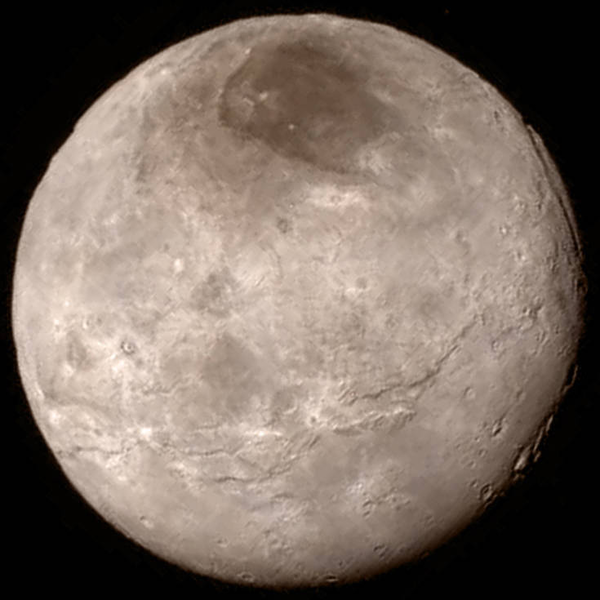
New Horizons Fly-Past: Pluto Looks Young And So Does Its Moon Charon


(Top) Charon. The black area is now known as Mordor. (Bottom) A closer look at Pluto. Images courtesy of NASA/Johns Hopkins University Applied Physics Laboratory/Southwest Research Institute)


Joel Kontinen

NASA scientists were expecting to see a dwarf planet that looked old and its largest moon Charon to be full of impact craters. What they saw in the images sent by the New Horizons spacecraft “blew our socks off,” as Deputy Project Scientist Cathy Olkin put it in a New Horizons press conference.

Both worlds looked too young and are probably geologically active.

New Horizons flew past Pluto on Tuesday the 14th of July, coming to within 12,553 kilometres (7,800 miles) of this amazing world, “revealing towering ice mountains rising from its surprisingly youthful face,” as an article on Space.com described it.

Planetary scientist John Spencer acknowledged that Pluto with its ice mountains rising to 3,500 metres (11,000 miles) and its lack of impact craters looked surprisingly young:

"The most striking thing about this image is, we have not yet found a single impact crater on this region. We're just eyeballing it, but we think that it probably has to be less than 100 million years old."

That is a tiny fraction of the solar system’s assumed 4.5 billion years, so they have a hard nut to crack. Resurfacing seems to be the most popular explanation at this stage.

There is a better explanation: Pluto is much younger than assumed.

Many other planets and moons in our solar system also look young, for instance Mercury, Venus, Jupiter’s moons Io and Europa, as well as Saturn’s moons Titan, Mimas and Enceladus.

Who said Genesis was not relevant? It could at least help us to keep our socks on.

Source:

Malik, Tariq. 2015. Pluto Unveiled: NASA Photos Reveal Ice Mountains and Active Moon. Space.com (15 July).

PS. I wrote about Pluto yesterday in my Finnish blog.