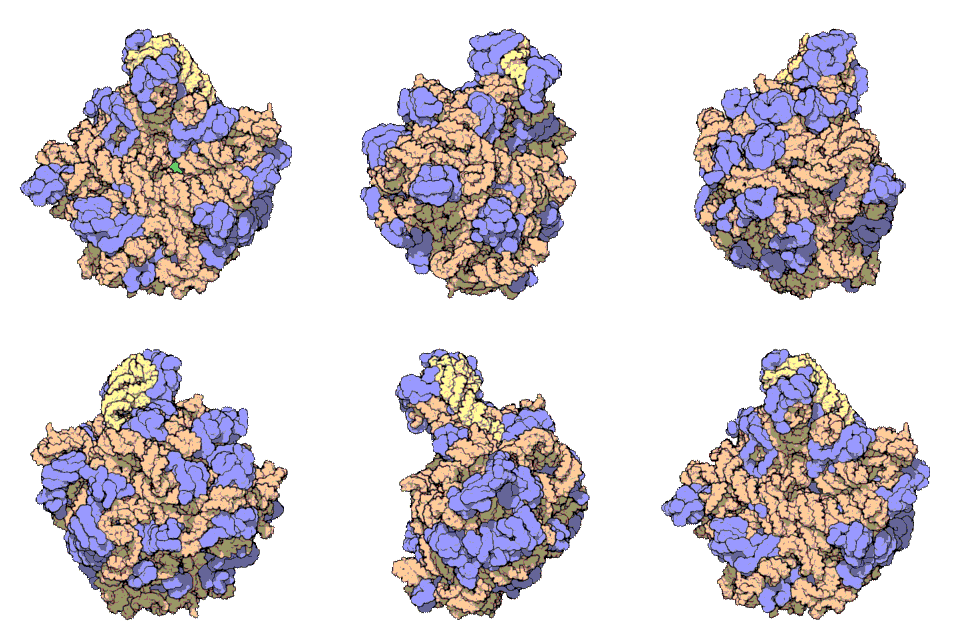
Doesn't look like junk. Image courtesy of Richard Wheeler, Creative Commons (CC BY-SA 3.0).
Joel Kontinen
For years, evolutionists believed that most of our genome was useless junk, leftovers from millions of years of evolution.
The ENCODE project, published in 2010, put an end to this, as researchers found that much of non-coding DNA had a function.
However, some diehard Darwinians refused to believe the facts.
Many recent studies have found functions for this “junk” (You can see examples here, here, here and here.)
Recently, University of Houston professor Dan Graur attempted to bring back the junk. In a paper published in the journal Genome Biology and Evolution he takes issue with ENCODE and subsequent discoveries, claiming that at least 75 per cent of our genome is rubbish.
According to New Scientist,
“The heart of the issue is how you define functional. ENCODE defined DNA as such if it showed any ‘biochemical activity’, for instance, if it was copied into RNA. But Graur doesn’t think a bit of activity like this is enough to prove DNA has a meaningful use. Instead, he argues that a sequence can only be described as functional if it has evolved to do something useful, and if a mutation disrupting it would have a harmful effect.”
In other words, it is the evolutionary tail wagging the dog. In the real world, our genome continues to be amazing and wonderful.
Source:
Le Page, Michael. 2017. At least 75 per cent of our DNA really is useless junk after all. New Scientist (17 July).
Showing posts with label ENCODE. Show all posts
Sunday, 23 July 2017
Sunday, 7 February 2016
New Nail in the Junk DNA Coffin: “Junk” Prevents Breast Cancer
Even in “simple” organisms, non-coding RNA is anything but simple. Image courtesy of David S. Goodsell, RCSB Protein Data Bank, public domain.
Joel Kontinen
Richard Dawkins and some other ardent evolutionists have used junk DNA as an argument for undirected evolution. They have called it the ultimate parasite and vestigial and some still dislike the idea that it could actually have a function.
However, in 2010, the Encyclopedia of DNA Elements (ENCODE) project disclosed that most of what was thought to be junk or useless leftovers from Darwinian evolution actually had beneficial consequences for us. In other words, junk DNA or, as it usually defined, “the strand of DNA that does not carry the information necessary to make proteins,” is anything but junk.
We keep on getting to know of more ways of how this assumed evolutionary junk is actually very necessary for us and for other living creatures as well.
The latest instalment comes from cancer research. A study conducted in the Universities of Bath and Cambridge, UK, found that this assumed junk “plays a role in suppressing cancer.”
A press released issued by the University of Bath states:
“In recent years it has become apparent that a lot of this non-coding DNA is actually transcribed into non-coding RNA…
Now a team of scientists from Bath, Cambridge and the USA has identified a piece of non-coding RNA – transcribed from a stretch of DNA that doesn’t code for a protein – that stops cells turning cancerous.
The researchers hope their discovery, published in Nature Communications, will help develop new treatments for cancer.”
Cancer can be caused by switches that determine which cells should replicate and which should die off. Sometimes the switch gets stuck in the on position, leading to a spread of cancer.
Dr Lovorka Stojic, who works at the Cancer Research UK Cambridge Institute, discovered that a strand of non-coding RNA known as GNG12-AS1 “prevents the growth switch getting stuck and suppresses metastasis. The specific genomic region where this non-coding RNA is located often gets damaged in breast cancer patients – this control is removed and the cancer cells spread.”
The role of non-coding RNA is more complicated than this. To keep cells healthy, it employs two mechanisms: 1) “regulating the levels of DIRAS3, one of its neighbouring genes that is involved in cell replication” and 2) “suppressing a network of genes that prepare cells to change their shape and prepare for metastasis.”
To sum up: non-coding RNA does not sound at all like junk. It prevents cancer from spreading.
It appears to be a very intelligent solution.
Source:
University of Bath. 2016. 'Junk' DNA plays role in preventing breast cancer. (February).
Tunnisteet:
ENCODE,
evolution,
intelligent design,
junk DNA,
junk RNA
Subscribe to:
Posts (Atom)