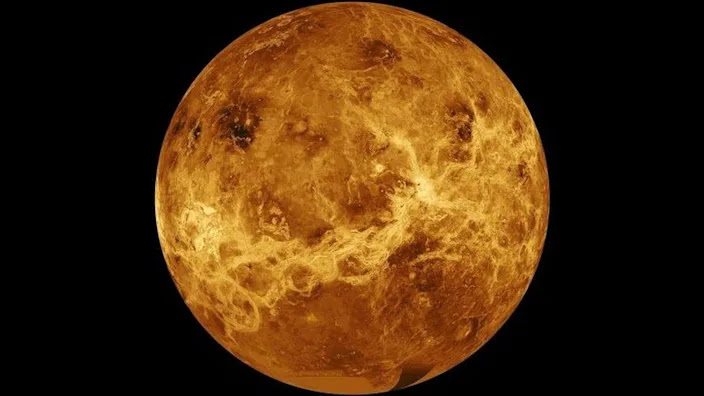
Showing posts with label Venus. Show all posts

Thursday, 3 September 2026

Venus may have had a moon for nearly "2 billion years"


Image courtesy of NASA imiages/Shutterstock

Joel Kontinen

Darwinian fables are interesting, as there is no proof of them being true. As with Venus having a moon many billions of years ago.    

Venus has no moon, but a modelling study suggests it probably did have one for "nearly 2 billion years" – before the planet ate it. Understanding this could help us learn about Venus’s previous habitability.

Many large objects probably hit Venus in the early solar system, which could have formed a moon, similar to the giant impact that is thought to have formed Earth’s moon. “There’s a very good chance that Venus did have a moon-forming impact,” says Stephen Kane at the University of California, Riverside..

 Kane and his colleagues modelled what would have happened if Venus did have a moon, and found that in almost all scenarios, it would have been consumed by the planet,.

Venus rotates quite strangely with respect to the sun, completing a rotation once every 243 days, compared with its orbit of 225 days. This is possibly a result of its thick atmosphere slowing its spin.

In contrast, Earth’s much faster spin transfers angular momentum to our moon, meaning it is moving away a few centimetres each year. For Venus, the opposite would have been true. “The moon is transferring angular momentum inward instead of outward,” says Kane. “It causes the moon’s orbit to catastrophically collapse.”

The researchers found that at the upper limit of their models, a moon about half the mass of our own could have survived around Venus for 1.7 billion years. At twice the mass of our moon, it would have survived just 30 million years, because of the stronger tidal effect.

Paul Byrne at Washington University in St Louis, Missouri, says the model is interesting but hard to prove. “It’s exceedingly hard to test this idea because there is basically nothing left behind.” This is because Venus’s surface has been repeatedly resurfaced by volcanism, he says.

In Genesis, God created the Earth and its moon without any evolution.

Source:

Jonathan O’Callaghan 2026 Venus may have had a moon for nearly 2 billion years | New Scientist 2 September 


Monday, 22 September 2025

Venus has lava tubes, and they're weird


Image courtesy of JSC/NASA

Joel Kontinen

Could massive underground tunnels exist on Venus?  Yes, according to recent studies.

It has been suggested that lava tubes - underground tunnels carved out by molten rock - might be on Venus, and now we have direct evidence that this is the case.

We now know for sure that massive underground tunnels, carved by lava, exist on Venus – and they are surprisingly wide and different from those on any other planet.

It is uncontroversial that lava tubes – underground tunnels carved out by molten rock – exist on Earth, the moon and Mars. Smaller planets with low gravity tend to form more cavernous tubes, in part because the rock walls are less likely to collapse with weaker gravity. On the moon, for instance, the tubes are so large that scientists have proposed using them as live-in shelters for astronauts, providing shielding from the harsh solar wind.

 Source:

Alex Wilkins 2025 Venus has lava tubes, and they're weird | New Scientist 22 September 


Saturday, 21 June 2025

Can space rock around Venus collide with Earth?


Image courtesy of ESA

Joel Kontinen

An 'invisible threat': Swarm of hidden 'city killer' asteroids around Venus could one day collide with Earth, simulations show

Could a killer asteroid one day collide with Earth? According to a new study, it could. This bring to mind the killer asteroids mentioned in the book of Revelation: “The third angel sounded his trumpet, and a great star, blazing like a torch, fell from the sky on a third of the rivers and on the springs of water. The name of the star is Wormwood. A third of the waters turned bitter, and many people died from the waters that had become bitter.” Rev. 8:10-11.

Researchers think there are more hidden space rocks lurking around Venus. All but one of the planet's known co-orbitals have eccentricities greater than 0.38, meaning they have very elongated trajectories around the planet. This suggests there is an observational bias, likely because objects with lower eccentricities are probably being obscured by the sun's glare.

Co-orbitals can also move around relative to Venus, which can change their chances of colliding with Earth in the future. Previous research has shown that this likely happens to the space rocks once roughly every 12,000 years — known as a co-orbital cycle.

We know that Earth is not 12,000 years old so there is a problem which this.  

Source:

Harry Baker 2025 An 'invisible threat': Swarm of hidden 'city killer' asteroids around Venus could one day collide with Earth, simulations show | Live Science June 4


Thursday, 22 May 2025

Venus may be geologically 'alive' after all, reanalysis of 30-year-old NASA data reveals


Image courtesy of NASA/JPL

 Joel Kontinen

Is Venus geologically active? Some articles state that she is not, but new research points that this is not so.

The Solar System is especial, God created the planets with water and made it geologically active, that is seen in Pluto and Mars. 

New research strengthens the case that Venus, long considered a geologically stagnant world, may be more Earth-like in its internal dynamics than once believed.

Scientists have uncovered fresh evidence that Venus is not dead — geologically speaking. Venus and Earth are similar in size and were bombarded by comparable amounts of water billions of years ago. This shared This research has provided a new and important insight into the possible subsurface processes currently shaping the surface of Venus," Gael Cascioli, an assistant research scientist at NASA's Goddard Space Flight Centre in Maryland who co-led the new study, said in a statement.

"We could hardly believe our eyes"

The latest evidence focuses on dozens of large, ring-shaped features on Venus' surface. These features, known as coronae, form when plumes of hot rock rise from deep within the mantle, pushing the crust upward. As the surface cools and collapses, a circular structure is left behind. Cascioli and his team simulated several formation scenarios for these features and compared their results with data from Magellan.

Origin has long fueled one of planetary science's biggest questions: Why did Venus become a hellish, uninhabitable world while Earth flourished into a cradle for life?

The predicted and actual data aligned so closely for some coronae that "we could hardly believe our eyes," Cascioli told Scientific American.

Of the 75 coronae they resolved in the Magellan data, 52 appear to sit above buoyant mantle plumes, according to the new study.

"We can now say there are most likely various and ongoing active processes driving their formation," Anna Gülcher, a planetary scientist at the University of Bern in Switzerland who co-led the new study, said in the statement. "We believe these same processes may have occurred early in Earth's history."

Venus hosts hundreds of such coronae, many of which are found in areas where the planet's crust is particularly thin and heat from below is high. Recent research simulated how different rock types behave under Venus' extreme conditions. The findings suggest that the planet's crust may break off or melt once it reaches around 40 miles (65 kilometers) thick, and in many areas, it is likely even thinner.

"That is surprisingly thin, given conditions on the planet," Justin Filiberto, deputy chief of NASA's Astromaterials Research and Exploration Science Division in Houston, who co-authored the study about Venus' crust, said in a different statement.

Source:

Sharmila Kuthunur 2025 Venus may be geologically 'alive' after all, shocking analysis of 30-year-old NASA data reveals | Live Science 21 May

Saturday, 12 October 2024

The water world with (potentially) living oceans


Image courtesy of NASA, ESA, CSA, Joseph Olmsted (STScI)

Will this exoplanet have life?

K2-18 b is a large world located about 120 light-years from the sun. It inhabits the Goldilocks zone around its star, meaning at liquid water (and potentially life) could exist there.

A recent analysis with the James Webb Space Telescope (JWST) supports the idea that the exoplanet may have its own liquid water ocean — and that the ocean may be home to living creatures. But probably not little green men.

In the study, JWST detected possible traces of dimethyl sulfide, a chemical known to be emitted only by phytoplankton on Earth, in the exoplanet's atmosphere.

But scientist have been adamant that such things happened on  Venus, which will not support life.

Source:

Brandon Specktor 2024 32 alien planets that really exist (msn.com)  2 October.

Wednesday, 18 September 2024

Venus could have be rocked by thousands of quakes every year


 Image courtesy of NASA/JPL

Joel Kontinen

Venus is so close to the sun, so that could be the centre of earthquakes each year, It could have more than 17,000 venusquakes a year.

Far away planets like Pluto and their moons have lava and vents and to things like cold freezes. But if God made the planets in one instant, this could be normal.

There could be thousands of quakes on Venus each year, and researchers might be able to detect them using balloons floating high above the planet’s surface.

Recent observations of volcanic features on Venus, such as vents and lava streams, have shown the planet is much more geologically active than we thought. This makes it more likely that there is also seismic activity, or quakes, on Venus.

By Alex Wilkins 2024. Venus could be rocked by thousands of quakes every year | New Scientist 18 September 


Thursday, 9 May 2024

Molecule responsible for robbing Venus of its water may finally have been identified


Venus, as seen by NASA’s Magellan spacecraft.  Image courtesy of NASA/JPL.

Joel Kontinen 

“Scientists have identified a water-loss mechanism on Venus that could explain how the once water-rich world became completely parched.”

A “molecule high in Venus' atmosphere, water escaped Venus at double the rate previously estimated. As faster water loss means less time is needed to boil away the planet's water reservoir, scientists say Venus may have harbored oceans — and potentially habitable conditions — for longer than previously thought before the drying process began.”

According to some evolutionists, "this would provide more time for possible life to arise," study co-author Eryn Cangi, a research scientist at the Laboratory for Atmospheric and Space Physics (LASP) ,”

 “Prior studies suggest that both Venus and Earth likely received similar amounts of water early in their history, mostly from water vapor-spewing volcanoes and icy comets that frequently bombarded the worlds.”

But only God can give life to a planet,  

Source;

Sharmila Kuthunur 2024. Molecule responsible for robbing Venus of its water may finally have been identified (msn.com) 8 May


Saturday, 6 January 2024

A renegade moon may have flipped Venus’s spin


Image courtesy of NASA/JPL-Caltech.  

Joel Kontinen

Some astronomers think that Venus rotates in the opposite direction to the other planets in the solar system, and astronomers aren’t sure why – but it may have been caused by the drag of an ancient moon in a backwards orbit. It is called Theia.  

Now, this calls for an ancient moon that may or not   to do the trick. But we do not know if the planet or moon existed,

According to evolutionists, the early solar system was a chaotic place, with rocks hurtling around at extraordinary speeds. Valeri Makarov at the United States Naval Observatory in Washington DC and Alexey Goldin at Teza Techno. logies in Chicago performed a series of’examples


Source:

Leah Crane. 2024. A renegade moon may have flipped Venus’s spin | New Scientist 4 January 


Thursday, 11 May 2023

Earth should not exist


Image courtesy of  BlenderTimer / Pixabay. 

Joel Kontinen 

Earth and the other inner solar planets —Mercury, Venus, and Mars —“should be a chaotic messaa nd models have suggested that they should not exist.

 “Planets constantly exert a mutual gravitational pull on each other – and these little tugs constantly make minor adjustments to the planets' orbits. The outer planets, which are much larger, are more resistant to little tugs and so maintain comparatively stable orbits.” 

They should have should have crashed into each other by now. However, that hasn't happened. 

Source: 

 Demming , Anna. 2023,  Scientists discover secret 'symmetries' that protect Earth from the chaos of space.  Live Science 9 May. 


Friday, 15 October 2021

No live on Venus - that might have been dry for ages .


Image courtesy of NASJPL.

Joel Kontinen

 A few weeks ago, the  science papers were shouting there’s live on Venus, However, now it seems that it is not – and has been not habitable.

For the past decades, Venus has been seen as a potential abode for life. For instance, models  based on evolution have said that Venus had bog oceans that they thought wuuld have kerpt live going for millions of years.

For live to endure, it has to float - floating in the clouds about 30 miles (50 kilometers) up, where temperatures and pressures are similar to what we enjoy at sea level here on Earth. 


However, the new study, which was published online Wednesday (Oct. 13) in the journal Nature, scientists led by Martin Turbet, a postdoctoral researcher at the Geneva Astronomical Observatory in Switzerland, simulated the climate of ancient Venus using a new model. And they came up with very different results. 


If the scientist are right, Venus has always been warm and dry, as it is today.


This has a message also for exoplanets: The ones  that orbit near the inner edge of the conventional habitable zone, where liquid water can exist on a planet’s surface, might not actually be habitable," the authors write.


Source:        


Wall,
Mike, 2021.  Life on Venus may never have been possible, Live Science 14 October,

Saturday, 5 June 2021

NASA announced two Venus trips


Image courtesy of NASA.


Joel Kontinen


Nasa has announced that it is sending two new missions to Venus to examine the planet's atmosphere and geological features.


The first instance is called Davinci+ (Deep Atmosphere Venus Investigation of Noble gases, Chemistry, and Imaging) mission will measure the planet's atmosphere to gain insight into how it formed and evolved. It will also aim to determine whether Venus ever had an ocean.

 NASA has termed the second mission, Veritas (Venus Emissivity, Radio Science, InSAR, , Topography, and Spectroscopy), will map the planet's surface to understand its geological history and investigate how it developed so differently than Earth.


Paul Rincon, Science Editor, BBC News website says” It may have harboured oceans for a billion years of its history, and there is even a region of the planet's thick atmosphere where microbial life could survive, floating among the clouds.” .

 So, the question seems to be  When did Venus grow to its present status, so different from Earth?

 Dropping the millions of years might do the trick. Maybe Venus looked like it does today when God created it, .

Source:  

Venus: Nasa announces two new missions BBC News 4.6, 


Thursday, 24 September 2020

No Hints Of Life On Venus, Sceptics Say


Image courtesy of NASA. 


Joel Kontinen

Last week, the blogosphere and some journals were full of the story that life was found on  the upper layers of  Venus that only living creatures on Earth could produce, .”At the centre of this debate is the molecule phosphine, or PH3, which is made from one phosphorus atom bonded to three hydrogen atoms. Phosphine is a nasty and poisonous gas for many creatures, including humans, but is produced by bacteria living in rotting sewage and swamps where oxygen is lacking, as well as in the intestines of some animals

Here on Earth, phosphine is associated with living organisms, but Venus is quite literally an alien planet, and scientists don't yet fully understand its many complex details.”

Now, some scientist doubt the results they have achieved. And some doubt the result they have made. In any case, the Venus has life is in not in the clouds but in deep water.

Source:

Mann, Adam. 2020. 'Grand claims' of life on Venus lack evidence, skeptics say. .Live Science.23 September


Tuesday, 15 September 2020

Life on Venus?


Image courtesy of NASA - Jet Propulsion Laboratory, public domain.


Joel Kontinen

Astronomers have detected gas in the clouds of Venus.

 “That gas is phosphine - a molecule made up of one phosphorus atom and three hydrogen atoms.”

Now, here on earth “phosphine is associated with life, with microbes living in the guts of animals like penguins, or in oxygen-poor environments such as swamps.”

 But there are no penguins or even factories on Venus, so why does the gas be there, 50 kilometres above the surface. The scientist can be sure.

 We can be sceptical, as most scientist are. There are too many hurdles for life to have emerged, from the clouds that hang over our sister planet, and life has to be created it does not just appear in places that are inhospitable to life.


Source:

Amos,Jonathan, 2020. Is there life floating in the clouds of Venus? .BBC.News. 14 September.


Sunday, 11 August 2019

The Earth Is A Great Place To Stay, Compared To Venus

Imagine courtesy of NASA, Public Domain.


Joel Kontinen

Contrasted with the planets in our solar system, the Earth is a great place to stay.

While we might plan to go to Mars, Venus is Earth’s sister planet. only that its temperature is 370 degrees (700 degrees Fahrenheit), with clouds entire made up “by carbon dioxide and chokingly thick with an atmospheric pressure at the surface 90 carbon dioxide and chokingly thick with an atmospheric pressure at the surface 90 times that of Earth.”

As an article in Space, com tells us, the times that of the Sun was normal in the beginning , but “as the sun aged, that habitable zone steadily moved outward. And as Venus approached the inner edge of that zone, things started to go haywire."

This would also happened to Earth, with the snowball Earth still an unsolved mystery.

" As the temperatures rose on Venus, the oceans began to evaporate, dumping a lot of water vapor into the atmosphere. This water vapor was very good at trapping heat, which further increased the surface temperatures, which caused the oceans to evaporate even more, which caused even more water vapor to get in the atmosphere, which trapped even more heat, and so on and so on as things spiralled out of control.”

This is what the article also claim will happen to Earth – 100 million years from today. However, the faint young sun paradox mentioned above would have resulted in a snowball Earth, killing all life.

Source

Sutter, Paul. How Venus Turned into Hell, and How the Earth Is Next Spece.com. (8.8.).

Friday, 22 December 2017

Young Venus? Venus Might Be Geologically Active


Image courtesy of NASA.


Joel Kontinen

An increasing number of observations don’t support the standard age of the solar system, i.e, 4.5 billion years. Instead, they seem to indicate a much younger date.

The list of “bad dates” is anything but short. It includes Venus, Saturn, Pluto, Saturn’s moon Enceladus and Jupiter’s moon Europa, among others.

A recent report posted on Phys.org gives more details about Venus:

“For planetary scientists, Venus's geologic heartbeat flat-lined around 700 million years ago. Now, a global view of some well-known deformation features on Venus's surface may indicate it's capable of crustal motion, and that motion might even be happening today, scientists reported Monday at the 2017 American Geophysical Union Fall Meeting in New Orleans.”

Research presented by Paul Byrne, a planetary geologist at North Carolina State University, and colleagues suggests “signs of deformation within a few of the lava plains.”

At least some of the jostling and moving and rotating could have taken place very recently,” he says.

While they did not find plate tectonics, they certainly discovered signs of unexpected youth.

Source:

Rehm, Jeremy. 2017. Lava-filled blocks on Venus may indicate geological activity. Phys.org (18 December).

Sunday, 9 July 2017

Stephen Hawking: Earth Could Become a Hothouse Planet Like Venus

Earth’s future according to Stephen Hawking? Image courtesy of NASA.


Joel Kontinen

Stephen Hawking likes being in the news. But often his speciality is news that could hardly be described as good or even pleasant.

He has kept on drumming that our time on planet Earth is about to end and we should search for a new planet.

Prof. Hawking has also warned of big bad aliens on at least two occasions.

And he sees artificial intelligence (AI) as a major threat to mankind.

Now, he has joined the global warning bandwagon. He warns that if we “don't curb irreversible climate change,” Earth could turn into a hot planet like Venus.

However, even Michael Mann, a climate scientist at the Pennsylvania State University, does not agree with Hawking.

Mann sent Live Science an email, saying:

"Hawking is taking some rhetorical license here Earth is further away from the sun than Venus and likely cannot experience a runaway greenhouse effect in the same sense as Venus — i.e. a literal boiling away of the oceans.”

Speculations nearly always get noticed, regardless of how little facts (if any) there are to give substance to them.

Source:

Ghose, Tia. 2017. Stephen Hawking: Earth Could Turn Into Hothouse Planet Like Venus. Live Science (5 July).


Friday, 13 May 2016

Earth’s Twin Is Still Missing, Despite Discovery of Over 1, 200 New Exoplanets

An artist’s impression of Kepler in action. Image courtesy of NASA.


Joel Kontinen

NASA has announced that its Kepler space observatory has found 1,284 new exoplanets, including roughly 550 Earth-sized ones. Of these, nine may orbit their star in the habitable zone or at a distance at which water is expected to be in liquid form but not too hot to evaporate.

Commenting on the discovery, Andrew Norton, Professor of Astrophysics Education at The Open University, writes:

“The latest announcement is an impressive piece of work, and the discovery of so many new exoplanets is stunning. It is increasingly clear that planets orbit stars as a rule – not an exception. While astronomers still haven’t found an exact twin of the Earth, the rapid pace of discoveries is surely a sign that it is just a matter of time until they do.”

But what if Earth really is unique, as some researchers have suggested, and there’s no place like home elsewhere in the universe?

The wildest speculations have put the number of Earth-like planets at over 100 billion billion, but that is based more on wishful thinking than on facts.

We should keep in mind that Venus and Mars orbit the Sun in the habitable zone, and just look how habitable they are.

Moreover, the goldilocks zone around some stars may be smaller than we assumed, and some habitable planets might not be habitable after all.

Research suggests that even Kepler-438 B, once touted as the most Earth-like exoplanet, might not be habitable.

Source:

Norton, Andrew. 2016. More than 1,000 new exoplanets discovered – but still no Earth twin. The Conversation (11 May).


Thursday, 10 March 2016

Sniffing for Life on Mars: ExoMars Trace Gas Orbiter Goes to Search for Martian Life

An artist’s impression of the ExoMars Trace Gas Orbiter. Image courtesy of ATG medialab/ESA.


Joel Kontinen

The evolutionary worldview has life popping up in all places where it could potentially be possible. Next week, the European Space Agency (ESA) is sending the ExoMars Trace Gas Orbiter (TGO) towards the red planet on a Russian Proton rocket from Baikonur in Kazakhstan.

The orbiter carries a lander named Schiaparelli. The agency aims to find out whether there could be any kind of life on Mars.

The TGO is packed with very sensitive instruments. An article in New Scientist explains how they will be used:

“Previous sightings of methane by NASA’s Curiosity rover, along with other orbiters and telescopes, have proved confusing, as the gas seems to be more short-lived than expected. To get to the bottom of this mystery, TGO is equipped with two suites of spectrometers designed to sniff out the planet’s atmospheric gases down to tiny amounts, a camera to photograph potential ground sources, and neutron detector to map water ice down to a metre below the surface.”

New Scientist goes on to say:

“Those tiny amounts – the trace gases that give TGO its name – will crack the planet’s methane secrets. If the methane is accompanied by a whiff of sulphur dioxide, and traced to geological features on the surface, active volcanism is the most likely cause. Methane laced with higher levels of the isotope carbon-12, which is preferred by life on Earth, would point to a biological origin – though we would still be far from confirming that there is life on Mars.”

Evolutionists seem to have a big dilemma. On Earth, life appears in extreme conditions, so they assume it should also exist on other worlds.

However, although Mars orbits the Sun in the habitable zone just like our planet and Venus, it does not appear to be very habitable. It lacks the fine tuning Earth has – for instance, a big moon at the right distance – for keeping it habitable.

Earth seems to be unique.

And we should not forget that life only comes from life. It requires hi-tech design and genetic information. Without these, no gases can ever produce life.

It has to be created, as the book of Genesis says.

Source:

Aron, Jacob. 2016. ExoMars probe set to sniff out signs of life on the Red Planet New Scientist (7 March).