Showing posts with label Big bang. Show all posts

Wednesday, 12 August 2026

Three black holes discovered in a young galaxy for the first time


Image courtesy of Hannah Übler

Joel Kontinen

This study throws a shadow on the big bang as massive black holes could not rise so soon after the big bang,

“This system is in the very, very early universe,” says Dougal Dobie at the University of Sydney, who wasn’t involved in the discovery. “So, how have we ended up in a situation where these three supermassive black holes have formed and come close together in only a billion years or so since the big bang?”

An analysis revealed two separate regions of high-velocity hydrogen gas in the centre of the galaxy, indicating two so-called accreting black holes that were separated by about 620 light years – a hop, skip and a jump in cosmic terms.

An accreting black hole is a super dense area of space, so compressed that light can’t escape, but that continuously drags in surrounding gas, dust and even stars. Our own galaxy, the Milky Way, has just one massive black hole at the core of its spiral arms.

Source:

James Woodford 2026 Three black holes discovered in a young galaxy for the first time | New Scientist12 August


Wednesday, 6 May 2026

300-year-old experiment could become world's best dark matter detector


Image courtesy of ESA/Euclid/Euclid Consortium/NASA, image processing by M. Schirmer (MPIA, Heidelberg)

Joel Kontinen

 Is dark matter real? Some scientist are saying that it is not and others are no so sure of it.  Many scientists believe that the universe was created by Big Bang.

In 1773, British scientist Henry Cavendish set up a simple experiment aimed at uncovering the nature of electromagnetism. It involved measuring the electric potential at the surface of two nested metal shells to discern how charged particles affect each other within them.

Now, Peter Graham at Stanford University in California and his colleagues say that reviving Cavendish’s experiment could help reveal an even more mysterious feature of our cosmos – the particles that make up dark matter. Dark matter makes up more of our universe than ordinary matter.

A centuries-old experiment could help accelerate the search for new and exotic particles, including those that make up dark matter.

Source:

Karmela Padavic-Callaghan 2026 300-year-old experiment could become world's best dark matter detector | New Scientist 4 May 


Monday, 3 November 2025

Evolutionary scientists may have found a surprisingly nearby cluster of primordial stars


Evolutionists think that the very first generation of stars, called Population III stars, are mostly expected to be too distant to see directly – but astronomers may have found some for the very first time. Image courtesy of NOIRLab/NSF/AURA/J. da Silva/Spaceengine/M. Zamani

Joel Kontinen

We may have finally seen the first generation of stars. Astronomers have been looking for these primordial behemoths, called Population III stars, for decades. Now they have found what may be the most promising candidate yet.

Population III stars are expected to be very different from modern, or Population I, stars, says the evolutionists. They would have formed from pristine hydrogen and helium gas, before heavier elements were distributed throughout the universe by supernovae and powerful stellar winds. They are also expected to be bigger and hotter than modern stars.

That is exactly what Eli Visbal at the University of Toledo in Ohio and his colleagues found when they did a detailed analysis of previous James Webb Space Telescope (JWST) observations of a distant galaxy called LAP1-B. It is at a redshift – a number that astronomers use to measure distance – of 6.6, which means we see LAP1-B as it was just about 800 million years after the big bang. That is so far away the only reason we could spot it at all is because its light was magnified by a nearer galaxy cluster in a process called gravitational lensing.

“There should be tons and tons of these all over the observable universe, but we can only look sort of under the lamppost of this cluster that’s magnifying the light,” says Visbal. When he and his team calculated how many Population III star clusters we should find at this redshift, they found that it should be about one – which is what they saw..

Another point in LAP1-B’s favour is it only seems to have enough stars to make up a few thousand times the mass of the sun. Other candidates for Population III galaxies tend to have much higher stellar masses, inconsistent with simulations of how clusters of Population III stars form. “This is the best candidate we have so far,” says Visbal.

Most Population III stars are expected to have lived and died between about 100 and 400 million years after the big bang, after which there would have been enough heavy elements in the cosmos to form stars that are more similar to the ones we see today. “This object ticks many of the boxes, but I am a bit sceptical because it’s late in the game for these stars to be around, and there may be alternatives that might do the job as well,” says Ralf Klessen at Heidelberg University in Germany. “It would be super interesting to see a Population III star cluster, but statistically this would certainly be an outlier.”

 “[For these to be Population III stars], it must be an extremely lucky combination of different factors, each of them extremely rare on its own, and much more rare when they have to happen together.” It will take deeper observations and more detailed simulations to find out for sure if LAP1-B marks the first time we have seen these strange stars.

This is important because understanding Population III stars is crucial to figuring out how and when the first heavy elements formed. “They can tell us how the chemistry of the universe evolved from just hydrogen and helium to all the cool chemistry and life and everything that we have in the universe today,” says Visbal. Population III stars were the first building blocks of the complexity that surrounds us now.

Source:

Leah Crane 2025 We may have found a surprisingly nearby cluster of primordial stars | New Scientist 3 November 


Monday, 13 October 2025

Galaxies fling out matter much more violently than we thought


Black holes are extremely powerful matter distributors. Image courtesy of NASA Image Collection/Alamy

Joel Kontinen

From where does dark matter come? Even the ordinary cosmic matter is a mystery for some cosmologists. Now they have a solution, black holes.

Unexpectedly violent black holes may have caused the mystery of the missing cosmic matter.

Most of the universe is filled with mysterious dark matter, but even ordinary matter has stumped cosmologists. Some of this normal matter – made up of particles called baryons – seemed to have been missing for a long time. Researchers recently worked out where it was hiding, and now Boryana Hadzhiyska at the University of California, Berkeley and her colleagues have learned how black holes may have shaped its distribution and kept it hidden.

 Source:

Karmela Padavic-Callaghan 2025 Galaxies fling out matter much more violently than we thought | New Scientist 6 October

Monday, 6 October 2025

Rogue planet gains 6 billion tonnes per second in record growth spurt


Artist’s impression of Cha 1107-7626, a rogue planet about 620 light years away. Image courtesy of ESO/L. Calçada/M. Kornmesser

Joel Kontinen

A free-floating planet has been seen devouring astonishing amounts of matter, hinting that stars and planets are more alike than we thought.

A ravenous rogue planet has been caught eating 6 billion tonnes of gas and dust per second. This behaviour blurs the line between planets and stars, suggesting both can form in similar ways.

Rogue planets, free-floating balls of gas unattached to any parent star, appear to be extremely common, and may even exceed the number of stars we see in the galaxy. But astronomers still don’t understand whether they form like planets in orbit around a star and are then banished to wander the galaxy alone, or if they can form like stars by themselves.

Source:

Alex Wilkins 2025 Rogue planet gains 6 billion tonnes per second in record growth spurt | New Scientist 2 October 


Friday, 3 October 2025

Exceptional star is the most pristine object known in the universe


The Large Magellanic Cloud, a satellite galaxy of the Milky Way, where the near-pristine star SDSS J0715-7334 was spotted. Image courtesy of Josh Lake/NASA/ESA   

Joel Kontinen

A star found in the Large Magellanic Cloud is remarkably unpolluted by heavier elements, suggesting it is descended from the universe’s earliest stars.

A relatively nearby star that appears to lack almost any of the heavy elements produced by supernovae could be a direct descendant of the very first stars that formed in the universe.

That is, according to evolution that states that God was not needed, and the planets just appeared from nowhere.

Astronomers think the first stars were made up of only the hydrogen and helium that were floating around after the big bang. It was only when these stars ran out of fuel and exploded in a supernova that elements heavier than helium were spread around. The leftover, element-rich gas from these initial explosions then formed the next generation of stars, with the cycle repeating to eventually produce all the elements we see in the stars and planets today.

 Source:

Alex Wilkins 2025 Exceptional star is the most pristine object known in the universe | New Scientist 3 October 

Saturday, 6 September 2025

Possible galaxy spotted by JWST could be the earliest we've ever seen


The possible galaxy in an image from the James Webb Space Telescope. Image courtesy of NASA, ESA, CSA, CEERS, G. Gandolfin the.ir view

Joel Kontinen

A possible galaxy named Capotauro may have formed within 90 million years of the big bang – but astronomers can’t be sure that’s what it is.

Would this be the first galaxy, evolutionists keep on asking. In their view, it appeared sometime after the big bang some 13.8 million years ago.

Astronomers might have discovered a galaxy that formed extremely early in the universe, nearly 200 million years before its closest competitor, but they caution there could be other explanations too.

Giovanni Gandolfi at the University of Padua in Italy and his colleagues probed data from the James Webb Space Telescope (JWST) to look for distant objects that formed early in our universe’s 13.8-billion-year history.

The further away a galaxy is from Earth, the longer its light will have taken to reach us and the more it will be shifted to the red end of the spectrum by the expansion of space, a property known as redshift.

Source: 

Jonathan O’Callaghan 2025 Possible galaxy spotted by JWST could be the earliest we've ever seen | New Scientist 5 September

Friday, 15 August 2025

Oldest fast radio burst ever seen sheds light on early star formation


Image courtesy of Science Photo Library/Alamys

Joel Kontinen

Radio bursts are a phenomenon that surprise us. We don’t know the cause.

A bright flash of radio waves from 3 billion years after the big bang is illuminating parts of the universe that astronomers can’t normally see. Magnetars, which are a kind of neutron star, may be the source of fast radio bursts.

A strange flash of light from near the beginning of the universe could help astronomers map difficult-to-see gas in between galaxies, like a flashbulb in a dark room.

Fast radio bursts (FRBs) are extremely short but powerful blasts of radio-frequency light that have puzzled astronomers since they were first spotted in 2007. A leading theory is that they are produced by extremely magnetic neutron stars, called magnetars. But because we only know of a few thousand examples in the whole universe, with most coming from galaxies that are relatively close to the Milky Way, there is much we still don’t understand about them.

Source:

Alex Wilkins 2025 Oldest fast radio burst ever seen sheds light on early star formation | New Scientist 15 August 


Wednesday, 30 July 2025

Is gravity a new type of force that arises from cosmic entropy?


Image courtesy of Vadim Sadovski/Shutterstock

Joel Kontnen

Some scientist say that a new type of force comes from cosmic entropy. But it isn’t true. The thought is based on the Big Bang.

“Decades ago, a renegade physicist suggested that gravity isn't so much a force as just a byproduct of the universe's tendency to get more disordered. Now this idea might finally be testable

There are some things in life that just sort of happen. Desks get covered in dust and scraps of paper. Clothes get dirty and the laundry basket fills up. Weeds slowly creep across an untended flowerbed. Things, in other words, tend to get messier unless we step in and tidy up.

Now here’s an idea: what if gravity itself works like that? It would certainly be a different way of looking at the force that keeps our feet on the ground and conducts the twirling dance of the planets. Most physicists see it as one of the four forces of nature, about as fundamental as you can get. But back in 2010, physicist Erik Verlinde suggested that it wasn’t a force at all, but simply a byproduct of the universe’s natural inclination to become more disordered. “For me, gravity doesn’t exist,” he told reporters at the time.”

Source:

Jon Cartwright 2025 Is gravity a new type of force that arises from cosmic entropy? | New Scientist 29 July 


Monday, 21 July 2025

Immortal stars could live forever by 'eating' dark matter


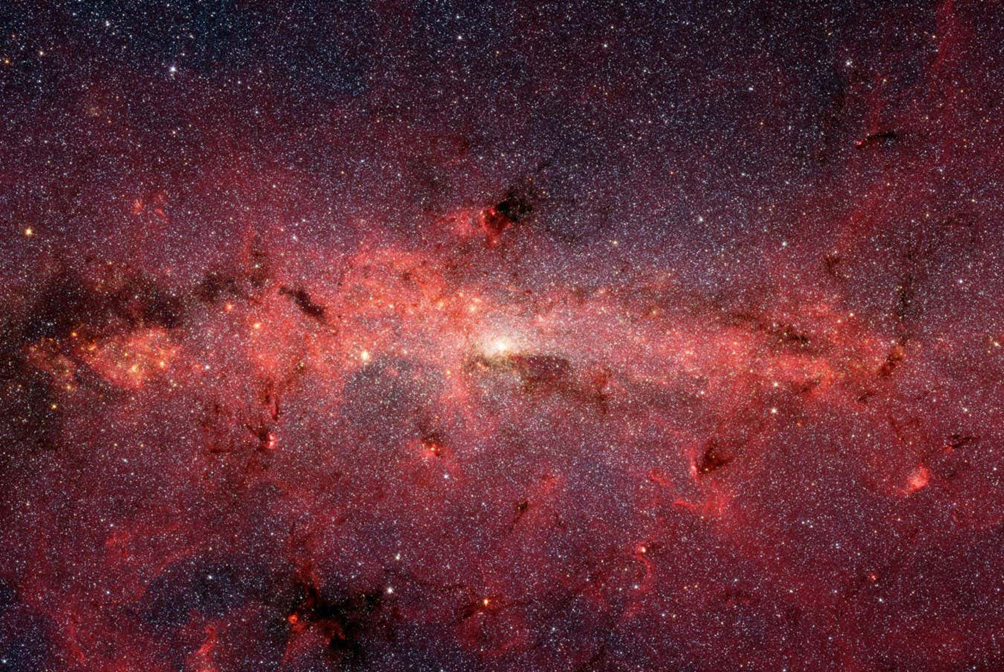
At the centre of the Milky Way, stars look younger than they should. Image courtesy of NASA, Caltech, Susan Stolovy (SSC, Caltech)

Joel Kontinen

Some evolutionists say that immortal stars eat up dark matter to go on living forever, but dark matter is never found. 'Impossible' particle that hit Earth according to some evolutionists may have been dark matter.

“Stars close to the centre of our galaxy may be nearly immortal because they gobble up dark matter for energy.

More than two decades ago, astronomers noticed something odd about the stars near the centre of the Milky Way. First, the light they emit suggests they are younger than expected based on their mass, a problem dubbed the “paradox of youth”. Second, older stars are unusually scarce in this region, an issue called the “conundrum of old age”.”

Source:

Karmela Padavic-Callaghan  2025 Immortal stars could live forever by 'eating' dark matter | New Scientist 21 July 


Sunday, 20 July 2025

Laws of quantum physics may rule out a universe that came before ours


Image courtesy of Vadim Sadovski/Shutterstock

Joel Kontinen

Instead of the Big Bang, some physicists have suggested tha t our universe may have come from a big bounce following another universe contracting – but quantum theory could rule this out.

Did our solar system had a beginning that was before  God created it at the beginning, Some evolutionists think so, but others are not so sure.

Could our universe be expanding and shrinking back into a tiny point, reliving a kind of big bang over and over again? Probably not, according to a mathematical analysis that argues that the laws of physic forbid such a cyclic universe.

A key moment in the life of a cyclic universe is the big bounce, an alternative to the big bang as the beginning of the known universe. The big bang starts with a singularity – matter and energy packed into a point so dense that gravity becomes strong enough to elude the laws of physics as we understand them – followed by an endless outwards expansion. But if the universe began with a big bounce, we could look beyond what we think of as the beginning and see another universe contracting to form an incredibly dense point, but not necessarily a singularity, before bouncing back out into the expanding universe we live in today.

Source:

Karmela Padavic-Callaghan 2025 Laws of quantum physics may rule out a universe that came before ours | New Scientist 18 July   

Monday, 19 May 2025

Strange 'sticky' dark matter could be lurking in a distant galaxy

Galaxy SDSS J0946+1006 acts as a gravitational lens, helping astronomers see the signs of dark matter

Image courtesy of NASA/ESA/R. T. Treu/University of California/SLACS

Joel Kontinen

Dark matter is thought to only interact through gravity, which is why it is so difficult to spot, but now evidence is growing for a type of dark matter that can also stick to itself.

Evolutionists and those who believe in Big Bang may be welcoming this study with expectation for a non-theistic view of the world.

An unusually dense galaxy could be the first clear evidence for the existence of an unconventional form of “sticky” dark matter, altering our understanding of this mysterious cosmic substance.

In the standard picture of cosmology, so-called cold dark matter only interacts with the rest of the universe through gravity, which causes it to bunch together in invisible, puffy clouds around galaxies. We can map these clouds indirectly by measuring the gravitational pull they exert.

Source:

Alex Wilkins 2025 Strange 'sticky' dark matter could be lurking in a distant galaxy | New Scientist 19 May

Sunday, 6 April 2025

The universe's water is billions of years older than scientists thought — and may be nearly as old as the Big Bang itself


Image courtesy of NASA

Joel Kontinen

When did life appear in the world? Scientists say that the appearance of water might say something about it.

“A new study suggests that water first appeared in the universe just a couple hundred million years after the Big Bang — meaning life could have evolved billions of years earlier than previously thought.”

Now some evolutionists say that humans came from ape like creatures and were moulded by Darwinian processes to become human They said that life may have appeared some 100 to 200 million years earlier that they  thought.

Water may have emerged in the universe far earlier than scientists thought — and it could mean that the life could be billions of years older too, new research suggests.

“Water is one of the most essential ingredients for life as we know it. But exactly when water first appeared has been a question of scientific interest for decades.”

Source:

Joanna Thompson 2025 The universe's water is billions of years older than scientists thought — and may be nearly as old as the Big Bang itself | Live Science 11 March


Thursday, 27 March 2025

An early hint of cosmic dawn has been seen in a distant galaxy


Image courtesy of SA/Webb, NASA & CSA, JADES Collaboration, J. Witstok, P. Jakobsen, M. Zamani

Joel Kontinen

How can galaxies form? A study has them forming some 239 million years ago after the Big Bang.

A galaxy found at the dawn of the universe appears to be the earliest known evidence of cosmic reionisation, the period when the universe was lit up for the first time.

Following the big bang, the early universe was filled with hot hydrogen and helium gas that scattered photons, making the cosmos somewhat opaque. Over the next few hundred million years, as stars began to shine, their light ionised the hydrogen and helium, enabling photons to flow freely and making the universe transparent, though the exact timing of this is uncertain.

Joris Witstok at the University of Copenhagen in Denmark and his colleagues used the James Webb Space Telescope (JWST) to study a galaxy called JADES-GS-z13-1-LA. The galaxy is seen 330 million years after the big bang, making it one of the earliest known galaxies in the universe.

Ultraviolet light from the galaxy suggests it was surrounded by a bubble about 200,000 light years across, which might be the result of its starlight interacting with the surrounding cosmic hydrogen. Seeing evidence for this so early in the universe is “beyond even our wildest expectations,” says Witstok.

Michele Trenti at the University of Melbourne agrees that the observations are consistent with the process of cosmic reionisation. “It’s both surprising and exciting,” says Trenti. “I would not expect the ultraviolet light emitted from this galaxy to reach JWST. The cold neutral hydrogen gas that we were expecting would have surrounded the galaxy should have blocked the photons. We are witnessing the onset of reionisation.”

The nature of the small galaxy itself is not entirely clear; it might be shining brightly because of a population of massive hot and young stars, or a powerful central black hole. “This would be the earliest known evidence for a supermassive black hole at the centre of a galaxy,” says Trenti.

While astronomers have seen other, later galaxies with a similar bubble around them, JADES-GS-z13-1-LA is the earliest known example. “It’s a benchmark,” says Richard Ellis at University College London. “It tells us that this galaxy must have been around for quite a while, and pushes that little bit further back to the beginning of when galaxies first emerged from darkness.”

JWST was able to unearth the secrets of this galaxy only by staring at it for a relatively long time, about 19 hours. Witstok is hopeful we might soon see other early evidence for cosmic reionisation. “We have a few more candidates,” he says. “We might find it even further [back in time], or maybe this is the most extreme that it gets.”

The millions of years in this study are not based on science but on  evolutionary thinking,

Source:

Jonathan O’Callaghan 2025 An early hint of cosmic dawn has been seen in a distant galaxy | New Scientist 26 March 


Tuesday, 18 March 2025

Giant Milky Way-like galaxy formed unusually soon after the big bang


Image courtesy of Weichen Wang

Joel Kontinen

“The Big Wheel, discovered using the James Webb Space Telescope, formed just 2 billion years after the Big Bang - surprisingly early for a spiral galaxy of a similar size to our Milky Way.”

 According to Big Bang cosmology, no galaxy should be this young, but research shows that this is incorrect and not true.  The Big Bang according to Darwinists cannot produce a galaxy so fast. The millions of years that are placed there, but this is an incorrect testimony of evolution that cannot happen in our time.  

“A newly-discovered spiral galaxy, dubbed the Big Wheel, formed just 2 billion years after the big bang – far earlier, considering its size, than astronomers thought possible.

Themiya Nanayakkara, at Swinburne University of Technology in Melbourne, Australia, says the discovery was an accident. He and his colleagues were looking for quasars, energetic regions at the heart of some galaxies, with the James Webb Space Telescope in November 2022 when a “large spiral galaxy popped up”.

Source:  

James Woodford 2025 Big Wheel: Giant Milky Way-like galaxy formed unusually soon after the big bang | New Scientist 17 March


Friday, 17 January 2025

Astronomers baffled by bizarre 'zombie star' that shouldn't exist


Image courtesy of  James Josephides

Joel Kontinen

A newly discovered neutron star is behaving so strangely that it may alter our understanding of the dense remains left behind when stellar objects die

Some astronomers are  worried because they see a neutron star that should not be living.  It is a mystery that is brought about the Big Bang story . But who do they support a theory that is one the way out?

A collapsed star around 13,000 light years away is so unusual that the researchers who have discovered it say it shouldn’t exist.

It was first detected in January 2024 by the ASKAP radio telescope in Western Australia and is likely to be a kind of pulsar that has never been seen before.

When supermassive stars reach the end of their lives and explode in a supernova, the remnants form a super-dense object called a neutron star. Pulsars are neutron stars that spin rapidly, emitting radio waves from their magnetic poles as they rotate. Most pulsars spin at speeds of more than one revolution per second and we receive a pulse at

the same frequency, each time a radio beam points towards us.

But in recent years, astronomers have begun to find compact objects that emit pulses of radio waves at a much slower rate. This has baffled scientists, who had thought that radio wave flashes should cease when the rotation slows to more than a minute for each spin.

These slow-spinning objects are known as long-period radio transients. Last year, a team led by Manisha Caleb at the University of Sydney, Australia, announced the discovery of a transient with a period of 54 minutes.

God made the universe at the beginning, it is full of wonders that people do not understand.

Source: 

James Woodford 2025 Astronomers baffled by bizarre 'zombie star' that shouldn't exist | New Scientist 15 January 


Friday, 27 December 2024

Could 2025 be the year we finally start to understand dark energy?


A map of 31 million galaxies created by the Dark Energy Spectroscopic Instrument will be released next year, and could shed light on the origins of this mysterious force. 

Image courtesy of SI Collaboration/KPNO/NOIRL​ab

Joel Kontinen

Dark energy is one the secrets of the universe.  According to evolution, it holds most of the material there but we do not know that  it exists.  Some scientists say that it does not.

Dark energy is one of big bangs problem.

We think dark energy makes up most of the universe, but we have no idea what it actually is. In 2025, the Dark Energy Spectroscopic Instrument (DESI) in Arizona may offer clues, particularly in relation to how this strange force has changed as the universe matured.

“Either there is some new form of dark energy that we don’t know about yet or this could be a paradigm shift, maybe [the data will show] that there is something we don’t understand about space and time.”

Source:

Karmela Padavic-Callaghan 2024 Could 2025 be the year we finally start to understand dark energy? | New Scientist 23 December 


Wednesday, 4 December 2024

James Webb Space Telescope smashes its own record to find the earliest galaxies that ever existed


 Image courtesy  of Esa/Webb, NASA & CSA, O. Nayak, M. Meixner.

 Joel Kontinen

A new surview has just announced that the James Webb Space Telescope  “has spotted five galaxy candidates dating to just 200 million years after the Big Bang”.

According to evolutionists, the “13.6 billion light-years away and just 200 million years after the Big Bang, are five galaxy candidates are the earliest ever detected”.

There is a problem with dating methods, since according to evolution, space events  are always counted in millions of years.  

Source:

Ben Turner 2024 James Webb Space Telescope smashes its own record to find the earliest galaxies that ever existed | Live Science 3 December


Saturday, 7 September 2024

Scientists might be on track to revealing new facets of physics.


An illustration of two merging galaxies setting spacetime ringing with gravitational waves. (Image courtesy of NASA/CXC/A.Hobart) 

Joel Kontinen

Research shows that there is something cool about the Big Bang.

"Theorists and experimentalists have speculated nanohertz gravitational waves originated from a known transition that happened very soon after the Big Bang — a change that generated the masses of all the known fundamental particles," Andrew Fowlie, an assistant professor at Xi'an Jiaotong-Liverpool University, said in a statement. "However, our work uncovers serious problems with that otherwise appealing origin."

Some scientists think that the first life in the universe could have formed in seconds after the Big Bang.

Many evolution believing scientists believe a "first-order phase transition occurred at the very beginning of time, triggering the launch of gravitational waves, or ripples in space-time. Those waves, experts think, could therefore be used to determine conditions present during the first epoch of rapid inflation in our universe, or maybe even the conditions present before the Big Bang”.

Big Bang has many problems, such as this one. Only God can create universe.

 Source:

Robert Lea 2024 Gravitational waves hint at a 'supercool' secret about the Big Bang | Live Science 24 August.


Saturday, 3 August 2024

When were the first stars formed?


Image courtesy of NSF's NOIRLab

Joel Kontinen

The first generation of stars changed the course of cosmic history. Now, thanks to the James Webb Space Telescope, we have a real chance of spotting them.

When were  the first stars created? According to the true history the universe, they were created when the sun, the Earth and everything was formed.

But the Big Bang story has a different view, it states that “between 200 and 400 million years after the big bang, the energy pouring from them ripped apart the atoms of gas that had been cooling the universe, reheating them in a process called re-ionisation Then, as they burned and died, they created a cocktail of chemical elements. they say that it took that primed the universe to generate galaxes, planets and, ultimately, life itself”.

Astronomers have speculated that .the first stars were “huge and ferociously bright, they are thought to have been up to 300 ties as massive as our sun and 10 times hotter”.

This seems to be a miracle and it might also be a false alarm.  

Source:

Stuart Clark, 2024, First stars: The search for the stars that changed the history of the universe | New Scientist. 29 July