Showing posts with label NASA. Show all posts

Monday, 27 April 2026

10,000 new planets found hidden in NASA telescope data


An artist’s impression of a star with two planets transiting across it. Image courtesy of NASA, ESA, and G. Bacon (STScI).

Joel Kontinen

How many planets are there? A recent survey says that there might be some 10, 000. This is according to a NASA research. But we do now know how many can harbour life, as only God can give  it.

Astronomers have identified more than 10,000 candidate planets in data from a NASA telescope, the most ever found in a single life.

NASA’s Transiting Exoplanet Survey Satellite (TESS) was launched in 2018. It is tasked with looking at stars across the sky for planets in orbit, known as exoplanets. It identifies these exoplanets by looking for brief dips in the brightness of the light reaching Earth from each star – a sign that an exoplanet orbiting the star has passed in front of it.

Source:

 Jonathan O’Callaghan 2026 10,000 new planets found hidden in NASA telescope data | New Scientist 27 April 


Monday, 14 October 2024

NASA set to launch Europa probe to search for signs of habitability


Image courtesy of NASA/JPL-Caltech

Joel Kontinen

A 6000-kilogram spacecraft will embark on a six-year journey to Jupiter to explore whether its icy moon Europa has the conditions to support life.

Could NASA a find life on Europa?

According to some evolutionists, “The largest spacecraft ever created NASA for an interplanetary mission will launch today to determine whether Europa, one of Jupiter’s moons, has an environment that could support life.

The Europa Clipper mission is expected to launch at 12:06 pm local time aboard a SpaceX Falcon Heavy rocket from NASA’s Kennedy Space Center in Florida, having been delayed by several days as a precaution because of Hurricane Milton.

Europa is the smallest of the so-called Galilean moons, which are Jupiter’s four largest moons. It is slightly smaller than our own moon and is of particular interest to scientists. Previous observations have indicated that Europa has a vast subsurface ocean, and this mission is designed to explore the possibility that life could reside within it.

With its solar arrays deployed that Europa has a vast subsurface ocean, and this mission is designed to explore the possibility that life could reside within it.

With its solar arrays deployed, Europa Clipper spans more than 30 metres and weighs 3241 kilograms without propellant, which will add a further 2750 kilograms.

The spacecraft will take around six years to travel 2.9 billion kilometres to its rendezvous with Jupiter in April 2030, using the gravity. of Mars and then Earth to boost its speed.

 Some believers in evolution have supposed that Europa is teeming with life, but only God can bring it about.

Source:

 Matthew Sparkes 2024 NASA set to launch Europa Clipper probe to search for signs of habitability | New Scientist 14 October.


Friday, 20 September 2024

Bacteria on the space station are evolving for life in space


Image courtesy of Dima Zel/Shutterstock

Joel Kontinen

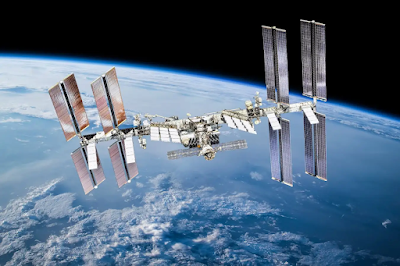
Can bacteria on board the International Space Station evolve new traits?

This is according to Darwinist believe that microbes can change into life giving things.  But only God can give life.

Bacteria on board the International Space Station (ISS) have evolved new traits in order to survive in low Earth orbit, and some show signs of increased virulence.

Microbes from Earth have made their way to the station via human hosts and the regular delivery of equipment and supplies.

NASA has been monitoring the ISS’s microbiome for a decade to understand how microbes survive in space conditions and what threat they might pose to astronauts.

Source:

James Woodford 2024. Bacteria on the space station are evolving for life in space | New Scientist 20 September. 


Wednesday, 3 January 2024

In 2024 the Hera mission will revisit the asteroid punched by NASA


Image courtesy of ESA/Science Officeh

Joel Kontinen

NASA’s DART mission slammed into the asteroid Dimorphos in 2022, and the European Space Agency (ESA) is sending the Hera mission to investigate the collision’s aftermath.

The goal of DART was to check whether smashing a spacecraft into an asteroid would be a good way to defend Earth should an asteroid ever be heading in our direction. We know that the impact shifted Dimorphos’ trajectory around its parent asteroid, Didymos, shortening each orbit by about 33 minutes, but we don’t have details on how exactly that collision affected the asteroid or what happened afterwards.”

“We need another spacecraft to go back to the crime scene in order to tell whether the impact left a crater or entirely reshaped the asteroid, because with the current data both scenarios are possible,” says Hera mission head Patrick Michel at the Côte d’Azur Observatory in France. “Hera is a detective that is going to do a complete investigation of the impact.”

Source:

Leah Crane 2024. In 2024 the Hera mission will revisit the asteroid punched by NASA | New Scientist 2 January.


Friday, 2 June 2023

NASA holds first confrence on ufos


Image courtesy of Radharc Images / Alamy Stock Photo. 


Joel Kontinen

NASA’s task force on UFOs and other strange phenomena held its first public meeting on 31 May.

the main takeaway from the meeting was that we do not know. Some have hinted that they are extraterestrials, but there is no scientific proof of making it,.

So we don’t have any scientific proof of them being   not from outside our world,  

The belief in extraterrestrial life has a Darwinian connection. Evolutionists believe that life must have evolved on myriads of planets all over the universe..

Source:

 Crane ,  Leah. NASA’s UFO team discusses its findings publicly for the first time 31 May, New Scientist 31 May.


Saturday, 5 June 2021

NASA announced two Venus trips


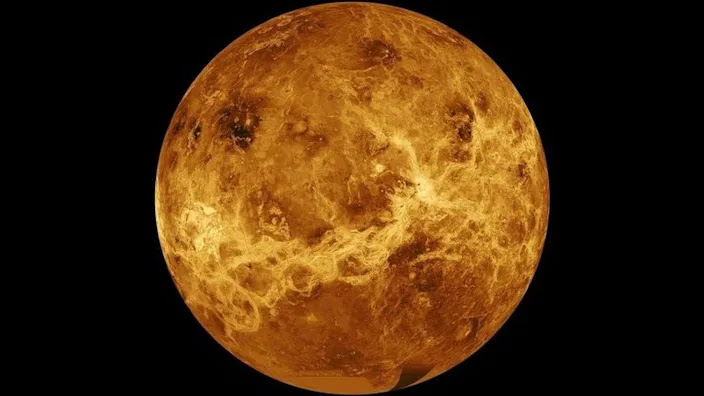
Image courtesy of NASA.


Joel Kontinen


Nasa has announced that it is sending two new missions to Venus to examine the planet's atmosphere and geological features.


The first instance is called Davinci+ (Deep Atmosphere Venus Investigation of Noble gases, Chemistry, and Imaging) mission will measure the planet's atmosphere to gain insight into how it formed and evolved. It will also aim to determine whether Venus ever had an ocean.

 NASA has termed the second mission, Veritas (Venus Emissivity, Radio Science, InSAR, , Topography, and Spectroscopy), will map the planet's surface to understand its geological history and investigate how it developed so differently than Earth.


Paul Rincon, Science Editor, BBC News website says” It may have harboured oceans for a billion years of its history, and there is even a region of the planet's thick atmosphere where microbial life could survive, floating among the clouds.” .

 So, the question seems to be  When did Venus grow to its present status, so different from Earth?

 Dropping the millions of years might do the trick. Maybe Venus looked like it does today when God created it, .

Source:  

Venus: Nasa announces two new missions BBC News 4.6, 


Sunday, 12 August 2012

Curiosity Rover: Evolution on Mars?


Evidence of life on the red planet? Image courtesy of NASA.


Joel Kontinen


As it is becoming increasingly difficult to find evidence for evolution on Earth, NASA has turned its attention to looking for it on the red planet.

Technically, NASA is not searching for proof of evolution, but merely for hints that there once could have been conditions on Mars that would have allowed life to appear on the planet.

The naturalistic origin of life is part and parcel of the worldview that rejects the Creator. In recent years, NASA has embraced a philosophical stance that has no place for God.

Gone are the days when astronauts were allowed to read Genesis aloud in space.

NASA’s approach is a bit odd, given that the more we have learnt about the cell, for instance, the more obvious it has become that it cannot have come about through blind Darwinian processes. The same applies to the origin of life. It is too complicated to pop up all by itself.

Information always requires a sender. Intelligent life requires an intelligent sender.


Source:

Chang, Kenneth. 2012. After Safe Landing, Rover Sends Images From Mars. The New York Times (6 August).


Saturday, 29 January 2011

The Coppedge Case: NASA’s Moral Quagmire


Wernher von Braun (1912 –1977), the father of the US Apollo space programme, believed that God created the entire universe. Image courtesy of NASA.


Joel Kontinen

In December 1968 Apollo 8 astronauts Frank Borman, Jim Lovell and William Anders orbited the moon. They read the first ten verses of Genesis as a Christmas greeting to the inhabitants of ”the good earth”:

In the beginning God created the heaven and the earth. And the earth was without form, and void; and darkness was upon the face of the deep. And the Spirit of God moved upon the face of the waters. And God said, Let there be light: and there was light. And God saw the light, that it was good: and God divided the light from the darkness.

And God called the light Day, and the darkness he called Night. And the evening and the morning were the first day. And God said, Let there be a firmament in the midst of the waters, and let it divide the waters from the waters. And God made the firmament, and divided the waters which were under the firmament from the waters which were above the firmament: and it was so. And God called the firmament Heaven. And the evening and the morning were the second day.

And God said, Let the waters under the heavens be gathered together unto one place, and let the dry land appear: and it was so. And God called the dry land Earth; and the gathering together of the waters called he Seas: and God saw that it was good
.”

Dr. Wernher von Braun (1912 –1977), the father of the Apollo programme, was also a Bible-believing Christian. Since his time, however, NASA has sunk into a moral quagmire. Now, NASA employees cannot even suggest that at least some aspects of nature appear to be designed – if they want to keep their jobs.

Since 1997 David Coppedge has worked as an information technology specialist and system administrator in the Cassini Program at NASA’s Jet Propulsion Laboratory. He was demoted when a colleague complained that he had loaned two pro-ID DVD documentaries to his co-workers.

This week NASA announced that Mr. Coppedge would loose his job because they have to downsize the staff at the Jet Propulsion Laboratory.

NASA’s excuse is a lame one. Mr. Coppedge is one of the senior computer experts at the Jet Propulsion Laboratory. Usually, it is the junior members who have to go first and not the most competent ones.

It seems that for some NASA bosses intelligent design is like a red rag to a not-too-friendly bull.


Source:

Background on David Coppedge and the lawsuit against NASA's Jet Propulsion Laboratory.

Wednesday, 21 April 2010

The Coppedge case: An illustration of Expelled: No intelligence Allowed

Joel Kontinen


What happens when a NASA employee lends two pro-ID DVD documentaries to his co-workers?


Although Dr. Wernher von Braun, the father of the US Apollo programme, and several astronauts were professing Christians, the atmosphere at NASA has changed diametrically from the days astronauts could read the opening verses of the Book of Genesis while orbiting the moon.

Since 1997 David Coppedge has worked as an information technology specialist and system administrator at NASA’s Jet Propulsion Laboratory. According to the Evolution News and Views blog, ”in 2000 he earned recognition for excellence, receiving the important role of 'Team Lead SA' (system administrator), a role he held until his demotion in 2009.”

The reason for his demotion? He loaned two DVDs - The Privileged Planet and Unlocking the Mystery of Life to his co-workers.


Source:

Crowther, Robert. 2010. How NASA's Jet Propulsion Laboratory Punished David Coppedge for His Views on Intelligent Design. (16 April)
http://www.evolutionnews.org/2010/04/how_nasas_jet_propulsion_labor.html#more