Showing posts with label Europa. Show all posts

Saturday, 20 December 2025

Spiders on Jupiter? Scientists uncover secret origins of arachnid-like 'demon' lurking on gas giant's moon.


NASA's Galileo spacecraft first photographed a bizarre spider-like structure lurking within a large crater on Europa during a close flyby of the moon on March 29, 1998. Image courtesy of ASA/JPL/University of Arizona

Joel Kontinen

A new study reveals the likely origin of a mysterious spider-like pattern first spotted on Jupiter's moon Europa in 1998. The finding could have implications for a NASA spacecraft en route to the frozen world.

In March 1998, NASA's Galileo spacecraft — which studied Jupiter and its major moons between 1995 and 2003 — made a close flyby of Europa, a frozen ocean moon often considered one of the most likely places for extraterrestrial life to exist in the solar system. During this flyby, the probe mapped out a roughly 13.7-mile-wide (22 kilometers) impact structure, dubbed Manannán Crater, on the moon's icsy surface, and found something strange lurking within it.

Some other experts say that it was created by eruptions from hydrothermal vents on the floor of Europa's subsurface ocean.

According to new study, in The Planetary Science Journal, researchers proposed an alternative explanation: that the Jovian spider formed in a similar way to how dark dendritic patterns on Earth, known as "lake stars," typically do.

With this in mind, the researchers used a similar technique to partially recreate the Manannán Crater's mysterious shape in the lab.

"Lake stars are really beautiful, and they are pretty common on snow or slush-covered frozen lakes and ponds," study lead-author Laura Mc Keown, a planetary scientist at the University of Central Florida, said in a statement. "It is wonderful to think that they may give us a glimpse into processes occurring on Europa and maybe even other icy ocean worlds in our solar system."

However, rather than water rising through tiny holes, as happens when lake stars form on Earth, Damhán Alla was likely birthed by an asteroid impact — which created a small crack in Europa's icy shell that enabled salty water to seep upward and paint the spider-like pattern on the surface. (This asteroid impact likely happened after the Manannán Crater was already formed.)

The researchers also noted similarities between Damhán Alla and the infamous "spiders on Mars," which are dusty deposits on the Martian surface that look like swarming spiders when viewed from above. These fake arachnids, known as araneiform terrain, form when submerged carbon dioxide ice sublimates, or turns directly into a gas. Mc Keown's team has previously recreated these features on Earth too.

The similarities in shape between Damhán Alla and the spiders on Mars are due to how "fluid flows through porous surfaces," Mc Keown said. In theory, similar spider features could also form on other frozen ocean worlds, such as Saturn's moon Enceladus, Jupiter's other moon Ganymede and the dwarf planet Ceres, which resides in the asteroid belt beyond Mars.

So, this means that some extraterrestrial life may abound on the moon, but life only comes when a creator give life to them.

Source: 

Harry Baker 2025 Spiders on Jupiter? Scientists uncover secret origins of arachnid-like 'demon' lurking on gas giant's moon. | Live Science 17 December

Monday, 14 October 2024

NASA set to launch Europa probe to search for signs of habitability


Image courtesy of NASA/JPL-Caltech

Joel Kontinen

A 6000-kilogram spacecraft will embark on a six-year journey to Jupiter to explore whether its icy moon Europa has the conditions to support life.

Could NASA a find life on Europa?

According to some evolutionists, “The largest spacecraft ever created NASA for an interplanetary mission will launch today to determine whether Europa, one of Jupiter’s moons, has an environment that could support life.

The Europa Clipper mission is expected to launch at 12:06 pm local time aboard a SpaceX Falcon Heavy rocket from NASA’s Kennedy Space Center in Florida, having been delayed by several days as a precaution because of Hurricane Milton.

Europa is the smallest of the so-called Galilean moons, which are Jupiter’s four largest moons. It is slightly smaller than our own moon and is of particular interest to scientists. Previous observations have indicated that Europa has a vast subsurface ocean, and this mission is designed to explore the possibility that life could reside within it.

With its solar arrays deployed that Europa has a vast subsurface ocean, and this mission is designed to explore the possibility that life could reside within it.

With its solar arrays deployed, Europa Clipper spans more than 30 metres and weighs 3241 kilograms without propellant, which will add a further 2750 kilograms.

The spacecraft will take around six years to travel 2.9 billion kilometres to its rendezvous with Jupiter in April 2030, using the gravity. of Mars and then Earth to boost its speed.

 Some believers in evolution have supposed that Europa is teeming with life, but only God can bring it about.

Source:

 Matthew Sparkes 2024 NASA set to launch Europa Clipper probe to search for signs of habitability | New Scientist 14 October.


Saturday, 16 March 2024

Life on Europa?


Image courtesy of NASA/JPL-Caltech.

Joel Kontinen

Will there be life on Jupiter’s icy moon Europa? That is what NASA is waiting for.

The message will be sent by the Europa Clipper spacecraft. which will start in October 2024.

“If any life is found on Europa, it is likely to be microbial, so the commemorative plate is more of a symbolic gesture than a bona fide message to extraterrestrial life forms, per se. “

The message has the names of some 2,6 million individuals:  

More than 2.6 million names have been stenciled into a "dime-size" silicon microchip by technicians at the Microdevices Laboratory at NASA's Jet Propulsion Laboratory. This microchip will be attached to a commemorative plate, which will feature a handwritten copy of the poem "In Praise of Mystery: A Poem for Europa" by U.S. Poet Laureate Ada Limón, among other design details.

Source:

Emily Cooke, 2024, NASA unveils cryptic message from Earth to be sent to Jupiter's icy ocean moon Europa | Live Science 13 March


Thursday, 14 March 2024

Europa’s seafloor may be impenetrable and inhospitable to life


Image courtesy of NASA/JPL-Caltech/SETI Institute.

Joel Kontinen

Is there life on Europa? A few weeks ago, it seemed that there was.  But now it seems that there is not.

“Jupiter’s icy moon Europa may not be as ripe for life as previously thought. Its underground ocean has long made it one of the most promising candidates in our solar system to host life, but theoretical studies of its seafloor are putting a damper on its promise.”

On Earth, much of the life in the oceans is supported by hydrothermal activity at the seafloor, where water interacts with rock. This activity is missing on Europa.“

Well, God made the Earth a space for humans and not other planets or their moons.

Source:

 Leah Crane, 2024. Europa’s seafloor may be impenetrable and inhospitable to life | New Scientist 13 March.


Thursday, 7 March 2024

Europa may have less oxygen to fuel life in its seas than we thought

Image courtesy of NASA/JPL-Caltech

Joel Kontinen

It is a hard for evolutionists, for “Jupiter’s moon Europa may be less ripe for life than we thought. Although it has an ocean of water beneath its icy shell, the frigid moon may be short of the oxygen necessary to sustain life as we know it.”

They just taught that Europa was ripe pr life. Now they are disappointed.  

“Oxygen is produced on Europa when radiation hits its surface and splits the water ice there into its constituent parts, hydrogen and oxygen. Models of that process have suggested the rate of oxygen production could be anywhere from 5 to over 1000 kilograms per second.

Jamey Szalay at Princeton University and his colleagues used data from the Juno spacecraft, which flew just 353 kilometres above Europa’s surface in 2022, to make a new estimate. They found oxygen is only being produced at a rate of about 12 kilograms per second on the surface – right at the low end of previous estimates.

“In some sense, the shell is like a lung for Europa. It’s continuously generating oxygen,” says Szalay. “That being said, we can’t speak to what happens after the oxygen is produced on the surface – it’s still a question how much of it could get into the ocean.”

Source:

Leah Crane 2024 Europa may have less oxygen to fuel life in its seas than we thought | New Scientist 4 March 


Thursday, 15 September 2022

Hidden life on Europa

Image courtesy of NASA/JPL-Caltech.  

Evolutionists are triumphant. They hope to get pictures of Jupiter’ s moon Europa.

For evolutionists, life could be anywhere. So Jupiter’moon Europa could be a place where life could be found, just as the Antartica of our planet.


A British scientist thinks Octupses live on Jupiter’s Moon.


The NASA team will even look for signs of the water vapour plumes that recent studies have suggested emanate from Europa.

“The last time a spacecraft got similarly close to Europa was in January 2000 when NASA’s Galileo orbiter swung by at a distance of 351 kilometres,”


Source;

 Gater, Will. 2022. Juno spacecraft prepares for close encounter with icy moon Europa. New Scientist 8 September


Thursday, 21 April 2022

Evolutionist get a view on what caused the ridges on Jupiter’s moon Europa


Joel Kontinen

Jupiter’s moon Europa is covered in strange pairs of parallel ridges. Now, evolutionary researchers have found a similar feature in Greenland and used it to unravel how such ridges form – which may help us understand how Europa’s subsurface ocean interacts with its icy shell.

So, Greenland example shows how Europa’ s ice formed.

 Riley Culberg at  Stanford University in California spotted a similar pair of ridges in satellite images of the Greenland ice sheet. He and his colleagues analysed how these formed and found that it was due to pockets of liquid water within the ice sheet. When some of that water refreezes, it expands, creating cracks in the ground and pressurising the remaining water, which pushes upwards on either side of the refrozen section. That upwelling causes the parallel ridges

According to evolutionists, this might be good for prospects of life on Europa “If there’s a lot of shallow water in the ice shell, it means that there has to be some amount of exchange between the ocean and the surface,” says Culberg. “That kind of movement allows for the mixing of chemistry and heat that you need in order for life to happen.” If there is life in Europa’s ocean, it might also make its way into these pockets of fluid, making it far easier to find, he says.

But we would say that the solar system was made by God,, So .Greenland   is an aberration,  

Souce:

Crane, Leah. 2022. We now know how the mysterious ridges covering Europa’s surface formed. New Scientist 19 April


Saturday, 19 March 2022

Evolutionists believe that octopuses brains may have become complex the same way human brains did


David Fleetham/Alamy


Joel Kontinen 

 For Darwinists, the octopus is a hard a hard´s nut to crack, They assume that octopuses have alien genes, and that some of them might live on Jupiter’s moon Europa.  

Some believe that octopuses genome abounds in transposons or transposable elements (TEs). Also known as jumping genes, they can move from one place to another within the genome.

When describing the octopus, journalists tend to run out of superlatives. A writer in Nature described it as an eight-legged marvel and another used the expressions octopus ballet and uncanny intelligence.

Few animals can match its intelligence.

Jumping genes move about in the part of the genome once dismissed as junk. Some believe that octopuses genome abounds in transposons or transposable elements (TEs). Also known as jumping genes, they can move from one place to another within the genome. hen describing the octopus, journalists tend to run out of superlatives. A writer in Nature described it as an eight-legged marvel and another used the expressions octopus ballet and uncanny intelligence. Few animals can match its intelligence. Jumping genes move about in the part of the genome once dismissed as junk. 

Now, a new study has likened them to humans. 


Source: 

Le Page, Michael. 2022, Octopus brains may have become complex the same way human brains did. New Scientist 17 March

Sunday, 21 June 2020

Why Icy Moons Like Europa Are Out Best Bet For Finding Life

Image courtesy of NASA / Jet Propulsion Lab-Caltech / SETI Institute Public Domain.


Joel Kontinen


Icy moons are the evolutionists best bet for finding alien life, they think that the icy moons of Jupiter and Saturn, particularly Titan and Enceladus , which orbit Saturn, and Jupiter’s moon Europa have all the liquid water beneath their frozen outer shells to harbour life. they think that life exists.

Oceans might host life

"If life exists in these places, Kevin Hand wants to find it. As director of the ocean worlds lab at NASA’s Jet Propulsion Laboratory in California, he is a leading expert on the potential habitability of these far-flung moons and a key player in the design of missions to explore them."

However, he obviously thinks that given an earth-like atmosphere, evolution would give life to those that are without it. However, life only come from life. It has to be he obviously thinks that given an earth-like atmosphere, evolution would give life to those that are without it. Nonetheless, life only come from life. It has be created .


Source:

Cossins, Daniel. 2020. Why icy moons like Europa are our best bet for finding alien life. New Scientist .17 June.

Thursday, 5 March 2020

An Animal That Does Not Breath

Image courtesy of Michal Maňas, CC BY 2.5.


Joel Kontinen


This might be a god-sent for evolutionists who try to find live on moons, such as Jupiter’s moon Europa. Life has to be created However, life only come from life. It has to be created.

"Breathing is essential for animals to stay alive.

Or so we thought. In a study published Monday in the Proceedings of the National Academy of Sciences, researchers have now identified the first animal that doesn’t use oxygen to breathe: Henneguya salminicola, an 8-millimeter white parasite that infects the flesh of Chinook salmon. Multicellular organisms use oxygen to produce energy, a process that happens in the mitochondria. This organelle has its own genes for this process, but when scientists looked for them in the parasite, they were completely absent, New Scientist reports. The reason why this animal¬¬ lost the genes to breathe is unclear, but it’s possible it gets its energy from its host."

Source:

Ortega, Rodrigo Pérez. 2020, This is the only known animal that doesn’t need oxygen to survive, Science 26 February.


Monday, 17 February 2020

British Scientist Thinks Octupses Live on Jupiter’s Moon Europa

Europa. image courtesy of NASA- Jet Propulsion Lab-Caltech / SETI Institute, Public Domain.


Joel Kontinen

The secularist haven’t given up on finding life, regardless of what it means. this time, it means finding life on Jupiter's moon Europa.

A British scientist says it is 'almost a racing certain' that the icy seas on Jupiter's moon Europa are home to alien life that are octopus-like live

Monica Grady, who is a professor of Planetary and Space Science at Liverpool Hope University, suggests the icy seas beneath Europa's surface is a prime location to find beings with similar intelligence to the marine animal.

Brady also thinks that the deep caverns and caves on Mars may also be harbouring life-forms, as these areas provide relief from the intense solar radiation.

'When it comes to the prospects of life beyond Earth, it's almost a racing certainty that there's life beneath the ice on Europa,'
she said.”

She obviously thinks that given an earth-like atmosphere, evolution would give life to those that are without it. However, life only come from life. It has to be created .

Source:

Liberatore, Stacy. 2020. British scientist says it is 'almost a racing certain' that the icy seas on Jupiter's moon Europa are home to alien life that are 'octopus-like creatures' Daily Mail 7 February.

Wednesday, 1 January 2014

Jupiter’s Moon Europa Challenges Billions-of-Years Dogma, Looks Young

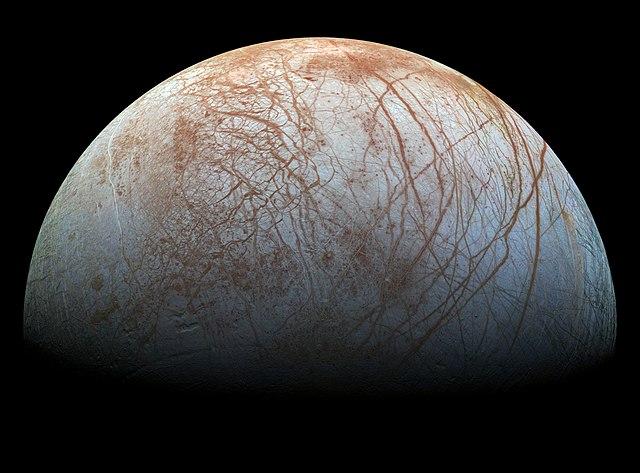
Europa looks like this. Image courtesy of NASA.


Joel Kontinen

Some of the big moons of Jupiter and Saturn show signs of youth. If they really were billions of years old, they should be more or less dead.

But they aren’t. There are active volcanoes on Jupiter’s moon Io. Copious amounts of tholin on Saturn’s moon Titan suggest that the moon cannot be billions of years old.

Recent research also suggests that liquid water is “spurting from [Jupiter’s moon] Europa.” The Hubble Space Telescope has observed “possible plumes emanating from mystery moon's south pole.”

As old moons will hardly spout water, the most logical conclusion is that Europa is not as old as is usually assumed, but supports the Genesis-based creation model very well.

Source:

Witze, Alexandra. 2013. Hubble spots water. Nature news (12 December).