Ben Stein’s film Expelled: No Intelligence Allowed revealed that evolutionists oppress and discriminate against scientists who doubt Darwinian evolution.
Joel Kontinen
A very suspicious stew is brewing in the academic sphere in the USA. It all began when Jerry A. Coyne, a professor at the University of Chicago and a well-known Darwinian blogger, complained about a fellow scientist.
Coyne, who is an outspoken atheist, claimed that Eric Hedin, Professor of Physics and Astronomy at Ball State University, favours the view of intelligent design (ID) and presents Christianity in a very positive light. Coyne demanded that the university had to scrutinise Professor Hedin’s teaching, and Ball State promised to look into the matter.
Coyne complained of a course that is actually not about science. In his own lectures he does not shy away from atheism, but like PZ Myers and Richard Dawkins (before he retired), he is quick to promote naturalistic dogma and exclude all other worldviews.
Darwinians have hardly ever tolerated dissenting views.
Source:
Jaschik, Scott. 2013. Science or Religion? Inside Higher Ed (17 May).
Thursday, 13 June 2013
Tuesday, 11 June 2013
Made in God’s Image
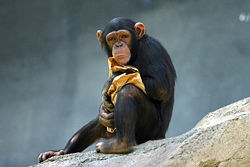
This creature was not made in God’s image, but we are.
Joel Kontinen
Evolutionists would claim that humans share a common ancestor with apes. But regardless of what they might believe, an unbridgeable chasm separates us from all animals.
It does not only have to do with biology but also with our mental skills, our creativity. Moreover, only humans can worship and fellowship with their Creator.
Only humans were created in God’s image. A brief video produced by Creation Ministries International discusses this topic:
Tunnisteet:
creation,
Creation Ministries International,
evolution
Sunday, 9 June 2013
Tiny Tarsiers Were Excellent Mariners – If Evolution Is to Be Believed

An ancient ancestor of the Philippine tarsier (Tarsius syrichta) perplexes evolutionists. Image courtesy of Jasper Greek Golangco, Wikipedia.
Joel Kontinen
A tiny fossil recently discovered in China is probably causing some head scratching to evolutionists. The fossil, an assumed ancestor of tarsiers, is thought to be 55 million years old.
Evolutionists believe that primates already lived in Africa 38 million years ago. This is interesting, because they assume that until 16 million years ago Africa was an island.
Primates thus had to sail from Asia to Africa on rafts.
But how on earth could tiny tarsiers no bigger than a human palm cope with a long sea voyage? In addition, at least two animals had to make the trip, otherwise we would not have had primates in Africa but they would have become extinct.
The root of the problem is the belief in millions of years. The problem disappears, if one gives up this dogma.
Source:
Wilford, John Noble. 2013. Palm-Size Fossil Resets Primates’ Clock, Scientists Say. The New York Times (5 June).
Tunnisteet:
evolution,
millions of years
Friday, 7 June 2013
Forgeries or Not? Science Calls For Stricter Scrutiny for Chinese Fossils
Some famous fossils, such as Archaeoraptor liaoningensis, were forgeries.
Joel Kontinen
The latest issue of Science has an interesting article that questions the credibility of some fossils found in China. It brings to mind what J. Shreeve wrote in Discoverer magazine in 1990: ”Everybody knows fossils are fickle; bones will sing any song you want to hear.”
The problem with Chinese dinosaur and bird fossils is that no one really knows whether they are authentic, as many have been collected and sold by amateurs.
According to Science,
“such secondhand fossils have a downside: Sloppy records or even outright forgeries can make it hard for researchers studying a specimen to tell where it came from, how old it is, or sometimes even whether it is genuine.”
Darwinian just so stories and even an entire worldview are often based on very flimsy evidence.
Source:
Balter, Michael. 2013. Authenticity of China's Fabulous Fossils Gets New Scrutiny. Science 340 (6137), 1153–1154 (7 June 2013).
Wednesday, 5 June 2013
How Many Monkeys Are Needed to Type Shakespeare’s Works?

Chimps can ruin a typewriter but they cannot use it to type intelligent messages. Image courtesy of Wikipedia.
Joel Kontinen
What do you get if you give monkeys a typewriter or computer in the hope that they would type Shakespeare’s collected works?
Some Darwinists have suggested that with enough time, anything could happen.
A scientific study attempted to examine what monkeys would do with a computer. The result: five pages of nonsense and a very dirty computer, as this brief video produced by Creation Ministries International shows:
Tunnisteet:
Creation Ministries International,
evolution
Monday, 3 June 2013
Human Size Has Not Changed in ”1.5 Million Years”, New Research Suggests

A recent footprint study does not support this scenario. Image courtesy of José-Manuel Benito Álvarez, Wikipedia.
Joel Kontinen
In real life things do not change like they are supposed to do in textbooks on evolution. According to Nature, “Fossil footprints indicate that hominins were already as large as modern humans by 1.52 million years ago.”
The short article reported recent research by Brian Richmond and Heather Dingwall at George Washington University and their colleagues. They compared footprints left by Homo erectus and Paranthropus boisei to those left by people in Kenya who in our time habitually walk barefoot, and noticed that the footprints were practically identical.
They found no evidence for evolution.
Source:
Footprints reveal hominin size. Nature 497, 538 (30 May 2013).
Tunnisteet:
evolution,
millions of years
Saturday, 1 June 2013
Aurornis xui, a Bird Older Than Dinos, Discovered in a Chinese Museum
Archaeopteryx (above) will probably have to relinquish its role as the grand daddy of modern birds.
Joel Kontinen
Recently, a fossil found in a Chinese museum might shake up the Darwinian view of the avian family tree and make the dino to bird connection less credible. The newcomer is a half a metre (20 inches) long feathered creature. Its discoverer, palaeontologist Pascal Godefroit, regards it as a real bird.
Aurornis xui, as the fossil is called, is assumed to be ”150-160 million years old, which would make it older than Archaeopteryx.
However, some researchers still think that Archaeopteryx is the earliest true bird.
It was difficult for birds to evolve from dinosaurs, if even evolutionists think that they are at least as old as dinos.
Source:
Woolston, Chris. 2013. New contender for first bird. Feathered creature shakes up avian family tree. Nature News (29 May).
Subscribe to:
Comments (Atom)